
Editor Autosave Trust Issues Meme Explained
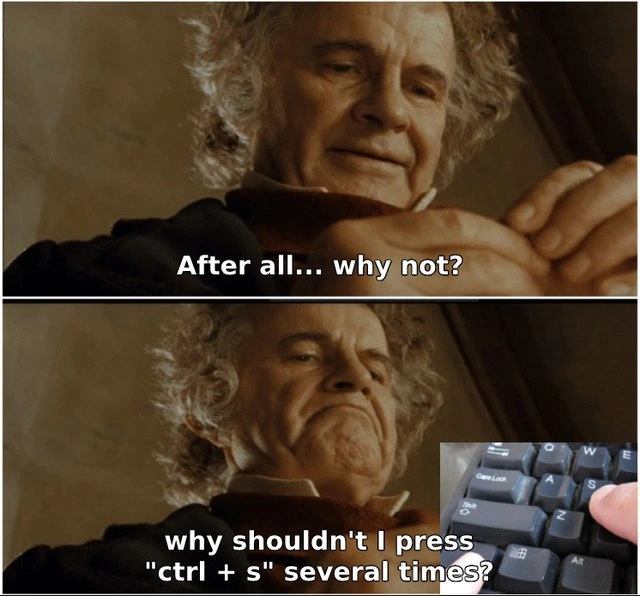
Bilbo’s “why not?” becomes “why shouldn’t I press ctrl + s several times?” The article explains the developer save reflex as cheap insurance against crashes, remote flakiness, and one bad unsaved-file memory—even when the IDE already saved.
Level 1: Locking the Door Twice
Imagine locking your front door, walking away, then going back to check it again even though you know it is locked. Pressing ctrl + s several times is the programmer version of that. The computer probably saved the work already, but pressing the keys again makes the developer feel safer.
Level 2: The Save Reflex
For a newer developer, ctrl + s is the common keyboard shortcut for save on many systems and editors. Saving writes the current file contents to disk so changes are not only sitting in editor memory. If an editor or machine crashes before saving, unsaved work may be lost.
In older or less reliable setups, saving manually was essential. Even now, developers often keep doing it because:
- Autosave may be disabled or delayed.
- Remote editors and network drives can behave strangely.
- Build tools may only read saved files.
- Crashes and freezes still happen.
- Losing work once is enough to create a permanent habit.
This belongs to DeveloperWorkflow, KeyboardShortcuts, and DeveloperProductivity because small editor habits shape how programming feels. Pressing save several times does not usually change the file after the first press, but it reassures the programmer that the work is safe before they run tests, switch branches, close a laptop, or make the next risky edit.
Level 3: Autosave Trust Issues
The meme shows the familiar tempted expression, first captioned:
After all... why not?
Then the thought becomes:
why shouldn't I press "ctrl + s" several times?
The small keyboard inset makes the target unmistakable: this is the developer reflex of repeatedly saving a file even when the editor already saved it, the tab shows no dirty marker, version control exists, and autosave is probably enabled. The joke works because ctrl + s is not just a command. For many developers, it is a tiny ritual of control against DataLoss, editor crashes, laptop battery surprises, remote sessions dying, and that one traumatic moment when an unsaved file vanished and permanently rewired the nervous system.
The deeper humor is that modern IDEsAndTextEditors have made saving both less necessary and more psychologically important. Tools now offer autosave, hot reload, local history, cloud sync, crash recovery, undo stacks, and Git. Yet the hand still moves. The shortcut is muscle memory, but it is also a private health check: "I have committed this buffer to disk; reality may continue."
Experienced developers know the difference between productive habit and anxious superstition is often whether the habit has ever saved you. Repeated ctrl + s costs almost nothing, so it survives forever. It is like tapping the brakes at a green light because you once saw someone run a red. Rational? Maybe not. Understandable? Absolutely. The editor can say "all changes saved" in three places, and the left hand will still file a duplicate incident just to be thorough.
The post message, "Using different hands? Crazy!", adds a workflow-specific layer. Keyboard shortcuts become so ingrained that people develop preferred hand positions, chords, and micro-movements. A developer's save reflex can become faster than conscious thought, happening between lines, after a semicolon, before running tests, after deleting a comma, or whenever the code begins looking suspiciously valuable.



Autosave can be enabled, green, and monitored, and my left hand will still run disaster recovery every nine seconds.
Because you are retarded.
Try to turn place of ctrl. Maybe fix your problem
:w
I still use ctrl s even in idea haha
IDE provides an AST engine for your code which is being analyzed and used for refactorings. I bet you do not understand what refactoring is and why it need 100% of the time.
Writing code is 10% the reset is debugging and refactoring. You’re using not more than 10% if you use vim with all the bells and whistles.
And I will give it more if it will ask.
Against bloateare? Throw away your mobile phone and buy a photo camera, video camera, music player, GPS navigator, walky talky and so on...
bro if you're trying to argue at least try to read what I wrote
How can I be an American using the metric system? Unheard of!
Yeah, it's oatmeal based.
There were days when MS had a fantastic visual studio. But nobody can beat JB today. Not even google.
For clang family, I know Clion handles (how good/bad dunno, not my field)
I believe it's the future.
Not even a Cmake.
Well, when I looked last time cpp had dozens of them and lots of people not satisfied with any of them.
Can Cmake into web assembly or backend in another language?
Clang-alike (c/cpp/swift/objective c/...)
Yeah, copying some concepts like a gypsy trying to steal a horse