
Cross-Platform Development Meme Explained
A social post says games ship native on 5+ platforms while web devs insist browsers are required for cross-platform. The dive separates browser portability from the broader category and notes both stacks carry real trade-offs—and that native apps often embed web UIs anyway.
Level 1: Different Kinds Of Bridges
This is like arguing that the only way to cross a river is one famous bridge, while someone points out that trucks, trains, and boats cross rivers every day too. The famous bridge is useful, but it is not the only solution. The funny part is that developers sometimes defend their favorite bridge so hard they forget other people are already getting across.
Level 2: Many Roads Across
Cross-platform development means building software that works on more than one operating system or device type. Web apps do this by running inside browsers. Native apps do this by compiling or packaging versions for each target platform, often with help from shared engines, frameworks, or cross-compilers.
Games are a strong example because they often share most of their code and assets while producing different builds for consoles, PCs, and mobile devices. A game engine can provide common tools for graphics, audio, physics, input, and asset loading. The developer still has to handle differences, but they are not starting from zero for every platform.
Browsers solve a different version of the same problem. They provide a widely available runtime with HTML, CSS, JavaScript, networking, and sandboxing. That is why web apps are so popular. The meme is funny because it challenges the idea that browser compatibility is the same thing as cross-platform development itself. It is one powerful route, not the whole map.
The post message about games using browser-based menus also matters. It shows how blurry the boundary is. A native game can still embed web technology, and a web app can still call native APIs through wrappers. Real-world software is usually less pure than the argument people have about it online.
Level 3: Portability Is Not A Browser
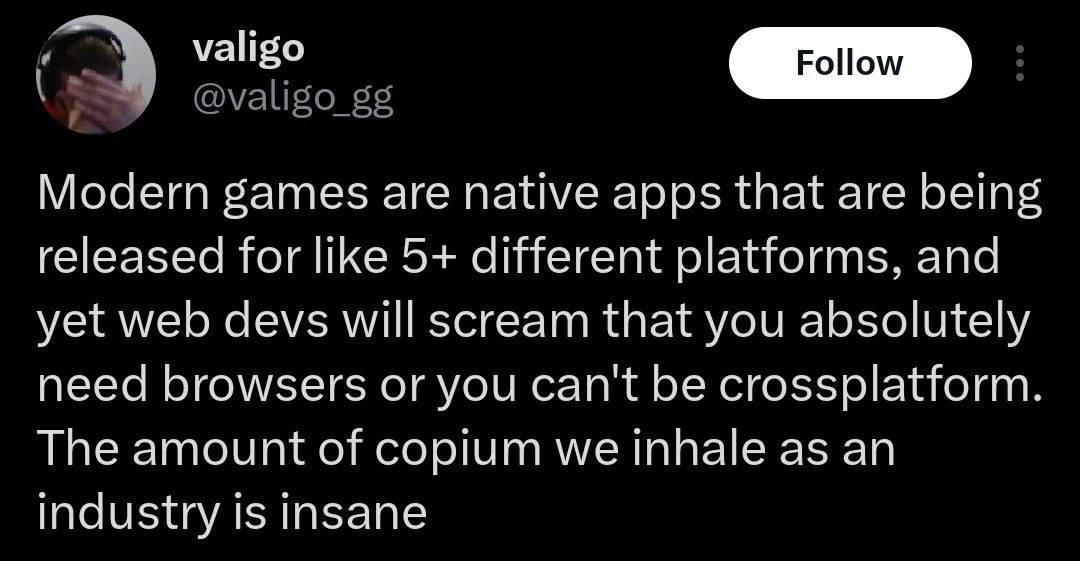
The screenshot is a dark-mode social post from “valigo” saying:
Modern games are native apps that are being released for like 5+ different platforms, and yet web devs will scream that you absolutely need browsers or you can't be crossplatform. The amount of copium we inhale as an industry is insane
The joke attacks a common web development reflex: treating the browser as the only serious answer to cross-platform software. Browsers are incredibly successful portability layers, but they are not magic. They are large runtimes with layout engines, JavaScript engines, security models, rendering pipelines, storage quirks, device APIs, and compatibility bugs. Saying “use the web because it is cross-platform” can be true and still incomplete, the way saying “ship a game on five platforms” is true while politely hiding the certification, controller support, graphics APIs, save systems, storefront rules, and platform-specific crash reports in the basement.
The comparison to modern games is deliberately provocative because games are some of the hardest native apps to ship broadly. A game may target Windows, PlayStation, Xbox, Switch, macOS, Linux, iOS, Android, or cloud streaming contexts, often through an engine that abstracts rendering, input, audio, assets, scripting, and build pipelines. That is cross-platform development, just with a different stack. The post is not saying game developers have it easy. It is saying web developers sometimes confuse one convenient portability strategy with the entire category.
The caption adds a useful wrinkle by pointing out that plenty of games also use browser-like technology for menus or UIs. That makes the meme less of a clean dunk and more of an industry self-own. Native applications and web runtimes are not enemies; they are often layered together. A native game might use an embedded web UI for panels, a launcher might be Electron-like, and a desktop app might ship a full browser engine because the team wants HTML/CSS tooling. The real criticism is not “browser bad.” It is “stop pretending the browser is the only way to avoid writing the same app five times.”
The senior developer read is that every portability layer has a bill. The browser bill includes DOM performance, hydration bugs, sandbox boundaries, cross-browser differences, offline constraints, and the eternal sadness of debugging layout at 1.25 zoom. The native engine bill includes platform SDKs, packaging, input devices, GPU differences, store policies, and native crash behavior. Both approaches are valid. The “copium” is pretending one bill does not exist because your team is more emotionally attached to its favorite runtime.

A browser is not a portability layer; it's a second operating system with worse patch notes.
This can't be real
Quake LIVE was a legend 🫡
💀
Hell nahhhhhhh
JS is the language of future. Stop wasting your time on C++ and other abominations like Rust, etc. Learn JavaScript 💪
Why I didn't know this
Kinda true, my friend in top 5 college said that too, js+python thats what you need
Also, you can always use flutter or avalonia ui to build almost native apps
something like code design
I love how this information ALWAYS makes people drop their jaws and shifts their world view 180 degrees. 😁
…this isn't true at all nintendo only releases for the switch (mobile too sometimes) and good luck getting all games to run natively on linux
True
Sounds like the problem is in their development capabilities, some extra work on optimization and obvious performance problems and everything should work smooth...
A network is a network. If you can’t make your developer teams agree on a protocol thats skill issue, not the lack of cross platformness. We don’t need 46263857 layers of abstraction
That’s you said clowny things about the big power consumption and absence various input support, not me. You contradict yourself now. Also flutter is not native UI. Btw you can run this thing on any common platform. Seriously suggest you to start googling before posting cringe.