
AI Last Digit of Pi Code Meme Explained
A generated function returns the last character of Python’s math.pi string as if pi had a final digit. The dive explains irrational numbers, floating-point approximation, and why AI-shaped code still needs semantic review.
Level 1: Endless Number
It is like asking for the last page of a book that never ends. The computer helper grabs the last page of a tiny preview copy and says, "Here it is." That answer is funny because it solved the easy fake version, not the real question.
Level 2: Pi Is Not A String
Python is a programming language, and math.pi is its built-in approximate value for pi from the math library. Floating-point numbers are how computers store many decimal-like values, but they have limited precision. They are approximations, not infinite exact values.
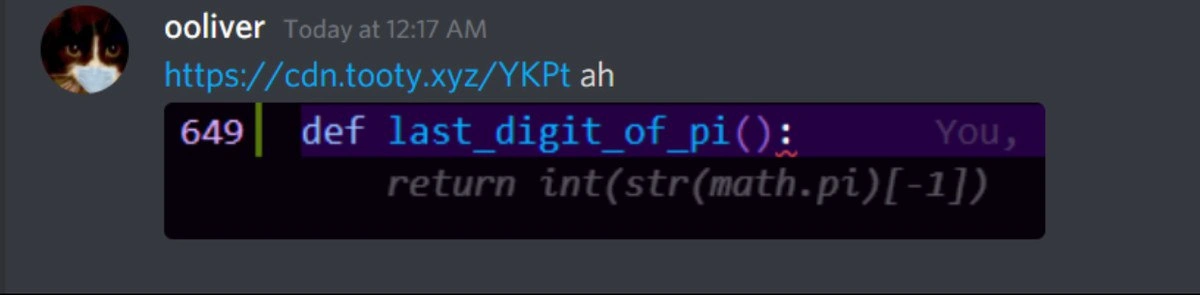
The code in the image tries to turn math.pi into text with str(...), take the last character with [-1], and convert that character back into a number with int(...). That technique can work for a normal finite string like "12345", where the last digit is clearly 5. It does not work for the real pi, because pi's digits go on forever.
For newer developers, the lesson is that code can be valid Python and still be logically wrong. A generated suggestion may look smart because it uses familiar operations, but you still have to check whether the operations match the actual problem.
Level 3: Autocomplete Does Math
The screenshot shows a chat post joking that Copilot "knows how to do real math," while the embedded editor shows an AI-style completion for last_digit_of_pi. The suggestion is syntactically plausible, compact, and completely wrong for the stated concept. That is why it lands so cleanly as AI coding assistant humor.
Code-generation tools are very good at recognizing patterns: function names, nearby imports, common idioms, and snippets that often appear together. For many everyday tasks, that is useful. But math and edge cases punish pattern completion. A model sees "last digit" and reaches for "convert to string, take index -1." That is a reasonable recipe for an integer or a finite decimal string. It is nonsense for pi.
Senior developers recognize the deeper failure mode: the code satisfies the shape of the request, not the semantics. It has a function, a return statement, a standard library constant, string conversion, indexing, and integer parsing. It looks finished. But the missing step is asking whether the requested value exists. This is exactly where AI-generated content needs human review: not just "does it compile?" but "is the problem definition valid?"
The meme also pokes at a classic software habit. Developers often convert things to strings because strings are easy to slice, compare, log, and inspect. That shortcut is useful until it smuggles display formatting into program logic. Once the code depends on the last character of a formatted float, the algorithm has left mathematics and entered vibes-based serialization.
Level 4: Irrational Meets Binary64
The visible code asks for an impossible function:
def last_digit_of_pi():
    return int(str(math.pi)[-1])
Mathematically, pi has no last digit in its decimal expansion. It is irrational, so its decimal representation does not terminate or repeat. A "last digit of pi" is not merely hard to compute; it is undefined. The joke begins there: the function name describes a value that cannot exist.
The proposed implementation quietly changes the problem from "last digit of pi" to "last character of Python's printable approximation of pi." math.pi is not the infinite mathematical constant. It is a finite floating-point approximation, commonly represented as a binary64 value. That means the computer stores a nearby binary fraction using a limited number of bits. When Python turns that value into a string, it chooses a decimal representation suitable for displaying and round-tripping the finite value. The final character of that string is an artifact of formatting, precision, and rounding, not a property of pi.
So str(math.pi)[-1] is a lovely little numerical-computing trap. The [-1] indexing operation is perfectly valid Python. int(...) can parse the final character if it is a digit. The code can even return a result. That is the horrifying part: wrong programs are at their most convincing when every local operation is legal. The function does not crash; it merely answers a different question with the confidence of a calculator wearing a fake mustache.
This is why floating-point precision belongs in the punchline. The bug is not "AI bad" in a vague way. The generated code has confused a mathematical object with one machine representation of that object, then confused that representation's display string with a meaningful decimal expansion. Three layers of abstraction walked into a function name, and none of them read the requirements.
Copilot solved the last digit of pi by quietly redefining infinity as however many decimals CPython felt like printing.
Not bad. Would not do it better myself
def last_digit_of_pi(): digit_i = 2 prevdigit = 3 digit = 1 while True: digit = int(math.pi*10**digit_i)%10 if digit == 0: break digit_i+=1 prevdigit=digit return prevdigit it's more complicated, so it must be better
Wow, so Pi is a rational number at the end of all. 🤪
Last digit of Pi is 0 if you have Pi numeric system.
0.99999.... = 1 bin 0.1111111 = 1 ?
One more proof. After infinite digits after point there will be 0 because: lim(x->infinity) 10^(-x) = 0
Please do not violate the rules! warning 1/1 for @baophan11 for spam/ad link. Your message will be deleted
And somebody who's class is 650 lines long knows how to do real programing