
AI Compute Rate Limits Meme Explained
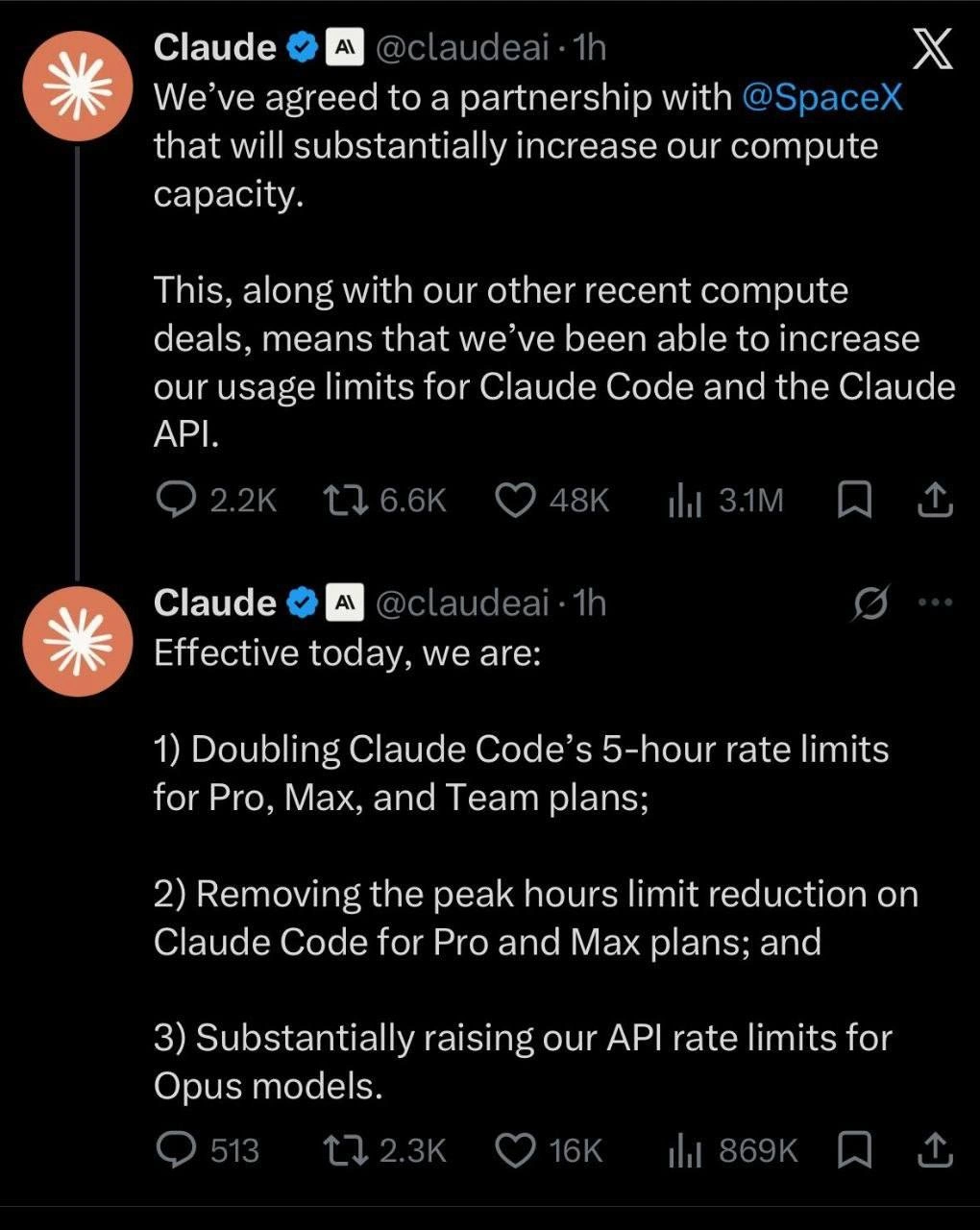
Anthropic announces a SpaceX compute partnership and higher Claude Code and Opus API limits. The dive frames rate-limit windows as the new productivity unit and explains why AI rivals still share infrastructure.
Level 1: Borrowing the Neighbor's Oven
Imagine two bakeries that compete fiercely for the same customers. One bakery gets so popular it can't bake bread fast enough — and the only neighbor with a giant spare oven is its rival's cousin. So it swallows its pride, rents the oven, and announces: "Good news, everyone gets twice as much bread starting today!" The joke is the awkward handshake behind the happy announcement: sometimes the only way to feed your fans is to pay the people you're competing against. And the customers, who've been lining up with ration cards, mostly just cheer about the bread.
Level 2: Reading the Rate-Limit Tea Leaves
A few terms doing heavy lifting here:
- Compute capacity: the raw pool of GPUs/accelerators a lab can run inference and training on. More capacity = more simultaneous users served = higher limits.
- Rate limits: caps on how much you can use an API or product in a time window. Claude Code's "5-hour rate limits" mean your usage budget refills on a rolling five-hour cycle; hit the cap and you wait.
- Peak hours limit reduction: temporarily shrinking those caps when demand spikes (think surge pricing, but instead of paying more, you just get less). Its removal is the announcement's real quality-of-life win.
- API rate limits for Opus models: Opus is the largest, most compute-hungry model tier, so its limits loosen last — exactly why it's called out separately in item 3.
If you're early in your career, the lesson is that the tools you depend on sit on top of physical machines someone has to buy, power, and cool. When your AI assistant suddenly gets more generous, it's rarely software magic — somewhere, a contract was signed and racks were powered on. Plan for limits the way you plan for flaky CI: assume they exist, and be pleasantly surprised when they lift.
Level 3: Scaling Orbital
The funniest line in this screenshot isn't written anywhere in it. It's the implied org chart: Anthropic, the company whose flagship products compete directly with xAI's Grok, announcing — from the verified @claudeai account — that it has "agreed to a partnership with @SpaceX that will substantially increase our compute capacity." The channel poster's caption nails the subtext:
Imagine winning so hard that you can rent out your compute to main competitor 🌚
This is the AI compute arms race in its purest form. By the mid-2020s, the binding constraint on every frontier lab stopped being researchers or even capital — it became GPU allocation. Datacenter buildouts are gated on power contracts, transformer lead times, and chip supply, so labs started signing compute deals with anyone holding capacity: cloud hyperscalers, sovereign funds, and apparently now a rocket company. When the scarce resource is megawatts and accelerators, ideological rivalry loses to procurement reality every time. Capacity is fungible; pride is not on the balance sheet.
The second post is where working developers actually feel this. "Effective today, we are: 1) Doubling Claude Code's 5-hour rate limits for Pro, Max, and Team plans" — that sentence describes the strange new unit of developer productivity: the rate-limit window. A generation of engineers learned to budget their AI-assisted coding sessions the way dial-up users once budgeted minutes, watching usage meters and timing heavy refactors for off-peak hours. Item 2, "Removing the peak hours limit reduction," quietly admits the previous state of the world: your tooling got worse at exactly the hours you were paid to work. That's load shedding — a classic SRE survival tactic — applied not to some backend queue but to the developer's primary interface. The engagement numbers (3.1M views on an infrastructure procurement announcement) tell you how many people's daily workflow hangs on someone else's capacity planning.
There's also a darker pattern long-timers will recognize: vendor consolidation among nominal competitors. The industry that gave us "Apple's iCloud runs on AWS and Google Cloud" and "Netflix streams from its biggest rival's datacenters" has simply repeated itself. Everyone competes at the application layer and colludes at the infrastructure layer, because the infrastructure layer is where physics lives.
The industry's hardest capacity-planning problem, solved the enterprise way: when you can't scale up or scale out, scale orbital
Nothing says "defensible AI moat" like enabling multi-tenancy for your main competitor.
Spaceship shareholders paid 250B for this btw 🌚🤝
Just to make it super clear It’s not just same non-busy capacity of Grok, it’s much more than that We’ve signed an agreement with SpaceX to use all of the compute capacity at their Colossus 1 data center. This gives us access to more than 300 megawatts of new capacity (over 220,000 NVIDIA GPUs) within the month. This additional capacity will directly improve capacity for Claude Pro and Claude Max subscribers.
I mean, I’m all-in for as long as we can have a chance to get back something similar to Opus 4.5 that we had at the end of December 2025 but it’s unlikely to happen anyway 🥲
spacex remembers they're the only AI company that actually builds stuff