
Age Verification ID Upload Meme Explained
A crying-bro meme begs users to upload government ID while pledging privacy and protecting children. The dive unpacks age-verification pipelines, KYC vendor storage risks, privacy theater, and why ID databases are a fuse-lit liability.
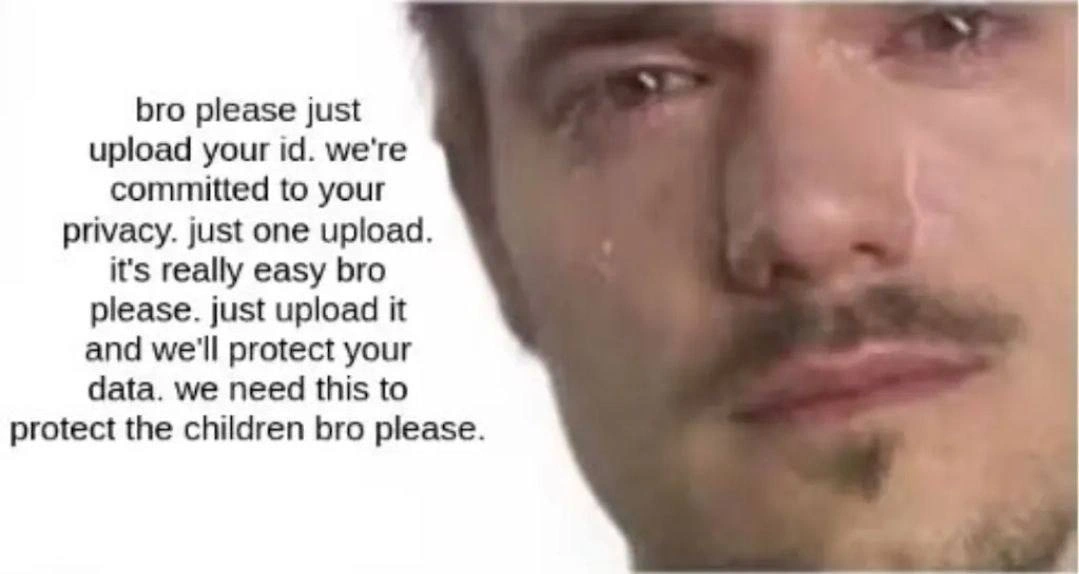
Level 1: Pinky Promise
Imagine a stranger at the park crying and begging: "Please just give me your house key. I promise I'll keep it safe. I only need it to make sure no kids get lost. Just one key, please." The more they insist it's easy and safe and for a good cause, the less you trust them — because people guarding something safely don't have to beg for it. The meme is funny because the internet keeps doing this exact crying-stranger routine, and everyone can see the tears are part of the sales pitch.
Level 2: What "Upload Your ID" Actually Means
When a site asks for ID verification, the typical pipeline is: you photograph your passport or license → it's sent to a third-party KYC ("know your customer") vendor → OCR and face-match models check it → a result is returned, and copies of your document often persist in the vendor's storage for "audit purposes." Key terms hiding in this meme's tags:
- Privacy theater: visible gestures (banners, pledges, the phrase "committed to your privacy") that signal protection without reducing actual data exposure.
- Surveillance creep: infrastructure built for one narrow purpose (age checks) becoming reusable for broader identification — once the rails exist, new cargo finds them.
- Data breach: any stored dataset is a target; ID scans are among the worst things to leak because, unlike passwords, you cannot rotate your face or your passport number with a reset email.
If you're junior and your team is handed an "integrate age verification" ticket, this meme is your design review: ask what's stored, where, for how long, and what happens when — not if — the vendor is compromised.
Level 3: Privacy Theater, Now With Tears
The crying-bro template does something a thousand-word policy critique can't: it captures the tone of the modern age-verification push. The pleading text — "bro please just upload your id. we're committed to your privacy. just one upload... we need this to protect the children bro please." — stacks every rhetorical move of the ID-mandate era into one desperate run-on. The tearful face beside it is the perfect avatar for platforms and legislators who frame mass identity collection as a small, reasonable favor you'd grant a friend.
Engineers laugh at this meme for a specific reason: they know what happens to that upload. An age-verification flow means a database (or a third-party vendor's database) of government IDs tied to accounts and, often, to browsing behavior on precisely the sites people least want associated with their legal name. That is not a privacy risk; it is a privacy liability with a fuse. The phrase "we're committed to your privacy" sits in the same paragraph as "upload your id" — a contradiction the meme doesn't even need to point out, because anyone who has filled out a vendor security questionnaire knows how "committed" translates: an S3 bucket, a retention policy nobody enforces, and a breach-notification email eighteen months later offering free credit monitoring. The age-verification vendor ecosystem has already produced real incidents of exactly this shape, which is why data_breach_waiting_to_happen isn't hyperbole, it's a threat model.
The "protect the children" line is the load-bearing joke. It's the universal solvent of tech policy: an unfalsifiable justification that reframes any objection as siding against children. Veterans of crypto-wars debates recognize the pattern — the same argument deployed against encryption, then client-side scanning, now anonymity itself. Meanwhile the security engineering critique is straightforward: age verification via ID upload fails open for motivated teenagers (VPNs, borrowed IDs, AI-generated documents) and fails closed for privacy-conscious adults, achieving surveillance of the compliant and nothing else. The technically sound alternatives — zero-knowledge age attestations, on-device verification where proof of "over 18" never reveals identity — exist, but they don't produce the data exhaust that makes "compliance vendor" a fundable business, and they're harder to legislate than "just upload it."


'We're committed to your privacy' - right up until the third-party age-verification vendor leaves the S3 bucket public
Please prove you're an adult by creating the most valuable row in our next breach.
danil kolbasenko
"We need to get rid of rivals"
admin@localhost
Haha nice try