
Apache mod_rewrite Leading Slash Meme Explained
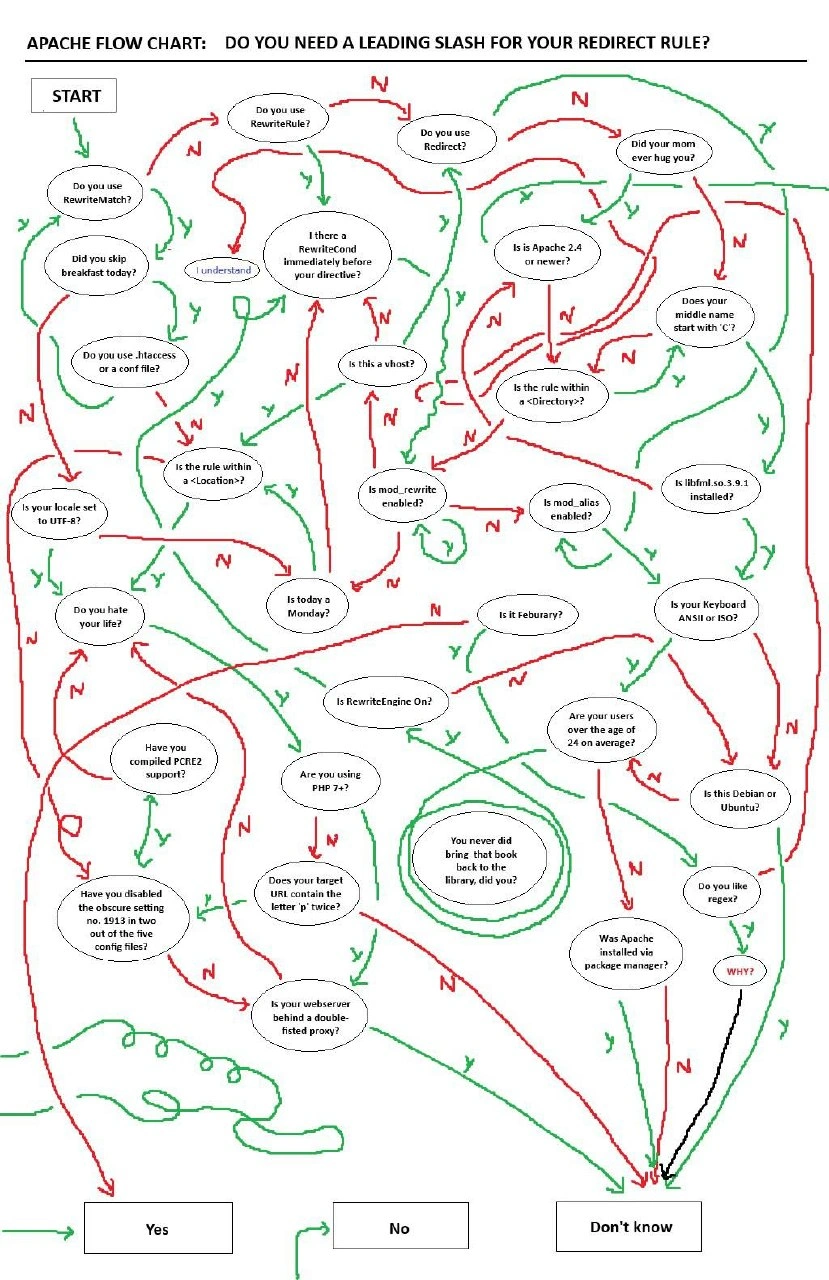
A chaotic flowchart asks whether Apache redirect rules need a leading slash and funnels almost every path to Don't know. The dive explains real mod_rewrite context rules—httpd.conf versus .htaccess, Directory scopes—and why the same RewriteRule behaves differently depending on where it lives.
Level 1: The Unhelpful Treasure Map
Imagine asking a simple yes-or-no question — "should I write the address with or without the first slash?" — and being handed a treasure map where the paths cross over each other a hundred times, some signs ask sensible things and others ask whether you returned your library book, and almost every path ends at a chest labeled "Don't know." The joke is that the map looks official and thorough while being completely useless — just like asking an expert a "simple" question and watching them inhale and say, "well... it depends."
Level 2: Rewrite Rules for the Recently Initiated
Apache HTTP Server ("httpd") is the veteran web server that for decades served most of the internet. mod_rewrite is its URL-manipulation module: RewriteRule directives use regular expressions to transform incoming URLs — redirecting old links, prettifying query strings, forcing HTTPS. Configuration lives either in central files (httpd.conf) or in .htaccess files dropped into individual directories, and — the meme's core grievance — the same rule behaves differently depending on which one it's in, including whether the path you're matching starts with /. <Directory> and <Location> are config blocks scoping rules to filesystem paths or URL paths respectively; "Is mod_rewrite enabled?" and "Is RewriteEngine On?" are the two classic ways a rewrite silently does nothing.
A flowchart is supposed to be the friendly artifact — follow arrows, reach an answer. This one weaponizes the format: real diagnostic questions tangled with nonsense, nearly all roads leading to "Don't know." If you're early-career, your rite of passage here is the first .htaccess redirect that loops infinitely or 404s for no visible reason; you will add and remove one leading slash, alternately, like a switch, until it works. The chart is simply that afternoon, drawn.
Level 3: Context-Dependent by Design
The title poses a question with a real, documented, infuriating answer: APACHE FLOW CHART: DO YOU NEED A LEADING SLASH FOR YOUR REDIRECT RULE? And the chart's true genius is that its chaos isn't random — it's mimetic. The leading-slash question in mod_rewrite genuinely is context-dependent in ways that have humiliated sysadmins for two decades. In server config (httpd.conf) or <VirtualHost> context, RewriteRule matches against a URL-path that begins with a slash. In .htaccess or <Directory> context, Apache strips the per-directory prefix first, so the pattern sees a path without the leading slash. Same directive, same syntax, different matching semantics depending on which file the line happens to live in. The chart's nodes "Is the rule within a <Directory>?", "Is the rule within a <Location>?", "Do you use .htaccess or a conf file?", and "Is Apache 2.4 or newer?" are not absurdist filler — they are the actual questions the official documentation makes you answer, hedged with the docs' famous warnings about per-directory rewrites.
The satire works by interleaving those legitimate questions with ones of identical visual weight and zero relevance: "Did you skip breakfast today?", "Is today a Monday?", "Did your mom ever hug you?", "Is your Keyboard ANSI or ISO?", and the devastating "You never did bring that book back to the library, did you?" The implicit claim: from inside the debugging experience, the real variables and the absurd ones are indistinguishable. When you've been bisecting a rewrite rule for three hours, "Is this Debian or Ubuntu?" (a genuinely consequential question, given Debian-family Apache splits config across sites-enabled, mods-enabled, and conf-enabled) feels exactly as arbitrary as whether you ate breakfast. The node "Was Apache installed via package manager?" routing to a box that just says WHY? is the chart's most honest moment.
Then there's the topology. Red N arrows and green Y arrows loop backward, sideways, and across the entire page — a flowchart drawn as spaghetti code, control flow rendered as actual spaghetti. Decision diagrams promise determinism: finite questions, finite answers, guaranteed termination. This one technically terminates, but observe where: three terminal boxes — Yes, No, and Don't know — and the visual mass of converging arrows lands overwhelmingly on Don't know. That's the punchline as data visualization. The system is so context-sensitive that the correct engineering posture is epistemic surrender, followed by the universal mod_rewrite methodology: try it with the slash, then without, and keep whichever one stops the 404s. Everyone does this. No one admits it.


This flowchart is still more deterministic than mod_rewrite, where the answer depends on whether the rule lives in httpd.conf, .htaccess, or a cursed <Directory> block
The mod_rewrite manual is a nondeterministic finite automaton with “Don’t know” as its only accepting state.