
Feature Flags Waiting Code Meme Explained
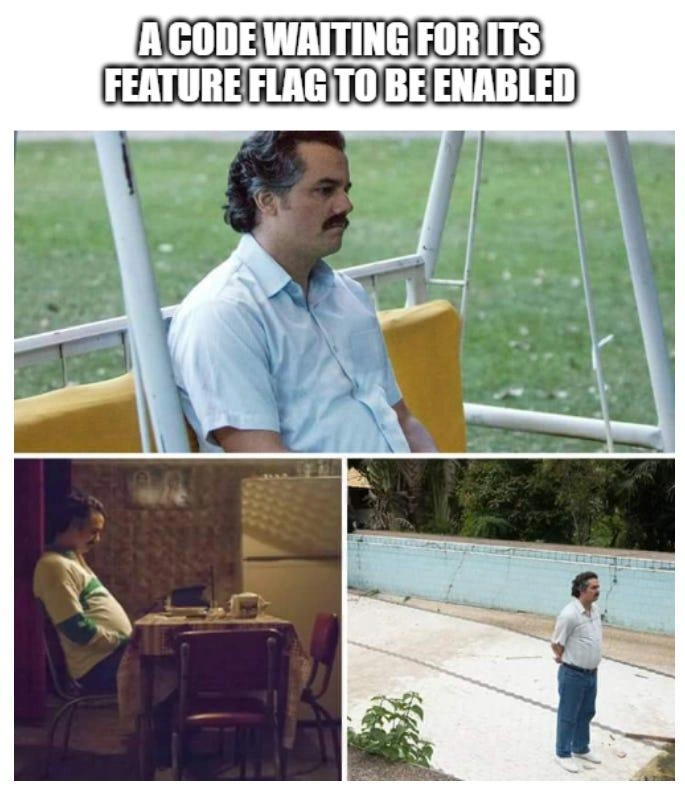
Pablo Escobar waiting alone stands in for code that shipped but never gets its feature flag enabled. The dive explains deploy versus release, rollout patterns, and flag lifecycle hygiene.
Level 1: Waiting Behind the Curtain
It is like an actor who has rehearsed, put on a costume, and arrived at the theater, but the director never opens the curtain. The audience cannot see the actor even though everything is in place. Showing the same lonely man waiting in three places is funny because the code has already traveled all the way to production and still has nothing to do.
Level 2: The Switch After Shipping
A feature flag is a piece of configuration that an application checks while it runs. It may return a Boolean such as true or false, but flags can also select named variants or other typed values. The decision can use evaluation context: information such as a user identifier, region, account tier, application version, or server.
That context enables several rollout patterns:
- Targeted release: enable the feature only for employees or test accounts.
- Percentage rollout: deterministically place a fraction of users into the new variant.
- Canary release: expose a small population first and expand if health remains good.
- A/B experiment: compare outcomes between variants.
- Kill switch: rapidly turn off behavior during an incident.
- Dark launch: deploy supporting behavior without making the user-facing feature generally visible.
For percentage rollouts, a stable targeting key matters. The system normally wants the same user to receive the same variant across requests rather than alternating randomly whenever another server answers.
A flag system usually has a control plane, where people define rules, and an SDK or provider inside the application that evaluates those rules. Production code should supply an explicit default because the provider can be unavailable, uninitialized, stale, or in error. Observability is equally important: engineers need to know which variant was evaluated when comparing failures and performance.
The safe progression looks like:
merge code
  -> deploy with flag off
  -> verify production integration
  -> enable for a small cohort
  -> monitor
  -> expand or disable
  -> choose a permanent path
  -> delete the flag and dead branch
The joke stops in the middle of that sequence. The deployment succeeded, but nobody performs the next transition. From the code’s imaginary perspective, the difference between prudent dark launching and being forgotten is simply how many times Pablo has had to move to another lonely chair.
For a junior developer, the important distinction is that “in production” does not always mean “available to everybody.” Continuous delivery lets teams integrate and deploy frequently; release management decides who sees the behavior and when. Feature flags are one mechanism for making that decision reversible. They are not a substitute for making it.
Level 3: Shipped Into Solitary
The caption says:
A CODE WAITING FOR ITS FEATURE FLAG TO BE ENABLED
Below it, the familiar Waiting Pablo Escobar sequence shows the Narcos character alone three different ways: blankly sitting on a yellow swing, lingering at a dim kitchen table, and standing beside an empty swimming pool with his hands behind his back. Nothing changes except the location. That repetition is the perfect emotional model for a feature branch that has reached production but still cannot meet a user.
A feature flag puts a runtime decision in front of behavior:
if flags.enabled("new_checkout", context=user, default=False):
    return new_checkout()

return existing_checkout()
Both implementations can be present in the deployed artifact, but the flag service or local configuration decides which path a particular request takes. With the flag disabled for everyone, new_checkout() waits like the man beside the pool. Strictly speaking, the application may still load or compile the code and evaluate the flag; it is the new behavior path that remains unselected.
This decouples deployment from release:
| Event | Meaning |
|---|---|
| Deploy | Put code into an environment |
| Enable for staff | Expose it to an internal cohort |
| Gradual rollout | Increase the eligible population |
| Full release | Make it the normal behavior |
| Remove flag | Delete the temporary fork and obsolete path |
That separation is enormously useful. A team can ship small integration changes continuously without revealing an incomplete product. It can expose a feature to employees, then one percent of customers, then larger cohorts while watching errors, latency, and business signals. If trouble appears, changing configuration can disable the path faster than building and deploying a revert.
The meme targets what happens when the temporary waiting room becomes permanent housing. The code may be complete, reviewed, tested, deployed, and still blocked by unfinished documentation, missing analytics, legal review, a dependent team, indecisive product ownership, or fear that no metric will make rollout feel completely safe. Every participant can be rationally cautious while the feature collectively spends months staring at an empty pool.
The longer it waits, the less “safe” the dormant path becomes. Surrounding APIs evolve, assumptions go stale, test fixtures stop representing production, and the original authors forget why peculiar decisions were made. A flag prevents exposure; it does not freeze the rest of the system. When somebody finally flips it, the branch may be exercising its real workload for the first time against a codebase that has moved on.
Flags also create combinatorial state. If $n$ independent Boolean flags can interact, there are theoretically $2^n$ configurations. Teams rarely test every combination, so stale flags expand the number of possible worlds while reducing confidence in each one. Long-lived forks can infect database schemas, caches, APIs, and client versions. The lonely code is not consuming food at the table, but it is absolutely consuming maintenance.
This is why flag lifecycle matters:
- Give every flag an owner and a clear purpose.
- Define the safe default used when evaluation fails.
- Record which environments and cohorts receive each variant.
- Observe evaluation and outcome metrics during rollout.
- Set a review or expiration date for temporary release flags.
- After the decision, remove the losing path and the flag itself.
Different flag types deserve different lifetimes. A short-lived release flag supports rollout and should usually disappear after the release stabilizes. An operational kill switch may remain because disabling a costly or risky subsystem is an intentional control. An experiment flag should end when the experiment produces a decision. Treating all three as eternal Boolean furniture is how configuration becomes an archaeological site.
The three-panel loneliness ultimately satirizes risk management without a terminal condition. Cautious rollout is engineering; indefinite non-rollout is inventory. If no one can say what evidence will enable or delete the feature, the flag is not controlling release risk—it is preserving organizational uncertainty in production.
It passed CI, reached production, and now serves zero requests with flawless uptime.