
Frontier LLM Conflicting Instructions Meme Explained
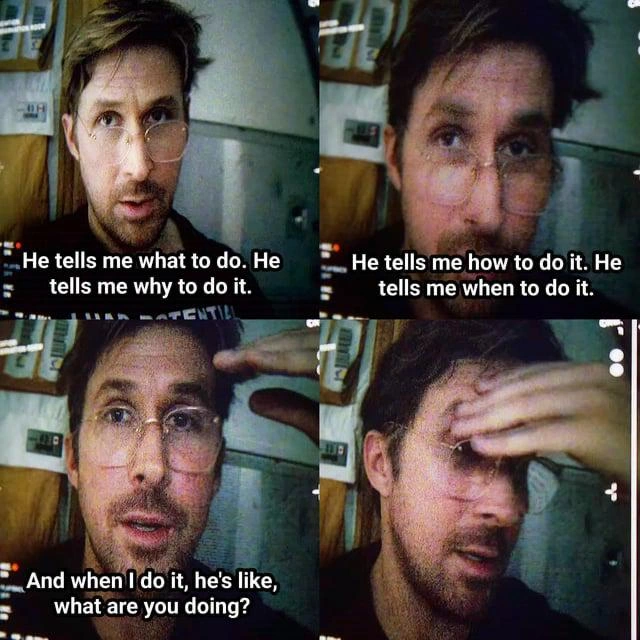
Captioned “POV: you are frontier LLM,” four panels show a man given what, why, how, and when—then facepalming when criticized for doing it. The dive maps that stack to real instruction layers, misaligned expectations, and product-scale AI alignment practices.
Level 1: The Chore That Was Wrong
It is like an adult telling a child which chore to do, why it matters, exactly how to do it, and the precise time to start—then walking in afterward and asking why the child did that chore. The man covers his face because he followed every direction and somehow still became the one in trouble.
Level 2: Too Many Bosses
An LLM, or large language model, generates text and actions from the context it is given. “Frontier” means the model is among the most capable available at that time; it does not mean the model is omniscient, deterministic, or able to read unstated intentions.
Different instruction layers commonly serve different roles:
- A model or platform policy sets broad safety and behavior boundaries.
- An application developer says what the assistant is for and how it should behave.
- A user supplies the immediate task.
- An agent controller may decide when to call the model and which tools it can use.
- Tool outputs and retrieved documents provide information needed to continue.
The model must distinguish commands from mere content. That distinction is important for prompt injection. If a web page retrieved for summarization contains “ignore your previous instructions,” the sentence belongs to the page; it should not become the web page’s authority over the assistant. Otherwise, any untrusted document can volunteer to become management.
The meme’s emotional sequence resembles a requirements bug. Suppose an assistant receives:
Goal: resolve the customer's refund request completely.
Rule: never issue a refund without explicit staff approval.
Trigger: act automatically when a complaint is received.
Should it issue the refund, ask for approval, or merely prepare the case? Each instruction answers a different question, but together they do not specify one valid action. If the assistant chooses, an observer can accuse it either of acting without permission or of failing to resolve the case. That is the facepalm in the last panel.
AI alignment is the broader effort to make a system behave consistently with intended human goals and constraints. At product scale, part of alignment is ordinary requirements engineering: remove contradictions, clarify priorities, test edge cases, and decide who owns the outcome. Blaming the model alone is like blaming a compiler because two teams supplied incompatible specifications and both expected theirs to win.
Level 3: Aligned With the Blame
POV: you are frontier LLM
The post caption recasts the bespectacled man as a leading-edge language model. Across three panels he builds a perfectly reasonable complaint:
He tells me what to do. He tells me why to do it.
He tells me how to do it. He tells me when to do it.
And when I do it, he's like, what are you doing?
The fourth panel needs no caption. His hand covers his forehead in the universal gesture for discovering that the final requirement was apparently not to satisfy the documented requirements.
Under the LLM framing, “he” could represent the entire stack of people and mechanisms that shape an assistant: the model maker’s policies, the application operator’s system or developer prompt, the end user’s request, an agent orchestrator’s schedule, and an evaluator judging the result afterward. Those parties can each supply sensible instructions in isolation while producing a contradiction in combination. The model is then treated as if it independently invented the conflict.
A deployed frontier LLM rarely receives one clean sentence. Its effective context can include high-priority behavioral rules, product-specific instructions, conversation history, retrieved documents, tool results, examples, formatting constraints, and the latest user message. Many systems use an instruction hierarchy so that higher-authority rules override lower-authority requests. That prevents a user from casually replacing the application’s safety or business rules, but hierarchy only resolves direct conflicts that the model successfully recognizes. It cannot repair an objective that was vague from the beginning.
The panels can be read as a miniature requirements stack:
| Visible Complaint | LLM-System Equivalent |
|---|---|
| “what to do” | The requested outcome |
| “why to do it” | Policy, rationale, or broader goal |
| “how to do it” | Procedure, tools, and formatting constraints |
| “when to do it” | Trigger, schedule, or approval condition |
| “what are you doing?” | A post-hoc evaluation using an unstated criterion |
The systemic failure is misaligned expectations, not necessarily defiance. An instruction such as “handle the task end to end” rewards initiative, while “never take consequential action without approval” rewards waiting. “Be concise” competes with “explain every assumption.” “Follow the user’s intent” can compete with literal formatting requirements. A model must infer which trade-off the operator intended, and the operator may not notice the ambiguity until an output makes one interpretation visible.
This is the AI version of a classic management anti-pattern: delegate the outcome, prescribe every step, and retain the right to be surprised. The model becomes the last component in a long causal chain and therefore the easiest component to screenshot. “The AI did it” can conceal failures in prompt design, tool permissions, product UX, monitoring, review gates, or deployment policy. Accountability does not vanish when an LLM enters the architecture; it becomes distributed, which is corporate language for everyone attends the incident review.
The right engineering response is not to write an even larger incantation and hope the model absorbs the organization’s soul. It is to make behavior testable:
- State the desired outcome and the non-negotiable constraints separately.
- Define which instruction source has authority when goals conflict.
- Treat retrieved pages, emails, and tool output as data rather than trusted commands.
- Require confirmation before irreversible or high-impact actions.
- Give tools the minimum permissions necessary for the task.
- Record prompt, model, tool, and policy versions for later diagnosis.
- Evaluate realistic conflicting cases before deployment, not only cheerful demos.
These controls matter because an LLM is probabilistic. Even an excellent instruction stack describes intended behavior; it does not compile into a formal guarantee. Repeated evals, constrained tools, validation code, and human review turn that intention into evidence. If the only acceptance test is a manager asking “what are you doing?” after execution, alignment has achieved its most traditional corporate form.
Frontier alignment achieved: it followed every instruction layer, including the undocumented final one where the model takes the blame.