
AI Hype Hypocrisy Meme Explained
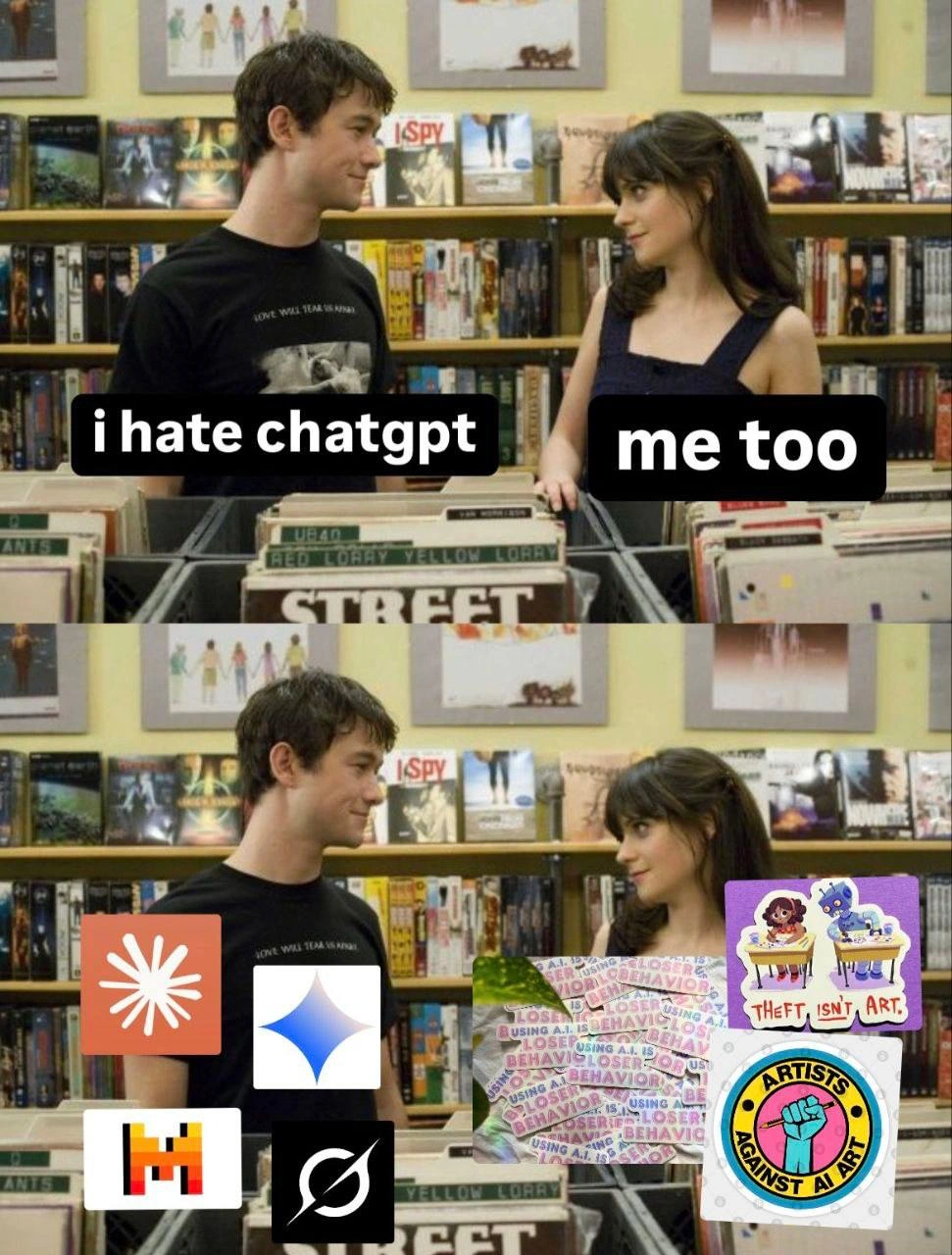
Two people high-five over “I hate ChatGPT,” then the frame fills with rival AI logos and anti-AI-art merch. The dive unpacks generative-AI hype cycles, ethics slogans, and why public critics often still ship with AI assistants.
Level 1: Secret Fans in Disguise
Imagine two kids on a playground loudly insisting, “Eww, we hate candy,” to look cool in front of others. They high-five each other for agreeing that candy is the worst. But then you peek into their lunchboxes and — surprise! — they’re packed with chocolate bars, lollipops, and gummy bears. 😄 This meme is just like that. The two friends are saying they hate ChatGPT (a super-popular talking robot helper) to fit in with the crowd that’s against it. But all around them, they have goodies and stickers from lots of other robots and AI helpers. It’s as if they’re secretly big fans of the very thing they claim to hate. The funny part is seeing them pretend to dislike something while being completely surrounded by it – they’re basically caught with candy wrappers in their pockets right after saying they don’t eat sweets. In simple terms, the joke is about people not being honest about what they like: they trash-talk the cool new thing in public, but behind the scenes they can’t get enough of it.
Level 2: Generative Guilt and Glossary
Let’s break down what’s happening for those newer to the AI hype train (or derailment). The meme uses a scene of two people chatting in a record store. In the movie this came from, they bond over a shared music interest; here it’s been remixed to bonding over hating ChatGPT. ChatGPT is a famous AI chatbot created by OpenAI – it’s basically a program you can talk to that generates human-like text. By 2025, it became super popular for answering questions, helping with code, writing content, you name it. But anything super popular in tech often gets a backlash. Some developers might say “I can’t stand ChatGPT” because: maybe it sometimes gives wrong answers confidently (yes, it “hallucinates”), or they worry using it is cheating, or they’re tired of the hype claiming AI will replace programmers. In the meme, both characters say “I hate ChatGPT” to each other. That’s them finding common ground by rejecting something trendy – a bit like two junior programmers agreeing “Ugh, I hate JavaScript frameworks” because they’ve heard seniors rant about them. It’s a performative stance – meaning they’re perhaps saying it to fit in or look cool to each other.
Now look at the second panel: suddenly we see they’re actually surrounded by AI tools and slogans! Those icons around them are logos of various generative AI products:
- The orange sunburst is Anthropic, a company that makes Claude, another AI chatbot similar to ChatGPT (Anthropic focuses on AI safety and ethics).
- The blue four-point star represents Google’s Bard (and its upcoming more powerful model Gemini). Bard is Google’s AI chat assistant – Google’s answer to ChatGPT.
- The little pixelated “M” likely stands for Midjourney, a popular AI image generator (people use it to create art from text prompts). It could be another AI project, but Midjourney fits especially with the art theme here.
- The black square with a white leaf is Cohere’s logo. Cohere is another AI company providing large language model services for developers (like generating text via API).
So these two who claim to hate AI chatbots are literally decked out in AI swag from multiple companies. “Swag” means fun free merchandise like stickers, badges, T-shirts you get at tech events or in support of a product. It suggests they not only use those AI tools, they’re proud enough to slap the stickers on their stuff! This contrast is the joke: their words say “I don’t like AI,” but their surroundings scream “I LOVE AI!”.
Also take note of the other stickers with phrases:
- “USING AI = LOSER BEHAVIOR” – This is a mocking slogan implying that anyone who uses AI for content or art is a loser (not a “real” developer or artist). It’s the kind of exaggerated insult you might see in heated online debates. The sticker showing it as a colorful word cloud is ironically loud. If someone actually wears that sticker, they’re making a bold anti-AI statement.
- “THEFT ISN’T ART” – This refers to a common argument by artists against AI-generated art. Many artists feel that AI image models (like Midjourney or Stable Diffusion) were trained on artwork taken from the internet without permission, effectively stealing artistic style or content. So they say the resulting AI art is theft, not true art.
- “ARTISTS AGAINST AI ART” – This is likely a badge representing a group or movement of artists who oppose the use of AI in art. It’s a real sentiment out there: communities of artists have rallied to say they don’t want AI to replace or infringe on human art.
So, in simpler terms, these two characters are outwardly siding with the AI critics. They have slogans and badges that an anti-AI person would have, especially an artist worried about AI ethics. A junior developer or art student might see seniors or peers brandishing these kinds of statements or sharing them on social media. It’s presented here as stickers to visually show how heavily they’re broadcasting “I am against AI.”
Now, why is that funny or notable? Because everything else around them – all the product logos – show they are also using AI all over the place. It’s like if a friend loudly says “I hate smartphones” but has an iPhone, an Android tablet, and a smartwatch all on them. The meme highlights a form of hypocrisy or internal conflict common in the current tech scene: people feel pressure to criticize AI (maybe to be on the “ethical” side or not seem blindly hype-driven), yet they can’t resist using the very tools they criticize because those tools are genuinely useful or cool. A developer new in the field might be confused, thinking, “Should I hate these AI assistants? Everyone on Twitter is dunking on ChatGPT,” but at the same time noticing that folks are quietly using AI assistants to speed up writing code or documentation.
The setting itself – a record store scene – is a popular meme format (taken from a movie). In the original movie scene, two people bond over liking the same indie band. Memes often remix it to bonding over any niche opinion. Here it’s flipped: bonding over a negative opinion (“I hate this thing”) because sometimes disliking something popular makes you feel part of the cool rebel crowd. The twist is the second panel exposing they’re not rebels at all; they’re surrounded by the thing they claim to hate. For newer folks: this is poking fun at a real trend in 2024–2025 where a lot of devs and content creators would publicly criticize ChatGPT and generative AI (calling it overhyped, unethical, or “not real art/code”) while at the same time everyone is experimenting with it, using GitHub Copilot (an AI coding assistant), asking ChatGPT for help, or using AI art in their projects. In short, AI is everywhere, and even the haters often have their hands on it. That ironic truth is what the meme is capturing. Once you know the logos and slogans, the meme basically screams: “We say we hate AI, but who are we kidding? We’re totally into AI.”
Level 3: Hype Cycle Hypocrisy
At first glance, this meme is calling out a classic tech culture irony: loudly hating on a hyped tool while secretly indulging in it. In the top panel, two people bond over “I hate ChatGPT” – a sentiment some developers and artists proclaim publicly these days. ChatGPT, an AI assistant built on a large language model (LLM), became incredibly popular, perhaps too popular, leading to a backlash. Seasoned devs have seen hype cycles before: a new technology rockets to fame (from Web3 to Generative AI), and inevitably a contrarian crowd forms. Here our meme characters are posing as part of that contrarian club, performatively agreeing that ChatGPT is awful.
The punchline comes in the identical second panel when the scene is suddenly flooded with AI swag and stickers. Logos of other AI tools – the orange burst of Anthropic (makers of the Claude assistant), a blue star for Google’s Bard/Gemini, a pixelated “M” (think an icon for Midjourney or another model), and Cohere’s white-leaf-on-black logo – surround them. There’s even a loud pastel sticker repeating “USING AI = LOSER BEHAVIOR,” plus “THEFT ISN’T ART” and “Artists Against AI Art” badges. It’s a hilarious visual metaphor: these two claim to despise ChatGPT, yet they’re literally immersed in AI tools and even anti-AI merch. It screams hypocrisy – akin to a developer ranting “I hate cloud computing” while wearing an AWS hoodie and deploying to AWS every day.
The humor hits home for many in the industry because it’s so relatable. We’ve all seen engineers or online influencers farm clout by ripping on the latest tech (be it ChatGPT, Kubernetes, you name it) and then catch them using it “off the record.” In 2023–2025, AI assistants are everywhere – coding helpers in IDEs, writing aids, image generators – so much that even the haters often rely on them quietly. The meme specifically nods to the ongoing AI ethics debate: those anti-AI art stickers mirror real-world artist protests that generative image models “steal” artists’ work. Some artists and devs publicly join the Artists Against AI chorus (“theft isn’t art!”) to take an ethical stand, yet here our meme suggests they’re still surrounded by (and benefiting from) AI tech. It’s a playful jab at how people might denounce ChatGPT as a matter of principle or trendiness, but then happily use some other AI model under a different name. The presence of all the big AI logos indicates the two characters haven’t exactly divorced themselves from generative AI – quite the opposite. They’ve got one foot in the protest, and one foot firmly in the AI hype.
For a senior engineer or anyone who’s been through tech hype waves, the meme also pokes fun at bandwagon behavior. The record-store setting (a nod to a famous scene from “500 Days of Summer”) usually signifies bonding over niche music tastes; here it’s bonding over ChatGPT criticism to seem “in-the-know.” But the joke’s on them because their environment betrays that they’re total AI enthusiasts. It’s the AI hype vs. reality gap: outwardly cynical, inwardly can't get enough. This resonates with devs who recall colleagues trash-talking a new language or tool in meetings, then googling how to use it after work. The meme’s message? In tech, actions speak louder than words (and stickers). No matter how much someone talks down the latest AI, chances are their stackoverflow history, Slack channels, or yes, sticker collection, tells a different story. The industry-wide inside joke is that using these tools is almost irresistible – even the loudest critics often have an AI assistant in their toolkit (or at least on their laptop). It’s hype hypocrisy at its finest, and we’re all in on the joke.
He hates ChatGPT because its context window is too small; she hates it because its training data was too large
Sprint ritual: complain that “AI will never replace real engineers,” then merge the PR Copilot wrote, auto-document it with ChatGPT, and let Claude summarize the retro - artisan software, handcrafted by three different LLMs
Even diffusion models with their stolen training data and artists wielding copyright claims can unite in their disdain for ChatGPT - turns out the real hallucination was thinking any of us would escape the prompt engineering industrial complex unscathed
The classic developer move: publicly denouncing ChatGPT while your terminal history shows 47 Claude API calls, your design folder is full of Midjourney outputs, and your commit messages are suspiciously well-formatted. It's not hypocrisy - it's having 'nuanced opinions' about which probabilistic text generator deserves your token budget this sprint
Two nodes with different state machines both commit value 'hate_chatgpt' - congrats, you achieved Byzantine consensus via branding
“I hate ChatGPT” is an overloaded function - architects mean “Claude/Mistral + RAG + Perplexity to dodge hallucinations and vendor lock‑in”; artists mean “stop training on my art.”
ChatGPT hate unites us like a monolith migration plan - until Claude's context window whispers sweet CAP theorem compliance
I really understand artists, that hate AI. It's really situation from Detroit: become human, where androids kicked out humans from factories, because they work better. You learnt how to draw for 10-40 years, you finally good at that and can live without worries, the biggest might be deadline. And all, that you learn for years now is needless. You can start think in 2 ways, your whole life is needless and AI is bullshit
Professional artist still outmatch ai. But for them ai can save a lot of time on routine tasks, so i dont see problem there.
Obviously because he hates it and doesn’t use it. The icons are there to show what other AI services he uses
well, in art... the artists, all of them, theft in somehow, because the inspiration is based on their experience on live....
https://faroutmagazine.co.uk/hayao-miyazaki-on-ai-utterly-disgusted/
Same
Hammer did not replace builders... The same thing here... AI could generate possible solutions but the final desicion still on engineer That was my point... not just achieve the result but make this result maintainable and stable using AI as support
Disagree... AI could help generate ideas and write templates for simple solutions My service has fully designed UI by AI... all related logic regarding state management, api calls, security and so on - fully on me but design part - AI support. Design != architecture... and AI helps me a lot to avoid spending money for design freelancers for example... my service is not so popular yet to pay for outsource 😅
honestly tho, I'm kinda scared
I did not see the tool yet that can build whole "house" (enterprise product) without human inspection