
WebDev Post #2594 · source on Telegram
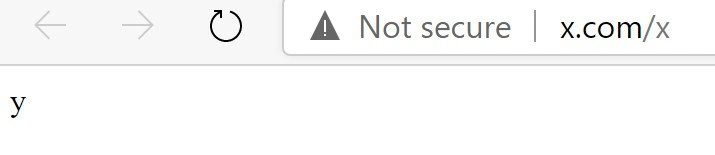
When x slash x returns y - and your browser screams "Not secure"
Description
Screenshot of a minimalist browser window: at the top left are disabled back/forward arrows and a circular reload icon. The address bar shows a gray warning triangle followed by the text "Not secure" and the URL “x.com/x”. The page body beneath is stark white with a single lowercase letter "y" aligned to the far left. Visually it jokes that requesting /x on the domain ‘x.com’ yields the literal response ‘y’, echoing a math-class f(x)=y gag. Technically it highlights an HTTP (non-TLS) connection triggering the browser’s insecure-site banner, a reminder of modern web-security expectations and the perils of serving plaintext over port 80
More like this
More like this in WebDev →

Use J and K for navigation
Comments
6Comment deleted
Our endpoint proudly maps GET /x → y with mathematic purity - right up until you ship it over plain HTTP and the network helpfully refactors y into alert(“pwned”)
When you spend $44 billion on a platform but forget to budget $50 for the SSL cert renewal
Ah yes, the scarlet letter of modern web development: 'Not secure' - because nothing says 'I'm a legacy system maintained by someone who retired in 2008' quite like serving traffic over plain HTTP in 2024. At least the warning triangle gives users a fighting chance before they enter their credit card details into what's essentially a digital postcard anyone can read. Remember when HTTPS was 'too expensive' and 'unnecessary for non-commerce sites'? Let's Encrypt really called that bluff, and now we're all just one cert renewal away from this badge of shame
x.com/x returning 'y' with a Not secure badge - when your URL rewrite has an off-by-one and your TLS rollout believes in eventual consistency
Math: x/x=1. Chrome: 'Not secure' - because webdev fractions always need that extra S
MVP math: f(x)=y; HSTS is left as an exercise for the reader