
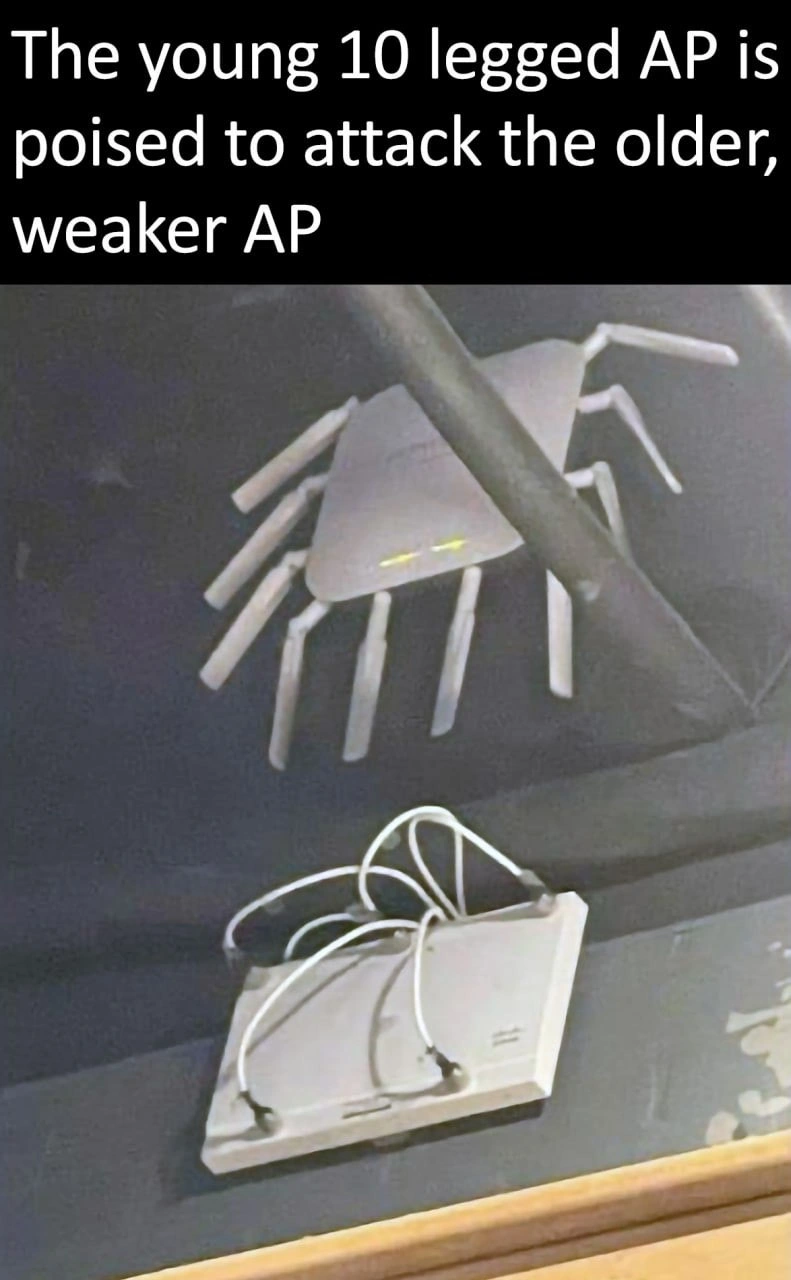
Wi-Fi spider AP prepares to overtake its obsolete flat sibling on the ceiling
Description
The top of the image contains the caption: “The young 10 legged AP is poised to attack the older, weaker AP”. Below the text, two ceiling-mounted Wi-Fi access points are shown: the upper device has ten outward-splayed antennas that make it resemble a mechanical spider, complete with two glowing green status LEDs as “eyes”; beneath it, an older, antenna-less access point hangs limply with several loose white patch cables draped over it like tentacles. The humorous composition suggests a Darwinian hardware upgrade, where the multi-antenna 802.11ax unit is about to ‘attack’ and replace the legacy 802.11n model. For network engineers, it pokes fun at rapid equipment obsolescence, antenna-array marketing wars, and the perpetual cycle of ripping out yesterday’s infrastructure for tomorrow’s throughput



Comments
6Comment deleted
Ceiling Darwinism: the new Wi-Fi 6E spider’s ten antennas are about to deprecate the old 802.11n slab - because in enterprise networking, survival of the fittest is measured in spatial streams per watt
The new WiFi 6E access point promises zero-downtime migration, but we all know it'll somehow take down the domain controller at 3am while you're explaining to the CEO why the legacy AP that's been running since 2009 was load-bearing infrastructure
This perfectly captures the API lifecycle: your elegant v1 with three endpoints gets hunted down by v2's sprawling ten-endpoint monstrosity. Give it five years and v2 will be the one cowering from v3's microservices swarm with forty endpoints, each requiring its own authentication flow, rate limiting strategy, and inevitably, its own Slack channel for outage notifications
Network Darwinism: the 10‑antenna AP asserts dominance by cranking Tx power, eating the PoE budget, and turning the room into one glorious co‑channel interference domain - proof that “more antennas” mostly breeds more management frames
New WiFi 6 spider AP to legacy relic: 'Your single spatial stream ends here' - just like sharding a monolith DB before it bottlenecks the cluster
That 10‑antenna 11ax thinks it’ll conquer the 11n fossil; in practice it just halves airtime with CCI and your WLC calls it “high channel utilization.”