
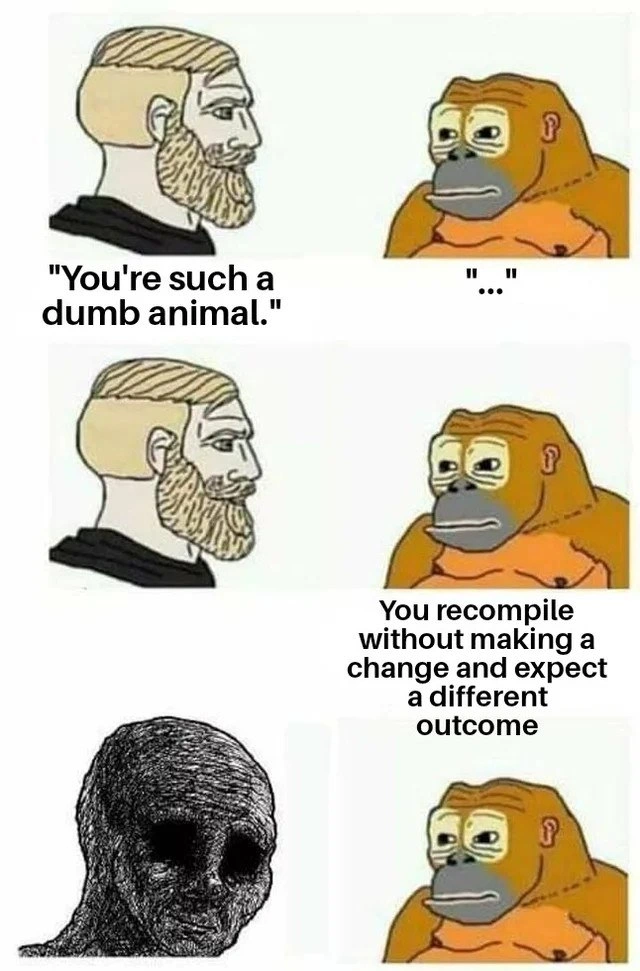
The devastating comeback to a developer's irrational hope
Description
A three-panel Wojak comic strip. In the first panel, a confident, bearded 'Chad' character tells a calm orangutan, 'You're such a dumb animal.' The orangutan is silent. In the second panel, the orangutan delivers a devastating comeback: 'You recompile without making a change and expect a different outcome'. The third panel shows the 'Chad' character replaced by a hollow-eyed, withered Wojak, staring into the void, utterly defeated. The meme is a sharp commentary on a common developer behavior born of desperation: rerunning a build or compilation without any code changes, hoping a different result will magically appear. It's a tech-centric version of the definition of insanity, and the orangutan's observation is so cuttingly accurate that it shatters the developer's sense of superiority, a feeling many senior engineers recognize from their own moments of debugging despair

Comments
13Comment deleted
The definition of insanity is recompiling with no changes. The definition of a senior engineer is doing it anyway, but this time with the '--verbose' flag, just in case the compiler feels like talking about its feelings
It’s not insanity, it’s a Heisenbuild - keep recompiling the same code until the race condition collapses into a passing state right before the CTO’s stand-up
The real insanity is knowing that deterministic compilation will produce identical output every time, yet still hitting 'make clean && make' like it's a slot machine, because deep down we all believe in compiler gremlins that only appear when the PM is watching the demo
The monkey puppet just delivered the most devastating technical roast in software engineering: calling out the universal developer ritual of running 'make clean && make' three times in a row, each time genuinely expecting the linker error to magically disappear. We've all been there at 2 AM, convinced that *this time* the compiler will have a different opinion about our undefined references, despite zero code changes. It's the programming equivalent of checking the fridge multiple times hoping new food appeared - except we have CS degrees and should know better. The real kicker? Sometimes it actually works due to race conditions or stale build artifacts, which only reinforces this Pavlovian response and makes us question our understanding of deterministic systems entirely
Non-deterministic builds: where your makefile channels quantum superposition, collapsing to 'works on my machine' only
Recompile without changes? It’s stochastic debugging - reseeds entropy, reshuffles link order, flushes caches, and sometimes the Heisenbug picks a happier timeline
It’s not insanity; it’s Monte Carlo debugging for a non-hermetic build - keep recompiling until the cache happens to align
Sometimes works Comment deleted
IT DOES SOMETIMES WORK !!!! Comment deleted
pov: interpreted language user (for example, python when not pypy) Comment deleted
I don't see what difference would JIT make there. The classes of bugs where you don't have reliable reproducibility are most frequently race conditions, dependency on external resource and uninitialized memory access and only the former two occur in memory safe languages like Python (ignoring native modules). Tests that sometimes fail is also good way to have Hypothesis scream at you. :-] Comment deleted
Did you perhaps mean mypy (the typechecking framework) instead of pypy (optimizing implementation with just-in-time compiler)? But unfortunately the types in mypy aren't powerful enough to save you from races. Comment deleted
some desktop wpf projects actually require it Comment deleted