
Observability Theater: Logging Everything, Monitoring Nothing
Description
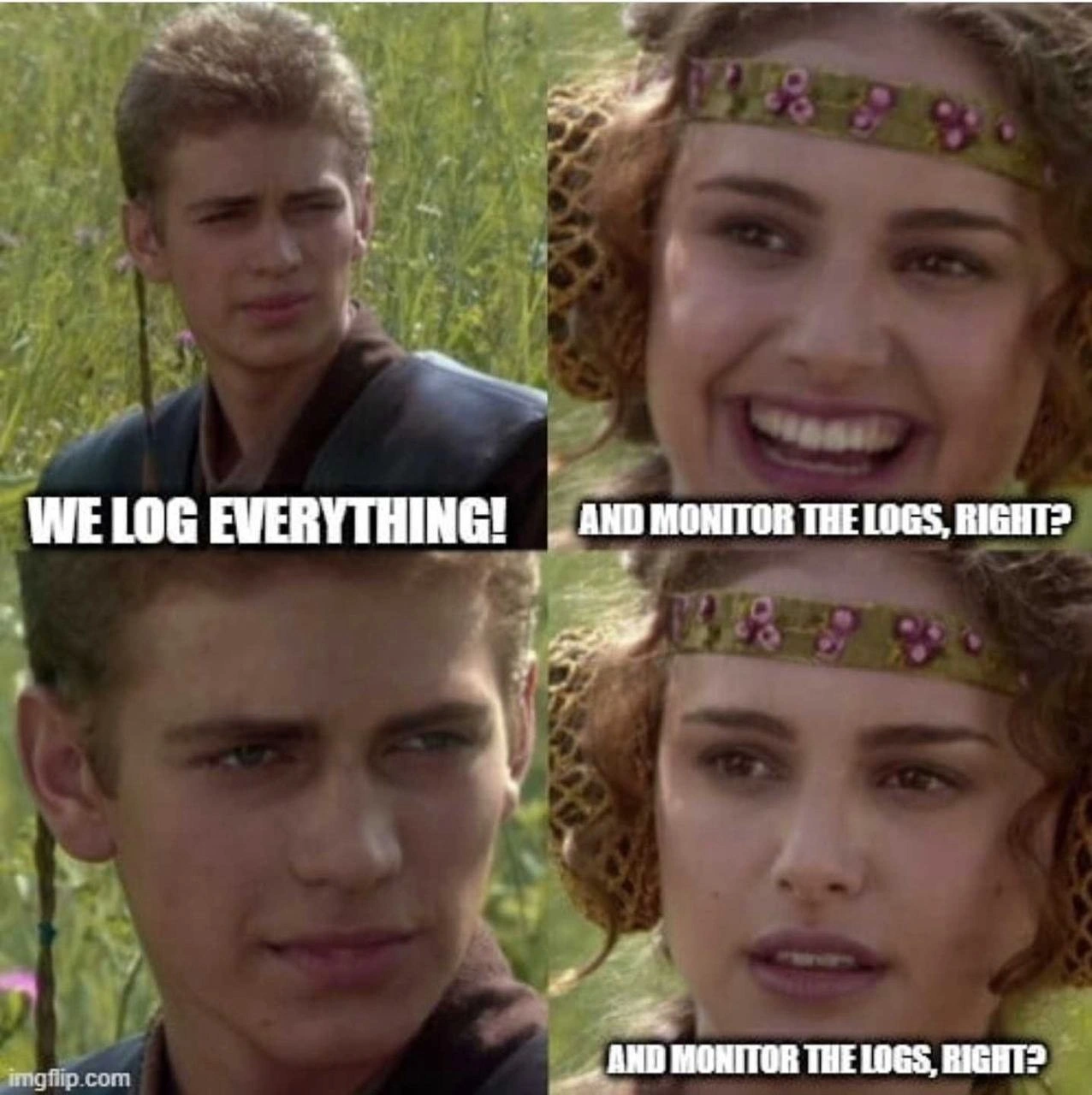
This meme uses the four-panel 'For the Better, Right?' format, featuring Anakin Skywalker and Padmé Amidala from Star Wars. In the first panel, Anakin looks proud and declares, 'WE LOG EVERYTHING!'. In the second, a smiling Padmé follows up with the question, 'AND MONITOR THE LOGS, RIGHT?'. The third panel shows Anakin's confident expression replaced by a silent, blank stare. The final panel shows Padmé's smile has vanished, replaced by a look of dawning horror as she repeats, 'AND MONITOR THE LOGS, RIGHT?'. A watermark for 'imgflip.com' is visible in the bottom-left corner. The humor targets a common organizational anti-pattern in software engineering and operations. Teams often put immense effort into generating vast quantities of logs, creating a false sense of security that their systems are observable. However, the crucial step of setting up effective monitoring, alerting, and analysis on those logs is often neglected. For experienced engineers, this is a painfully familiar scenario where logs exist but provide no real-time insight, rendering them useless during an actual production incident. Anakin's silent panic perfectly captures the moment of realization that the 'observability' is just for show

Comments
37Comment deleted
Our logging strategy is simple: we write everything to a distributed, highly-available, and infinitely scalable black hole called /dev/null
“We log everything” - translation: our alerting pipeline is the CFO pinging Slack when the S3 bill doubles
Somewhere there's a 10TB Elasticsearch cluster with perfect log retention, zero dashboards, and one alert: disk space at 95%. The logs will tell us exactly what went wrong... if anyone remembers the Kibana password from 2019
Ah yes, the classic 'we have observability at home' scenario - petabytes of logs dutifully shipped to S3 at $0.023/GB, zero alerts configured, and a Grafana dashboard that hasn't been opened since the proof-of-concept. When the 3am page comes in, you'll grep through CloudWatch Insights with a rate limit, discover your retention policy deleted last week's data, and realize the only person who knew the log format left six months ago. But hey, at least you're GDPR compliant with that 90-day retention policy, right? Right?
“We log everything.” Cool - who monitors it, who redacts it, and who pays the ingest bill when cardinality pages Finance before on-call?
“We log everything” usually means DEBUG in prod, zero sampling, PII confetti, and a CloudWatch invoice that pages finance before SRE
Logs: our single source of truth, buried under 99.9% cat photos from debug spam
😂😂😂😂😂 Comment deleted
- We log everything! - And do not erase monthly old logs to make up space? - We dont erase older logs to make up space, don't we? Comment deleted
my school does the opposite - keep courses (including attached images and everything) from every year since 2014 - our servers have run out of space twice this year. Comment deleted
note: we have a lot of teachers that write stuff in latex, parse it to an image and put it into the course like that Comment deleted
a w e s o m e Comment deleted
Not the worst case scenario. Imagine if they actually stuffed the big-size (Full HD-like) pictures into the document shrunk to tiny images, but with original size maintained. Comment deleted
uhm… I don't understand, please elaborate? Comment deleted
Here's the deal. You take the big size image that takes some big space. You insert it into a document and shrink it on the page to some tiny size. You save the document. The document won't actually shrink the image per se — instead it will maintain its original size, just displaying it minified. In other words, put such big images into a document and it will bloat drastically, no matter how these images are shrunk visually. Comment deleted
ahh I get what you meant. Well, they already do this to some degree. The images have like four times the resolution they have to be, and then insert them into moodle at (for my screen size) ~200% of the screen's resolution. Comment deleted
although my screen size is only 1366x768, so there's that Comment deleted
Oh dear. I'm afraid to even ask how much server space did it all take, if those "eggheads" were actually doing this all the way since 2014. Comment deleted
I have no idea, that info isn't accessible to students. Comment deleted
but I imagine it's at least several terabytes Comment deleted
🤣🤣 Why not directly in pdf? Comment deleted
because they usually embed it on our website - you can't embed pdfs (afaik) Comment deleted
But you can use js-based pdf viewer like Mozilla's pdf.js Comment deleted
you can also use js to embed latex directly into html, but the point is that they're incapable Comment deleted
mathml Comment deleted
yes, that Comment deleted
For embedding, they could use mediawiki or mathjax or mathml. There are many more nowaday. Comment deleted
yes, if they had like 2 minutes of IT experience, they could do that Comment deleted
Why? It's the same as latex editing. Comment deleted
I believe they have a word-like frontend to latex, and you do need to include some javascript libraries (which they can't) Comment deleted
mathml is supported by Opera Presto (partial) One of old Chromes (partial) Firefox Safari So using mathml for everyone is not good at all Comment deleted
If you know either, you can easily do the other. Comment deleted
Also, some latex editors support exporting as html Comment deleted
look, can we just agree that my teachers are fucking stupid? Thanks Comment deleted
You in HS? Comment deleted
the austrian of equivalent of it, yes Comment deleted
I be like: Comment deleted