
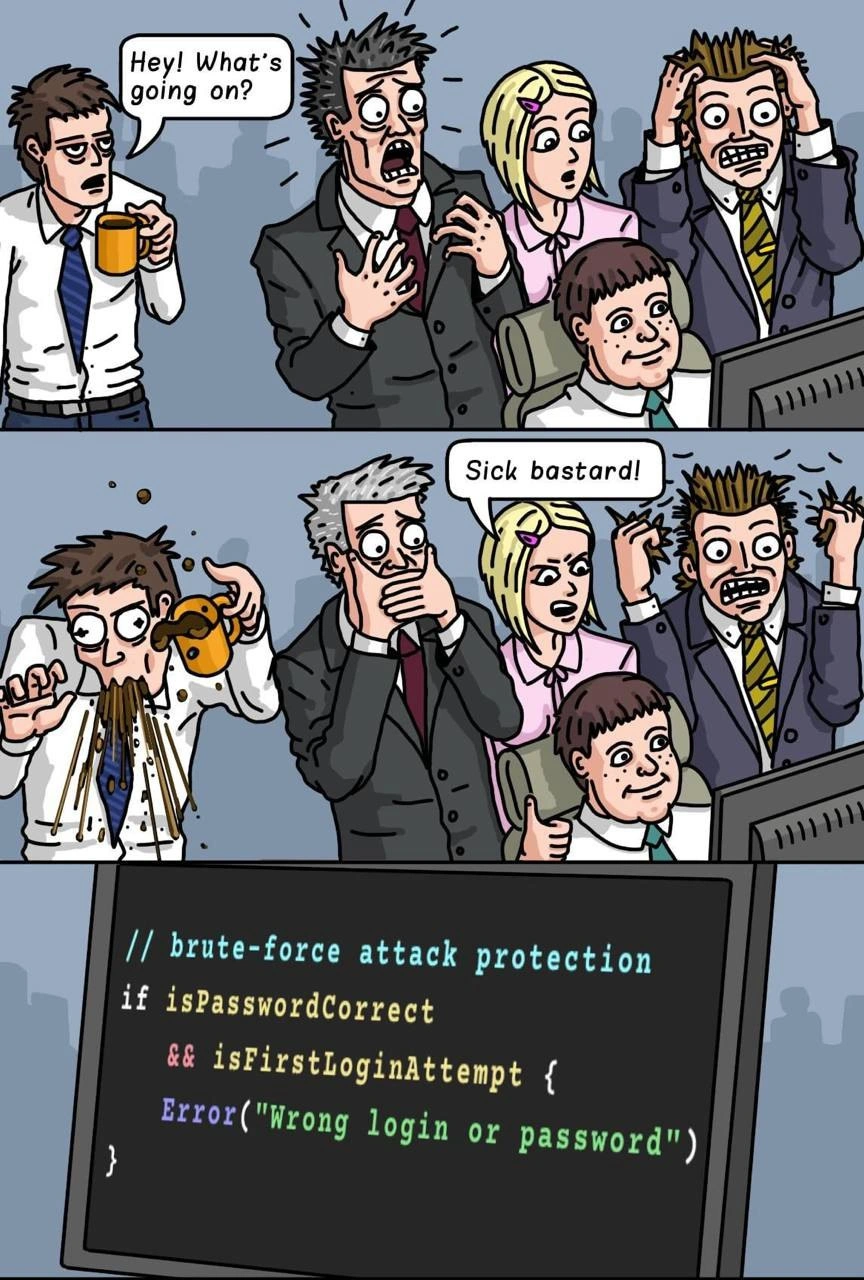
A Developer's Diabolical 'Brute-Force Protection' Logic
Description
A three-panel comic strip depicting an office scene. In the first panel, a group of colleagues looks on in horror at a developer's computer screen, with one asking, 'Hey! What's going on?'. The developer at the computer has a smug look. In the second panel, the horror intensifies: one man spits out his coffee, others are in shock, and a woman exclaims, 'Sick bastard!'. The developer gives a calm thumbs-up. The third panel reveals the cause of their reaction: a close-up of a monitor displaying a code snippet. The code, under a comment '// brute-force attack protection', reads: 'if isPasswordCorrect && isFirstLoginAttempt { Error("Wrong login or password") }'. The humor comes from the deliberately perverse and chaotic logic. Instead of protecting against attacks, this code ensures that a user with the correct password will be locked out specifically on their first attempt, causing maximum confusion and frustration, while likely failing to prevent any actual security threats
Comments
32Comment deleted
This isn't a security feature; it's a CAPTCHA for emotions. It just checks if the user is human enough to feel infuriated
Why bother rate-limiting when you can ship Schrödinger’s password - simultaneously valid and invalid until attempt two?
This is the authentication equivalent of a bouncer who only lets you into the club if you give the wrong password - but just on your first try. After 20 years in this industry, I've seen this exact pattern deployed to production at least three times, usually right before a major product launch when the CEO decides to 'test the login flow personally'
When your brute-force protection is so sophisticated it tells attackers 'You got the password right, but I'm going to pretend you didn't because it's your first try.' It's like having a bouncer who says 'Nice try with that correct password, buddy, but company policy says I have to reject you once before letting you in.' This is the authentication equivalent of implementing rate limiting that only triggers after you've already given away whether the credentials are valid - a masterclass in defeating your own security measures through helpful error messages
If your threat model is 'users who know their password,' this control is airtight
Marketed as “brute-force protection,” it’s really a human-only rate limit - bots just wrap curl in while(true) and your helpdesk explodes
Rate-limits successes to gaslight legit users while brute-forcers feast on silent failures - peak architectural irony
THAT'S DEPRAVITY Comment deleted
but also very smart Comment deleted
I sometimes wonder if reddit has that Comment deleted
actually that makes sense.. though the checks should be swapped Comment deleted
Exactly, one less check Comment deleted
USB-A authors have managed to do the same in hardware! Comment deleted
https://t.me/mmmeme_channel/6677 Comment deleted
thats fucking gold Comment deleted
Skill issue /s Comment deleted
You actually CAN insert a USB jack into an Ethernet port. Anyway, there are no wrong ports, there are weak people. Comment deleted
and thats how I broke PS/2 kb port (by flipping the plug accidentally) Comment deleted
Художественный фильм "Спиздили" Comment deleted
English Comment deleted
exactly our uni website Comment deleted
Whats limit? Comment deleted
2. but the bot only counts the warns, so in the end, the moderator decides if the person gets another chance Comment deleted
Ah okay Comment deleted
the code is poorly written btw Comment deleted
did you expect the prod code to be posted online? Comment deleted
no, I expect meme code to be written pretty Comment deleted
How to explain this in music terms Comment deleted
done Comment deleted
Well... Why it won't work? Comment deleted
It's actually brilliant Comment deleted
😂😂 Comment deleted