
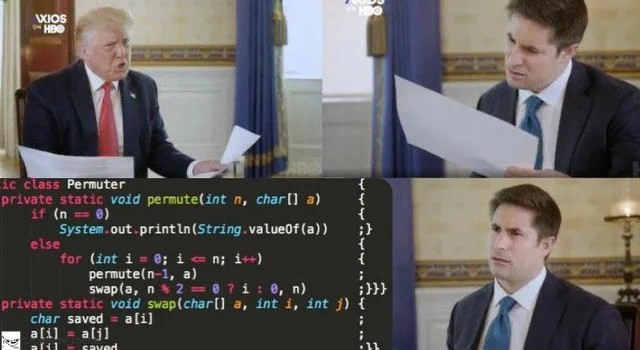
Code Reviewer Reacts to Obfuscated Permutation Algorithm
Description
A three-panel meme using the Donald Trump and Jonathan Swan interview format. The top panel shows Trump presenting a document, which is revealed in the bottom panel to be a snippet of Java code. The interviewer, Swan, is shown in the top-right and bottom-right panels with an expression of intense confusion and disbelief as he reviews the code. The Java code defines a 'Permuter' class with a recursive 'permute' method that generates permutations of a character array. The code is notably complex and difficult to understand at a glance, featuring a recursive call and a tricky swap operation using a ternary operator: 'swap(a, n % 2 == 0 ? i : 0, n)'. This meme humorously captures the experience of a code reviewer encountering overly 'clever,' obfuscated, or simply unreadable code. The inscrutable algorithm, a variation of Heap's algorithm, is a perfect stand-in for the kind of code that makes developers question the sanity of the original author. Swan's face perfectly embodies the reviewer's internal monologue of 'what is this and why was it written this way?'
Comments
7Comment deleted
This isn't just a permutation generator; it's a pull request that generates a permutation of which team member will volunteer to maintain it in six months. Spoiler: the list is empty
When the CEO hands you a printout of an O(n!) permutation method and calls it our “cloud scaling strategy,” you realize FaaS now stands for “Factorial as a Service.”
After 20 years in the industry, you learn that the most diplomatic way to handle a junior's creative interpretation of variable naming conventions is the same face you make when the CEO suggests blockchain will solve the legacy mainframe migration
When the interviewer asks you to implement permutations and you mentally execute Heap's algorithm with that ternary swap operator while maintaining eye contact - because nothing says 'senior engineer' quite like casually generating n! arrangements with O(1) space complexity in your head during small talk
You can tell it’s Heap’s algorithm - the permutations, closing braces, and reviewer questions all grow at O(n!)
Whiteboards it flawlessly, then they ask for duplicates: suddenly your O(n!) is 'inefficient' compared to HashSet wizardry
Heap’s algorithm with a swap that does a[i] = a[i]; - O(n!) activity, O(1) change. Perfect enterprise transformation KPI