
The Futile Quest for a Proper USB-C Data Cable
Description
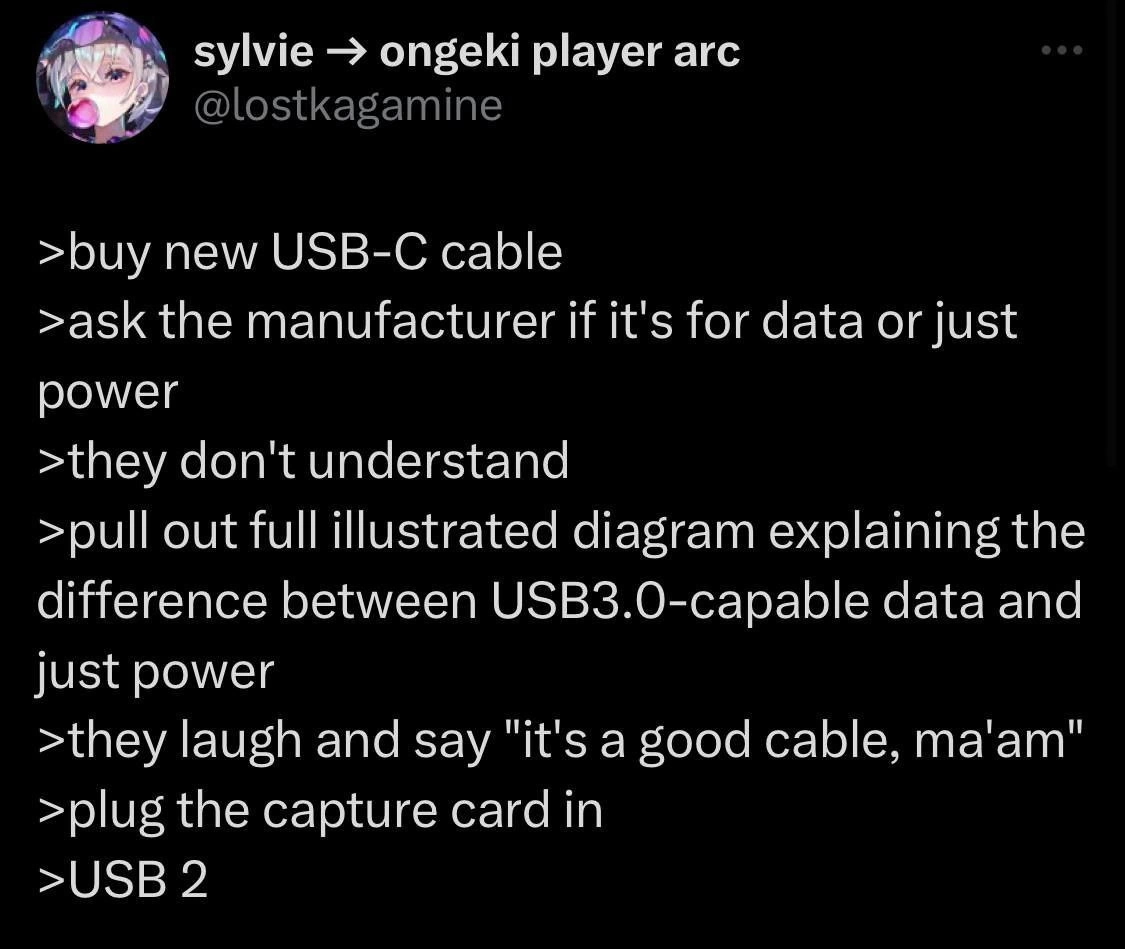
This image is a screenshot of a tweet in dark mode from the user '@lostkagamine'. The tweet is written in a 'greentext' story format, where each line begins with a '>' character. The story humorously details the frustrating experience of trying to purchase a new USB-C cable. The narrator recounts asking the manufacturer if the cable is for data transfer or just for power, but the manufacturer doesn't understand the question. The narrator then shows them an illustrated diagram explaining the difference between a USB 3.0-capable data cable and a simple power cable, to which the manufacturer laughs and dismissively replies, 'it's a good cable, ma'am.' The punchline comes in the last two lines, where the narrator plugs a capture card in and discovers the cable is only USB 2.0. This meme is highly relatable for tech-savvy individuals who understand the frustrating lack of clear standards and labeling in the USB-C cable market, where functionally different cables can look identical. It highlights the pain of dealing with vendors who are ignorant of the technical specifications of their own products


Comments
7Comment deleted
The USB-IF really missed the chance to call the spec 'USB-Schrödinger,' where a cable is simultaneously for high-speed data and 5V charging until you plug it in and the waveform collapses into disappointment
USB-C: 24 pins of theoretical glory, but the vendor shipped the Conway’s-Law version - only the power team made it into prod, so my capture card’s stuck at USB 2
USB-C: the only standard where you need a PhD in electrical engineering to buy a cable, but still end up using the USB 2.0 port because at least you know what you're getting
The USB-C specification is Schrödinger's cable: simultaneously capable of 40Gbps Thunderbolt and 5V/0.5A charging until you actually need it for a capture card, at which point it collapses into USB 2.0. The real tragedy isn't the manufacturer's confusion - it's that after 25+ years of USB standards, we've somehow made cables *more* confusing by making them all look identical while having wildly different capabilities. At least with USB-A, you could tell a USB 3.0 port by the blue plastic; now you need a PhD in electrical engineering and a multimeter to buy the right cable
USB-C is the REST API of hardware: identical endpoint, undocumented semantics; “good cable” returns 200 OK with a USB 2 payload
USB3 diagram for a USB2 card: hardware's premature optimization, dev's eternal regret
USB‑C: VBUS+GND and D+/D− only - no SuperSpeed pairs, no e‑marker - marketing calls it a “good cable”; your 4K capture card calls it USB 2