
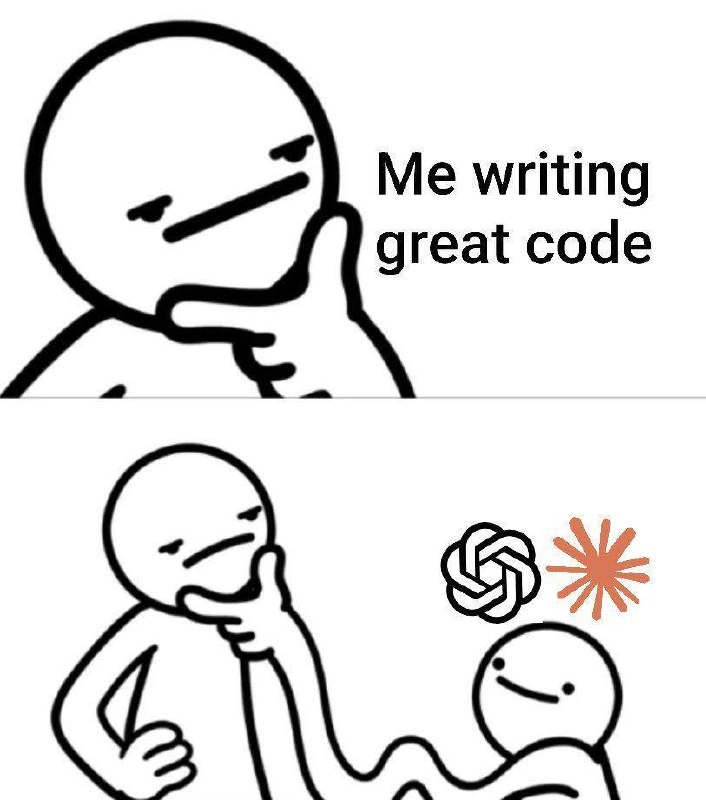
My AI-Powered Coding Prowess
Description
A two-panel meme featuring simple, black-and-white stick-figure characters. In the top panel, a character is depicted in a classic thinking pose, hand on chin, with a look of concentration and confidence. The text next to it reads, 'Me writing great code.' The bottom panel reframes the scene: the same character is in the thinking pose, but a smaller, smiling character is physically holding the first character's hand to its chin, as if puppeteering the thoughtful gesture. Positioned between the two figures are the logos for OpenAI and Google's AI (appearing to be Gemini/Bard). This meme humorously deconstructs the idea of individual coding genius in the age of AI. It satirizes developers who might take full credit for their work, while heavily relying on AI coding assistants like ChatGPT or Gemini to generate the 'great code' they're so proud of. The joke is on the developer's inflated sense of self, oblivious to the AI acting as the ghostwriter


Comments
53Comment deleted
My new pair programmer is amazing. It never gets tired, types at the speed of light, and only occasionally hallucinates an entire API that doesn't exist
ChatGPT leans over my shoulder and within two suggestions converts my tidy functional pipeline into an AbstractFactoryBuilderFactory - proof its training data peaked in 2006
After 20 years of arguing about tabs vs spaces and defending our hand-crafted abstractions, we've finally found the ultimate code review partner: one that never questions our architectural decisions because it helped write them, creating the perfect echo chamber where every pull request is just us agreeing with ourselves at different confidence levels
Every senior engineer knows this feeling: you're in the zone, abstractions are elegant, patterns are pristine, and you're convinced you've just architected the Sistine Chapel of code. Then you step away for coffee, return with fresh eyes, and realize you've actually built a distributed monolith with circular dependencies that would make a graph theorist weep. The real wisdom isn't avoiding this trap - it's recognizing that the gap between 'writing great code' and 'having written great code' is exactly one code review, three production incidents, and a humbling conversation with your future self at 3 AM
About to model aggregates and invariants; the LLM autocompletes a 500‑line singleton utils.ts, swallows errors, and asks me to press Merge - apparently I’m the rubber duck now
Intending SOLID principles, shipping a dependency graph that defies Tarjan's algorithm
Pairing with ChatGPT: my “great code” becomes a confident, elegant snippet that aces the happy-path test, ignores idempotency, and deadlocks the moment reality introduces concurrency
Gemini 2.5 pro is better Comment deleted
I am better Comment deleted
I am prompt developer Comment deleted
Does that means you develop apps promptly ? Comment deleted
Yes, still counting as apps maker tho. Comment deleted
Idk, for now llm struggle to even understand my ideas. Right now my pet project is some ecs like data structure that allow multithreading processing. And llm struggle to even understand how it work in general way, not to saying about a lot of corner cases with addition/deletion of components Comment deleted
yea imo LLMs at the current level can't comprehend problems actual programmers are hired to solve Comment deleted
or maybe I just suck at prompting. it's not a skill I care to hone Comment deleted
Skill issue still 🪦 Comment deleted
if you're only working on problems LLMs can solve, that speaks about your skills more Comment deleted
That's strange take LLM is just an instrument. It's how you use it what defines if it can solve some problem or not Comment deleted
There's a ton of problems LLMs can't solve, or at least can't solve at a smaller cost than a human (including time spent). Riedler's (and mine as well) point was that a majority of tasks developers do, or at least good developers, are of this category Comment deleted
And this is what I’m talking about, because "solve" needs definition in that context, otherwise it depends solely on personal expectations Comment deleted
Okay Comment deleted
Thanks to gemini 2.5 and it's context of 1M tokens I just solved a problem with reverse-enginering on which I gave up 2 years ago I had to load context for 700k tokens, full of different networks dumps, etc Its completelly different reality we live in right now Comment deleted
Naah. I’m using LLMs to create problems to solve 💸 Comment deleted
It's funny cause I've tried some different LLMs to write a C++ OpenGL app with basic functionalities (such as zoom, pan, rotate). Neither of them could deliver a working one. It's even funnier cause every time i tried to debug and modify a portion, it's like you are talking to a new guy with a completely new mindset 😂😂 Comment deleted
yes. even trying some small things, like parts of the program, particular algorithms, which usually works out quite well. I noticed, they are oftentimes in different styles. while you can keep the leafs of the architecture a blackbox, it is a huge problem when one lets AI develop abstraction layers, because they need to be in consistent style, but after a while they look like you hired 50 different people and fired them immediately after they wrote 1 function. Comment deleted
at some point it becomes a huge problem resulting in unmaintainable and inextensible codebase Comment deleted
and by trying to feed LLM code to an LLM to fix it, you run into ML-autofagia, because of which it starts to produce even worse and worse results over time. Comment deleted
it actually follows from the underlying math models, but some people don't know why, and some people don't tell why. Comment deleted
Maybe LLMs perform good in other languages like python,... I've never tried. But they can give an overall example how your code structure should look like. Comment deleted
no Comment deleted
and yes for the second part Comment deleted
I use LLM for inspiration, not for writing Comment deleted
this works out well Comment deleted
especially because llms produce errors uncommon for people, and they look okay at the first glance, and at the second and third oftentimes too, but people with a bit of proffecionality could never fail in such places, this results in very hardcore debugging. that's why I better read the code, and write it in a same manner as everything else by myself. Comment deleted
I work with lawyers, they tried sometimes to spare themselves some work, they can code what they need most of the time if it's simple enough. and recently they tried to use Claude to write code they could write in 2 days. and then I had to fix it for a week. Comment deleted
You could get the same results by paying a tweaker $10 Comment deleted
here I get it for free and in plenty of contexts. I'm more than full stack. Comment deleted
Which one did you used? Comment deleted
Copilot, Qwen coder, Deepseek, Hermes, Mercury(this one feels different, it's a diffusion model, it's real fast) Comment deleted
Btw, did you already found any devmeme's page where webgl is used? Comment deleted
Not really, I'm not a web developer actually. Sometimes i build small Desktop apps for my own use. Mainly in C/C++ and WxWidgets for GUI. Comment deleted
You don't need to be a webdev to know about basics of how internet/browsers work tho Comment deleted
The client will pay "only 10 USD" to make their software with LLMs (Vibe Coding).... then they need to pay me 10k to solve all the holes and crash of the software made by using the LLM Comment deleted
A good thing for us, no? Comment deleted
💯 Comment deleted
Rage bait Comment deleted
That's a funny gag, but that's it Comment deleted
This was funny some time ago, but really, tokenizers are not complicated https://platform.openai.com/tokenizer Comment deleted
Tho to be honest I'm not even sure if this screenshot is real 🌚 Comment deleted
Just took it in t3 chat Comment deleted
It's 4o) Comment deleted
Would you say that it could've been AI generated? 😈 Comment deleted
or it could just be devtools'd Comment deleted