
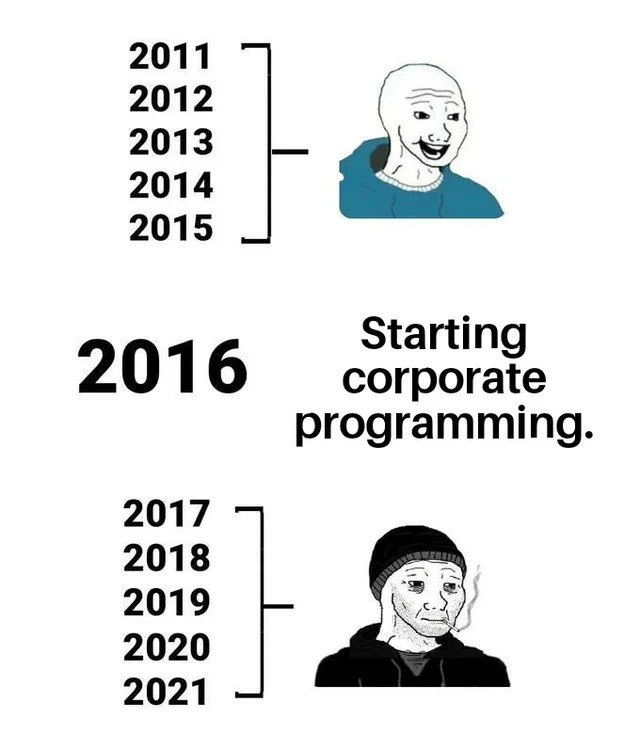
How corporate coding transformed a bright dev into a burnt-out husk
Description
Three-panel vertical meme on a white background. Top panel lists the years “2011, 2012, 2013, 2014, 2015” in black text, bracketed to a cartoon head-and-shoulders of a fresh-faced person in a light teal hoodie. Center panel shows the bold text “2016” on the left and, on the right, the caption “Starting corporate programming.” Bottom panel lists the years “2017, 2018, 2019, 2020, 2021” bracketed to a much darker illustration of the same person: black hoodie, hollow eyes, cigarette smoke curling from the mouth, conveying fatigue and cynicism. The meme humorously depicts the rapid deterioration of a developer’s appearance and spirit after entering corporate software development, hinting at burnout, relentless deadlines, and corporate bureaucracy familiar to seasoned engineers
Comments
9Comment deleted
Joined in 2016 as a shiny greenfield microservice - five fiscal years of reorgs later I’m a mission-critical legacy monolith nobody’s brave enough to refactor, including me
The real enterprise design pattern nobody talks about: the Singleton Developer Pattern - where one person maintains legacy systems from 2016 while their soul gradually migrates to /dev/null, but at least the JIRA tickets are color-coded and the Confluence documentation from 2017 still says 'TODO: update this section.'
Five years of joy, five years of Jira. The transformation has 100% reproducibility across all test subjects
The meme perfectly captures what happens when you trade your startup hoodie for enterprise slacks - five years in corporate programming ages you like maintaining a COBOL codebase ages your soul. That 2016 pivot point? That's when 'move fast and break things' became 'submit a change request form and wait three sprints for approval.' Harold's transformation mirrors every developer who's experienced the joy of replacing their elegant microservices with a monolithic ERP integration, where the only thing more legacy than the code is the organizational structure that produced it
Pre-2016: git push origin master. Post-2016: PR with 17 approvals in Jira hell
Started corporate programming in 2016; by 2021 I’d shipped 400 pages of SOC2 evidence and one line of code - still waiting on CAB
Joined enterprise in 2016 and discovered relativistic time: a one-line fix spends five years in JIRA, CAB, and release-freeze windows before hitting prod
In 2022 you just die Comment deleted
what if you never did the first part. asking for a friend Comment deleted