
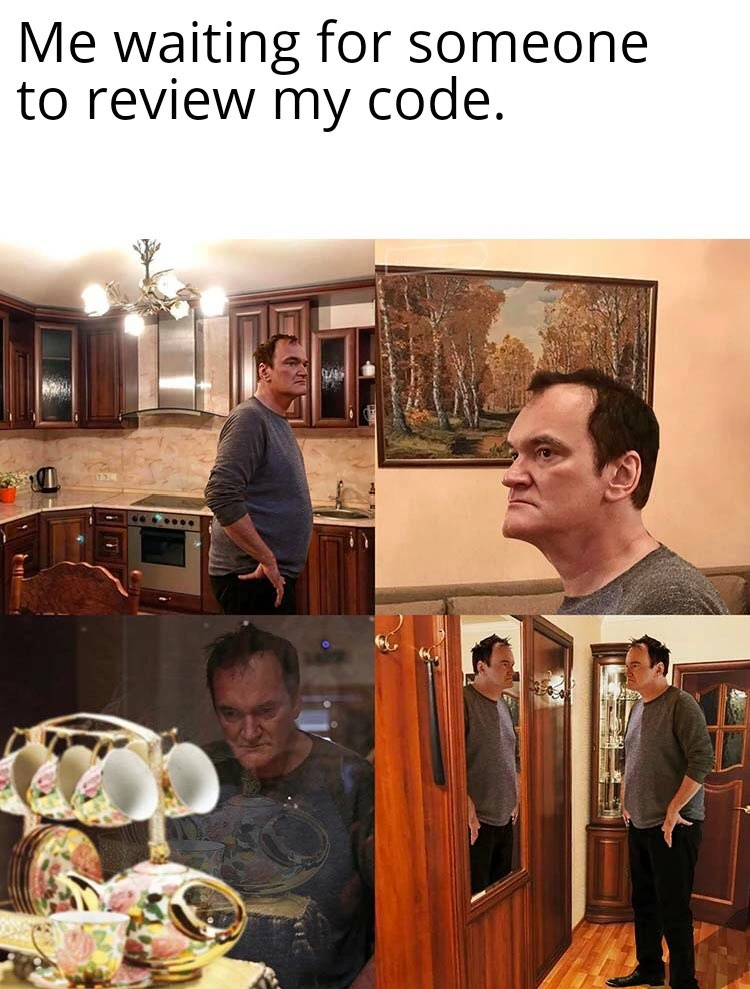
The Agony of Waiting for a Code Review
Description
A four-panel meme captioned, 'Me waiting for someone to review my code.' The panels depict film director Quentin Tarantino looking awkward, bored, and impatient in various parts of a house. He is seen standing in a kitchen, staring at a painting, looking down at a fancy tea set, and examining his reflection in a mirror. This meme format, sometimes known as 'Confused Travolta' but here with Tarantino, perfectly captures a sense of aimless and restless waiting. The technical context is the common developer experience of being blocked after submitting a pull request (PR). This waiting period for a code review is a frequent bottleneck in software development, disrupting a developer's flow and hindering team velocity. For senior engineers, it's a deeply relatable commentary on the importance of a swift and efficient code review culture
Comments
7Comment deleted
I've had Kubernetes deployments finish faster than getting a 'looks good to me' on a three-line CSS change
I’ve accepted that our review stage runs under the BASE consistency model: basically available, sometimes engaged - eventually someone will click “Approve.”
The same energy as refreshing the CI pipeline that's been "waiting for runner" for 20 minutes, except at least the runner has an excuse - it's probably mining crypto
The real technical debt isn't in the code - it's the compound interest accruing on your mental context while that PR sits in review limbo for three sprints. By the time you get feedback, you've already refactored that module twice in your head and forgotten why you made those architectural decisions in the first place
PR review wait times prove CAP theorem's P: even in distributed teams, partition tolerance trumps timely approval
CI: 8 minutes. Human reviewers: eventual consistency with unbounded tail latency - my PR is basically S3 Glacier
Our DORA dashboard says lead time is 3 days - 2.9 of them waiting for CODEOWNERS to release the distributed lock called LGTM