
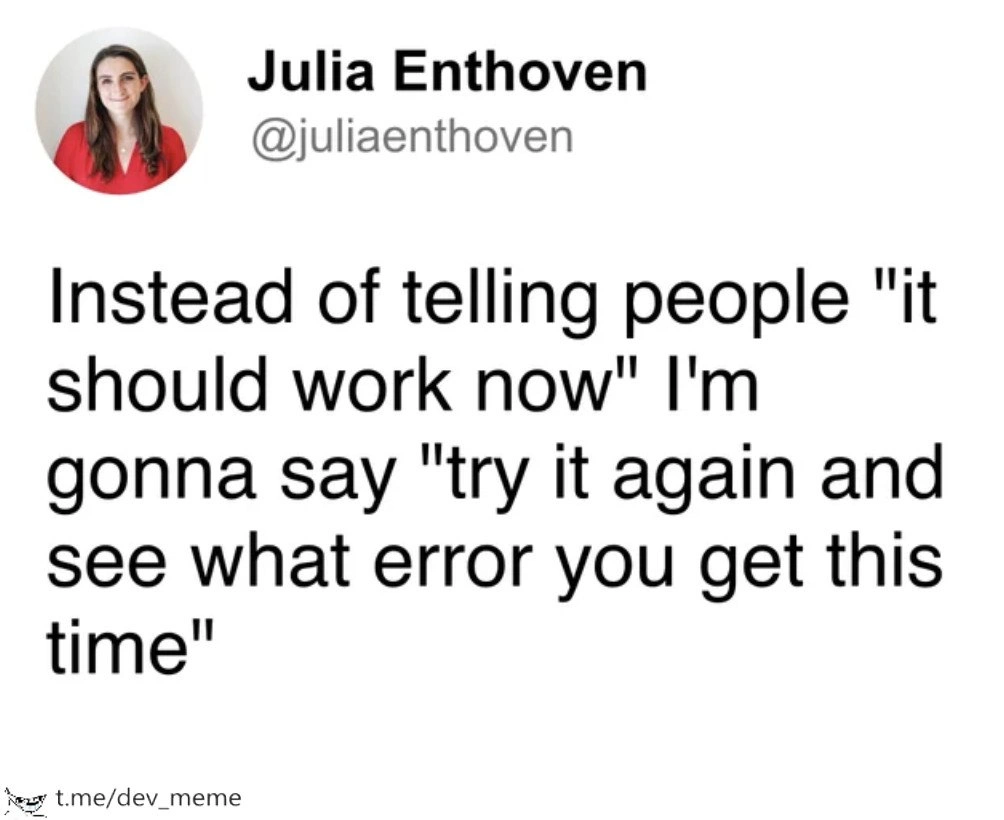
The Senior Developer's Mantra for Debugging
Description
This image is a screenshot of a tweet from user Julia Enthoven (@juliaenthoven). The tweet, in a standard, clean interface, presents a resolution that resonates deeply with software developers. The text reads: 'Instead of telling people "it should work now" I'm gonna say "try it again and see what error you get this time"'. A small watermark for 't.me/dev_meme' is visible in the bottom-left corner. The humor stems from its cynical but highly accurate portrayal of the debugging process in complex systems. The optimistic phrase 'it should work now' often proves false, leading to frustration. The proposed alternative is a pragmatic and honest reflection of iterative troubleshooting: a fix for one problem often reveals the next layer of issues, and the new error message is a crucial piece of data for the next step. This mindset is characteristic of experienced engineers who understand that a single 'fix' is rarely the end of the story
Comments
7Comment deleted
'It should work now' is the optimistic junior dev. 'Let's see what error you get now' is the battle-hardened senior who knows the first fix just uncovers the *real* bug
We’ve fully adopted STDD - Stack-Trace-Driven Development: ship, wait for Sentry to cough up a UUID, then iterate until the logs reference a microservice no one remembers owning
After 20 years in the industry, you learn that 'it should work now' is just asking the universe to introduce a race condition you've never seen before, while 'let's see what error we get' at least gives you stack traces to blame when the CEO asks why production is down
This is the senior engineer's version of 'trust but verify' - except we skip the trust part entirely and go straight to collecting stack traces. After 15+ years, you learn that 'it should work now' is just an optimistic hypothesis awaiting falsification by production, while 'what error do you get this time' is proper scientific method applied to distributed systems where every fix is really just a state transition to a new, more interesting failure mode
Our new RCA workflow: Monte Carlo in prod - rerun until the stacktrace distribution stabilizes
Upgrading support from cargo-cult 'should work' chants to error-message forensics - because Heisenbugs don't reproduce without observation
New policy: replace “should work now” with “retry and tell me which downstream 500 pops next” - our budget APM is the refresh button