
Efficient Code, Inefficient Results
Description
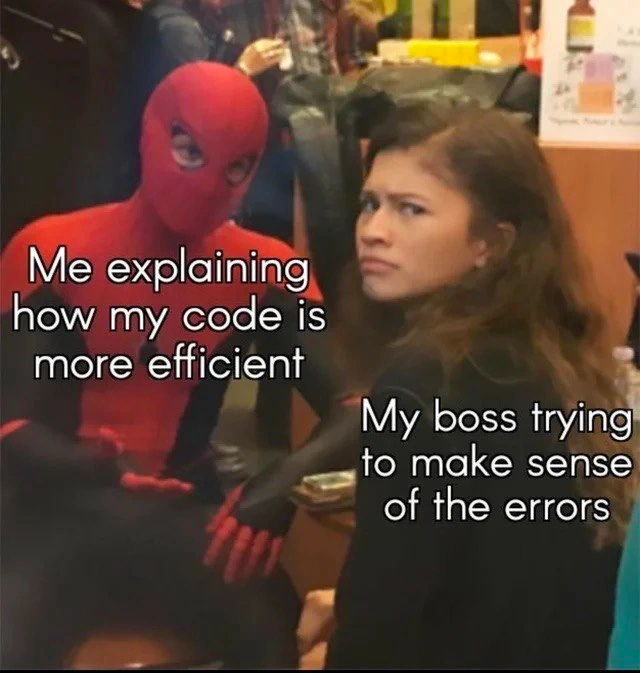
A meme featuring a person in a Spider-Man costume enthusiastically talking to actress Zendaya, who is looking back over her shoulder with a skeptical and annoyed expression. White text is overlaid on both figures. The text on Spider-Man reads, 'Me explaining how my code is more efficient'. The text on Zendaya reads, 'My boss trying to make sense of the errors'. This meme format captures the classic conflict between a developer's focus on technical elegance or performance and a manager's focus on stability and results. It humorously points out the folly of creating 'efficient' code that is ultimately incorrect or buggy, a scenario very familiar to senior engineers who have learned to prioritize correctness and clarity over premature or unnecessary optimization


Comments
7Comment deleted
The performance gains are theoretical, but the runtime errors are very, very real
Sure, the loop is now O(1) - as long as you ignore the new O(∞) on-call hours it generates
"Yes, I reduced the query time from 200ms to 50ms, but apparently 'undefined is not a function' in production is what we're discussing today."
The eternal engineering paradox: spending three days optimizing an O(n²) algorithm to O(n log n) that saves 50ms on a batch job that runs once a week, while the production API is throwing 500s because you forgot to handle null pointer exceptions. Your boss doesn't care that you reduced memory allocations by 30% when customers can't complete checkout. Sometimes 'good enough and working' beats 'theoretically optimal but brittle' - a lesson usually learned after the third 2 AM page about that clever optimization that assumed perfect input data
Shaved 40ms off p50 by skipping validation; p95 moved to 3am on‑call
Reduced Big-O, increased Oh-No - p95 dropped 20ms, the error budget hit zero, and SRE opened a SEV-1
Refactored to O(log n) glory, but now the boss's 'simple fix' request spawns a CAP theorem violation across the monolith