
A Tale of Two Protocols: TCP's Orderly Process vs. UDP's Casual Data Handling
Description
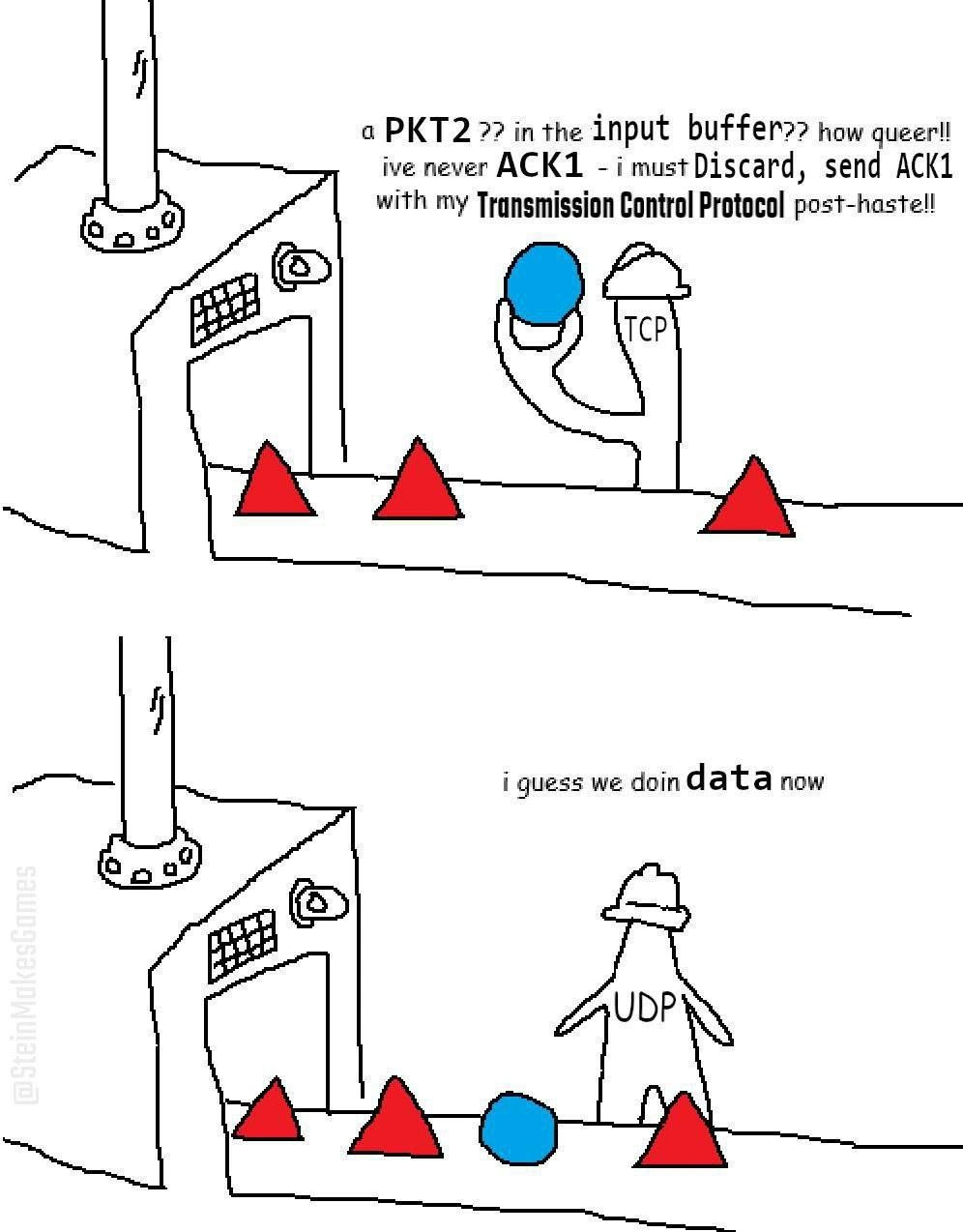
A two-panel, minimalist comic strip drawn in a simple black-and-white line style, comparing the TCP and UDP networking protocols. A watermark on the left side reads '@SteinMakesGames'. In the top panel, a factory-like machine has a conveyor belt with red triangular packets and one blue circular packet. A character labeled 'TCP', depicted as a cautious figure, holds up the blue packet and says, 'a PKT2 ?? in the input buffer?? how queer!! ive never ACK1 - i must Discard, send ACK1 with my Transmission Control Protocol post-haste!!'. This illustrates TCP's strict, in-order, and reliable nature, where packets received out of sequence are discarded until the expected packet is acknowledged. In the bottom panel, the scene is similar, but a new character labeled 'UDP', drawn as a laid-back figure in a hard hat, stands casually amongst the packets on the conveyor belt, simply stating, 'i guess we doin data now'. This humorously captures the essence of UDP as a 'fire-and-forget' protocol that does not guarantee order or delivery, prioritizing speed over reliability. The meme is a classic personification of fundamental computer science concepts

Comments
8Comment deleted
TCP is that senior engineer who insists on a full JIRA ticket, peer review, and sign-off for a one-line config change. UDP just pushes straight to main on a Friday afternoon
TCP is the architect who blocks the release until every review comment gets an ACK; UDP is the intern who slaps “LGTM,” hits merge, and calls it “eventual delivery.”
After 20 years of debugging distributed systems, I've realized TCP and UDP perfectly represent the two types of senior engineers: those who triple-check every deployment with rollback plans and monitoring alerts, and those who push straight to prod on Friday because 'the tests passed locally and besides, we have good observability now.'
This perfectly captures the existential difference between TCP and UDP: TCP is that senior engineer who's seen every edge case, maintains a 47-step checklist for deploying a single packet, and will retry indefinitely until they get that ACK - even if it means the user's video call has already ended. UDP is the pragmatic architect who knows that for real-time systems, a dropped frame beats a 3-second buffering delay, and sometimes 'good enough now' beats 'perfect eventually.' The real joke is that after 20 years in the industry, you realize both are right - it just depends on whether you're building a banking system or a multiplayer game. Though let's be honest, we've all shipped that UDP-based feature that should've been TCP because 'the network is reliable, right?'
TCP: full audit on every packet. UDP: 'It'll get there or it won't - retransmit in userland if you care.'
TCP sends a dup-ACK and kicks off fast retransmit; UDP read the SLO as “best effort” and promoted the packet straight to prod
TCP refuses PKT2 without ACK1 - classic head‑of‑line blocking; UDP: “Stateless means never having to say you’re sorry.”
for those who wonder Comment deleted