
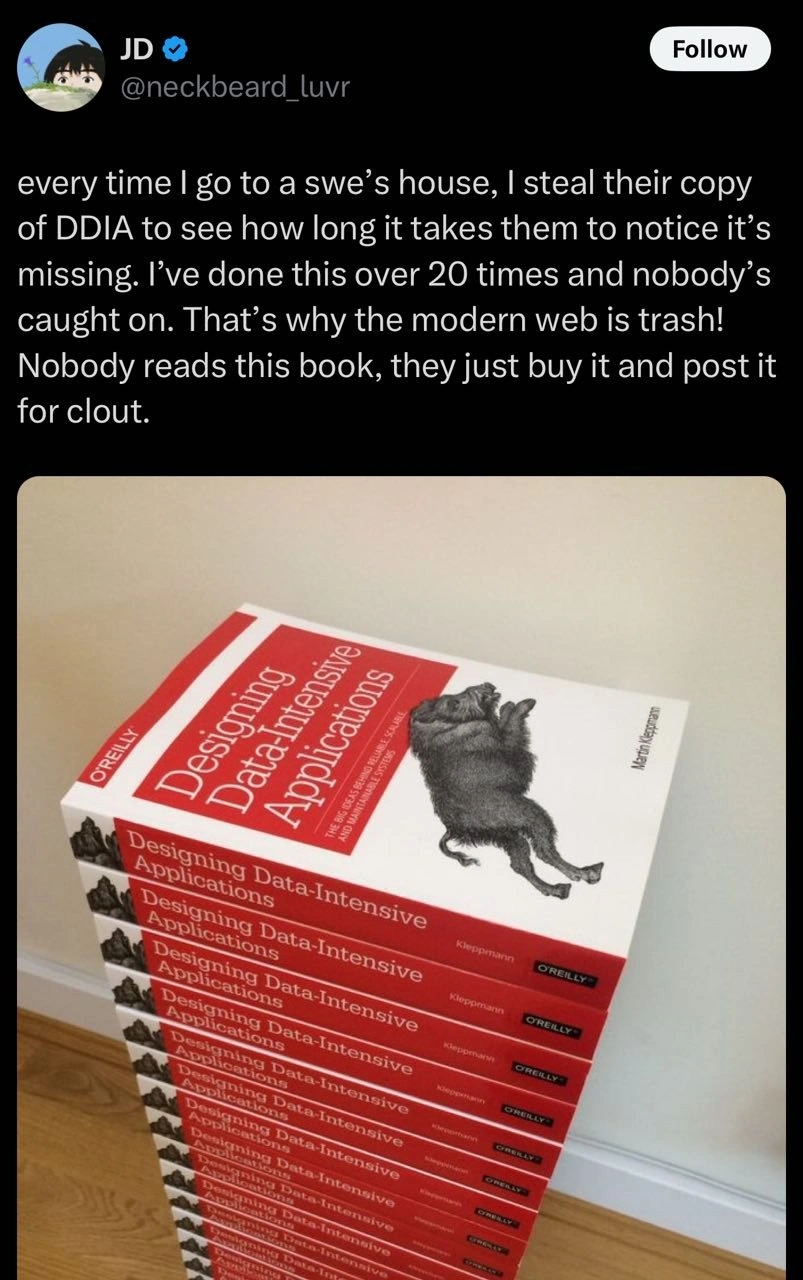
The Unread Bible of System Design on Every SWE's Shelf
Description
A screenshot of a tweet from the user JD (@neckbeard_luvr). The tweet text reads: 'every time I go to a swe's house, I steal their copy of DDIA to see how long it takes them to notice it's missing. I've done this over 20 times and nobody's caught on. That's why the modern web is trash! Nobody reads this book, they just buy it and post it for clout.' Below the text is a photograph of a very large stack of the book 'Designing Data-Intensive Applications' by Martin Kleppmann, published by O'Reilly. The book has a distinctive red cover with a black-and-white illustration of a wild boar. The meme satirizes the culture within software engineering where possessing certain highly-regarded, dense technical books is a form of status signaling. 'Designing Data-Intensive Applications' (DDIA) is considered an essential, almost canonical text for system design and backend engineering. The joke implies that many developers own it to appear serious and knowledgeable but haven't actually read it, using the tweeter's anecdotal theft as humorous 'proof' that this lack of fundamental knowledge contributes to poor software quality



Comments
20Comment deleted
That book is the senior engineer's equivalent of a Peloton. Everyone has one, but you can tell who's actually using it by whether they can explain the difference between two-phase commit and two-phase locking without checking the index
I’ve swiped so many unattended copies of DDIA that I now have enough for a full Raft quorum in my living room - still faster than getting any of the original owners to commit to chapter one
The real distributed system failure here isn't split-brain or network partitions - it's 20+ engineers achieving perfect consensus that they definitely read DDIA last quarter while their bookshelf silently implements eventual consistency
Ah yes, the infamous 'Designing Data-Intensive Applications' - the distributed systems equivalent of having a gym membership you never use. Every senior engineer's bookshelf has one, pristine and uncracked, serving its true purpose: proving to visiting engineers that you *totally* understand CAP theorem and could architect the next Cassandra if you weren't so busy with sprint planning. The real distributed system here is the network of software engineers collectively pretending they've read past chapter 3, achieving eventual consistency in their shared delusion that buying the book counts as learning. Meanwhile, production is held together with Redis as a message queue and a prayer, because nobody actually implemented any of Kleppmann's patterns - they just know the book exists, which is apparently enough to ship features
DDIA is the coffee table’s Kafka: an append-only log of good intentions, highly replicated, zero consumers
This DDIA stack nails fault tolerance: 20+ replica removals, zero downtime alerts, perfect eventual consistency for observers
The most accurate DDIA deployment I have seen is the bookshelf: infinite write throughput (purchases), near-zero read throughput, and an SLO of 'eventually consistent after the next outage'
Why did they go to 20 SWE's houses? Comment deleted
Sex Comment deleted
gay sex, to be more precise Comment deleted
Checks out Comment deleted
React devs hanging out Comment deleted
What does a swe mean? Oh, software engineer? Comment deleted
O really? Comment deleted
Nobody reads PAPER books for information nowadays. Paper books are purely status symbols. Comment deleted
commits crime calling out clout chasers posts on social media to chase clout truly remarkable Comment deleted
How good is that book ? And between 1 and 10 how's the pain ? Comment deleted
Book is amazing, pain progressivly gets worse from 2 to 8 i would say Comment deleted
late chapters when they talk about async stuff is pretty hard to comprehend Comment deleted
Interesting, I'll try that in a few months, thanks ^^ Comment deleted