
Software Architecture and Other Reasons to Cry
Description
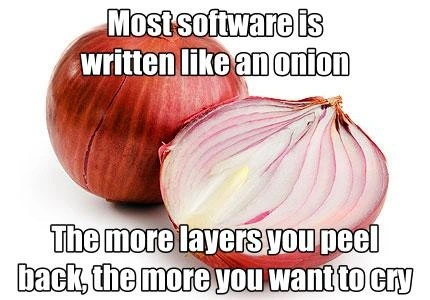
An image macro meme featuring a whole red onion and another one cut in half, revealing its concentric layers, set against a plain white background. The text, in a bold, white 'Impact' font with a black outline, is placed at the top and bottom of the image. The top text reads, 'Most software is written like an onion'. The bottom text completes the thought: 'The more layers you peel back, the more you want to cry'. This meme uses a simple but effective metaphor to describe the experience of working with complex, poorly documented, or legacy codebases. The 'layers' represent levels of abstraction, modules, or historical additions to the software. As a developer 'peels' them back to debug an issue, add a feature, or simply understand the system, they often uncover increasing levels of complexity, technical debt, and questionable design decisions, leading to frustration and despair, much like the eye-stinging effect of cutting an actual onion


Comments
7Comment deleted
The first layer is a clean DI framework. The second is a mess of circular dependencies. By the core, you're just staring at a global variable that controls everything and weeping
Our ‘onion architecture’ means a single HTTP call tunnels through a Python gateway, a gRPC sidecar, two feature-flag decorators, and a legacy SOAP adapter before the COBOL core finally responds - pair-programming with a raw Vidalia would sting less
After 15 years in the industry, I've learned that every 'clean architecture' diagram looks beautiful until you're 8 layers deep trying to add a simple field to the database, navigating through DTOs, mappers, repositories, use cases, and domain models, only to discover the original developer left because they couldn't debug their own creation
This perfectly captures the experience of inheriting a 'well-architected' enterprise system where each layer of abstraction was added by a different architect who never met the others. You start with a simple bug fix, peel back the repository layer, find three different ORM abstractions, discover a custom event bus wrapping another event bus, encounter a service layer that's actually seven micro-services in a trench coat, and by the time you reach the actual business logic buried six layers deep, you're questioning every life choice that led you to this moment. The real kicker? The original developer left a comment saying 'TODO: simplify this' dated five years ago
Onion architecture: we kept adding layers to reduce coupling - now a null pointer tours adapters, mappers, proxies, and the service mesh before it reaches my eyes; at least the crying is load-balanced
Onions have natural layers; software's are 'strategic' wrappers from every architect since Y2K, each leaking their own brand of tears
Our ‘onion architecture’ turned out to be 14 layers of DTOs around one 300-line SQL query - great separation of concerns, zero separation of tears