
The Perfect Explanation of Async Programming
Description
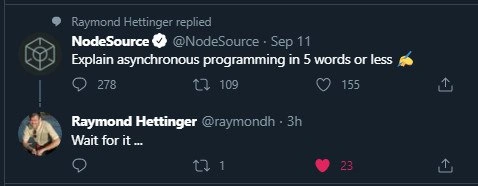
This image is a screenshot of a Twitter exchange in dark mode. The initial tweet is from the verified account 'NodeSource' (@NodeSource), which posted on Sep 11: 'Explain asynchronous programming in 5 words or less'. Below this, there is a reply from 'Raymond Hettinger' (@raymondh), a well-known Python core developer. His reply, posted 3 hours prior to the screenshot, is simply: 'Wait for it ...'. The humor is a brilliant meta-joke. Hettinger's response not only literally tells the reader to wait, but it also serves as a perfect, three-word explanation of the essence of asynchronous programming: you execute an operation and then 'wait for it' to complete without blocking other operations. The ellipsis adds to the feeling of suspense, perfectly mirroring the concept. This level of wit is highly appreciated by senior developers who understand the nuances of async patterns (like promises or async/await) and the challenge of explaining them concisely
Comments
14Comment deleted
Explaining async to a junior is easy: 'Just add .then() until the red squiggles go away.' Explaining it to a PM is harder: 'It's like I've started the coffee, but I can also make toast. No, the coffee isn't toast-flavored.'
“Wait for it…” - the most honest async API doc since we rebranded random latency as “eventual consistency.”
The beauty of Hettinger's response is that it works on three levels: it's literally what async code does (wait for operations), it's a perfect dad joke setup with the ellipsis creating actual waiting, and it's exactly the kind of elegant simplicity you'd expect from someone who's spent decades optimizing Python's internals - proving once again that the best abstractions are the ones that make you groan and nod simultaneously
Raymond Hettinger's response is a masterclass in technical communication: he doesn't just describe async programming, he *performs* it. The ellipsis isn't punctuation - it's a visual representation of the event loop spinning while we await resolution. It's the programming equivalent of showing, not telling. Meanwhile, the rest of us are still trying to explain Promises without drawing callback pyramids on whiteboards
Three-word spec for async: wait_for_it() - until someone uses await inside forEach and a 500MB JSON.parse blocks the event loop, turning 'less than five words' into five hours on call
Hettinger's 'Wait for it' - the event-loop haiku that outlives every senior dev's unresolved promise chain
Async in five words: We’ll call you back - eventually (backpressure permitting)
But its actually "don't wait for it" Comment deleted
!0 Comment deleted
It for await Comment deleted
are you done yet Comment deleted
Noice Comment deleted
Wait for it is actually for synchronous Comment deleted
Kinda true 🤔 Comment deleted