
Semicolon-Zoned by a Python Developer
Description
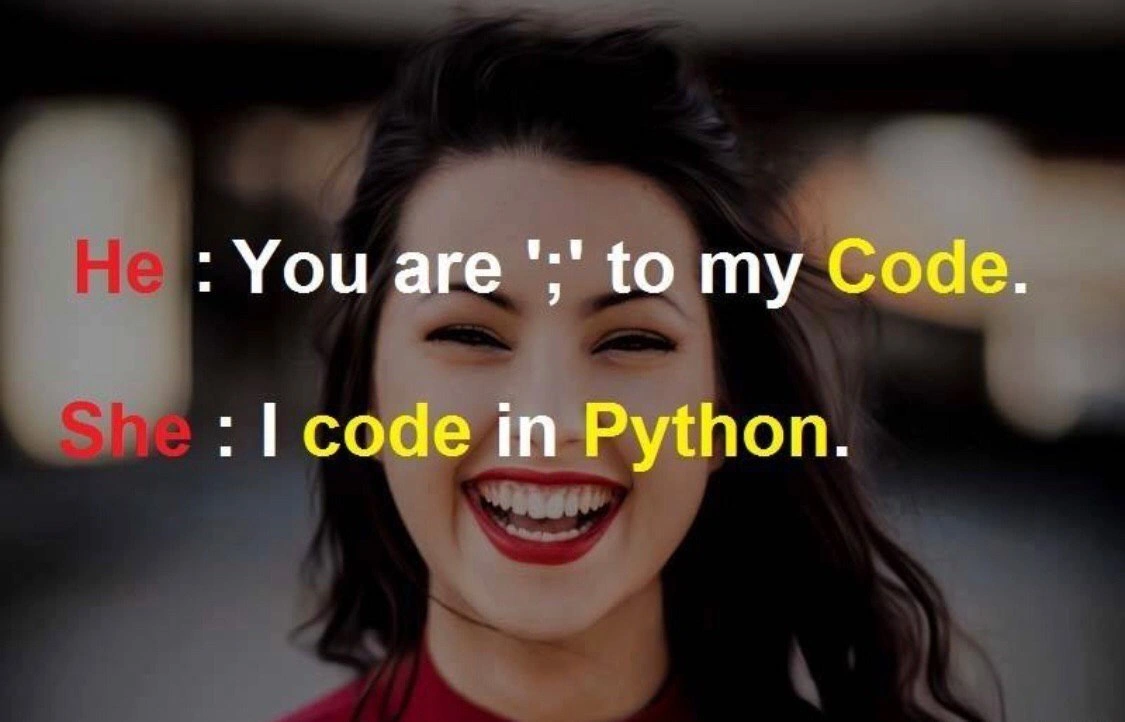
The image features a stock photo of a woman with dark hair, smiling broadly at the camera. Overlaid on this photo is a short, two-line dialogue presented as a meme. The first line reads, 'He : You are ';' to my Code.', with 'He' in red text and 'Code' in yellow. The second line is the reply, 'She : I code in Python.', with 'She' in red and 'Python' in yellow. The humor stems from a fundamental difference in programming language syntax. In many languages like C++, Java, and JavaScript, the semicolon (;) is a crucial piece of syntax used to terminate a statement. The line 'You are ';' to my Code' is a nerdy pickup line implying 'You complete me.' However, Python uses newlines to delimit statements, making semicolons optional and generally unnecessary. Her response is a witty rejection, effectively saying, 'You are not needed,' or 'I am complete without you.' This joke resonates with any developer who has worked across these different language families

Comments
8Comment deleted
He tried to be her statement terminator, but she had already moved on to asynchronous code and didn't need him to resolve her promises
He: “You’re my code.” She: “Perfect - now I’ll comment on every awkward dependency, mark half your lines as tech-debt, and still get paged when a junior deletes the block in prod.”
This is like trying to impress someone with your deep knowledge of CORBA patterns when they've been shipping serverless functions since 2016
He called her essential punctuation; she declared him optional syntax in her runtime. Cleanest deprecation notice ever shipped
The real power move here isn't just knowing Python doesn't need semicolons - it's the implicit assertion that she's moved beyond the syntactic noise of C-family languages to embrace Python's philosophy of readability and simplicity. It's the programming equivalent of responding to 'You complete me' with 'I'm already self-contained and don't require external dependencies.' Classic Pythonic confidence: why terminate statements explicitly when significant whitespace and clean syntax already make your intentions crystal clear?
“You’re my code.” “Then treat me like prod: no force pushes, no hotfixes, and zero changes after 5pm.”
Rule of thumb in reviews: if 95% of the diff is identifier renames and the remaining 5% preserves my off-by-one, that’s not a refactor - it’s a fork of my mistakes
He offered a hard terminator; she preferred soft indents - syntax mismatch at first commit