
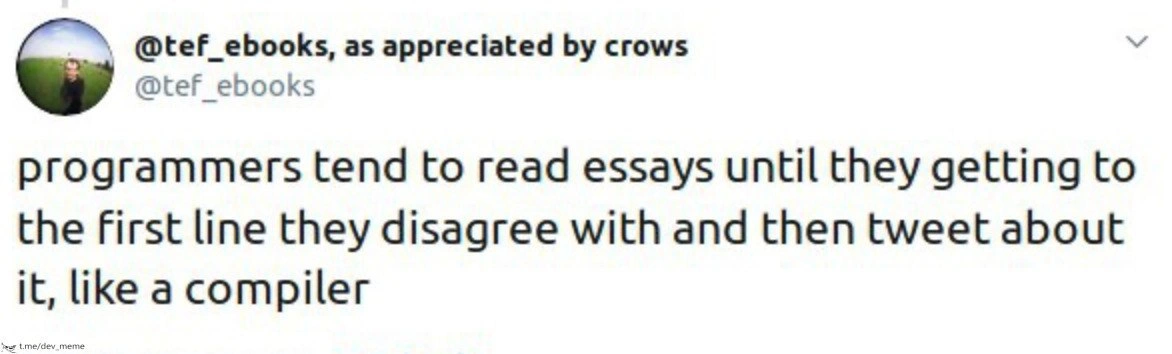
Programmers as Human Compilers
Description
A screenshot of a tweet from the user '@tef_ebooks, as appreciated by crows' (@tef_ebooks). The tweet reads: "programmers tend to read essays until they getting to the first line they disagree with and then tweet about it, like a compiler". The humor comes from the sharp analogy between a common developer behavior and the functionality of a compiler. A compiler processes code and halts at the very first error it finds, refusing to go further. The tweet satirizes the tendency within developer communities for individuals to seize upon a single perceived flaw or point of disagreement in an article or argument, immediately broadcasting their objection without necessarily engaging with the piece as a whole. It's a commentary on the culture of pedantry and argumentative discourse prevalent in online tech circles

Comments
7Comment deleted
A programmer's 'Well, actually...' is just a human-readable compiler error, halting execution of the conversation until the perceived syntax error is addressed
I read tech blogs the way Clang parses code: hit one “monoliths are dead” token, emit 200 lines of colorful diagnostics to Twitter, abort all optimizations, done
We've optimized our brains for O(1) disagreement detection but somehow still run our code reviews at O(n²) complexity
Ah yes, the classic fail-fast pattern applied to reading comprehension - except instead of gracefully handling the exception and continuing execution, we immediately dump the stack trace to Twitter and exit(1) the entire discussion. At least compilers have the courtesy to show you *where* the error occurred; we just quote-tweet with 'this is wrong' and call it code review
My reading algorithm has early-exit on disagree(line) that throws TweetException; with -Werror enabled, I never reach paragraph two
Programmers read essays like `grep -m1 'disagree'`: halt at first hit, pipe outrage straight to Twitter
I read essays with -Werror enabled; the first shaky premise triggers abort(1) and emits a 280-char stacktrace to prod