
The Perils of NFS over UDP on High-Speed Links
Description
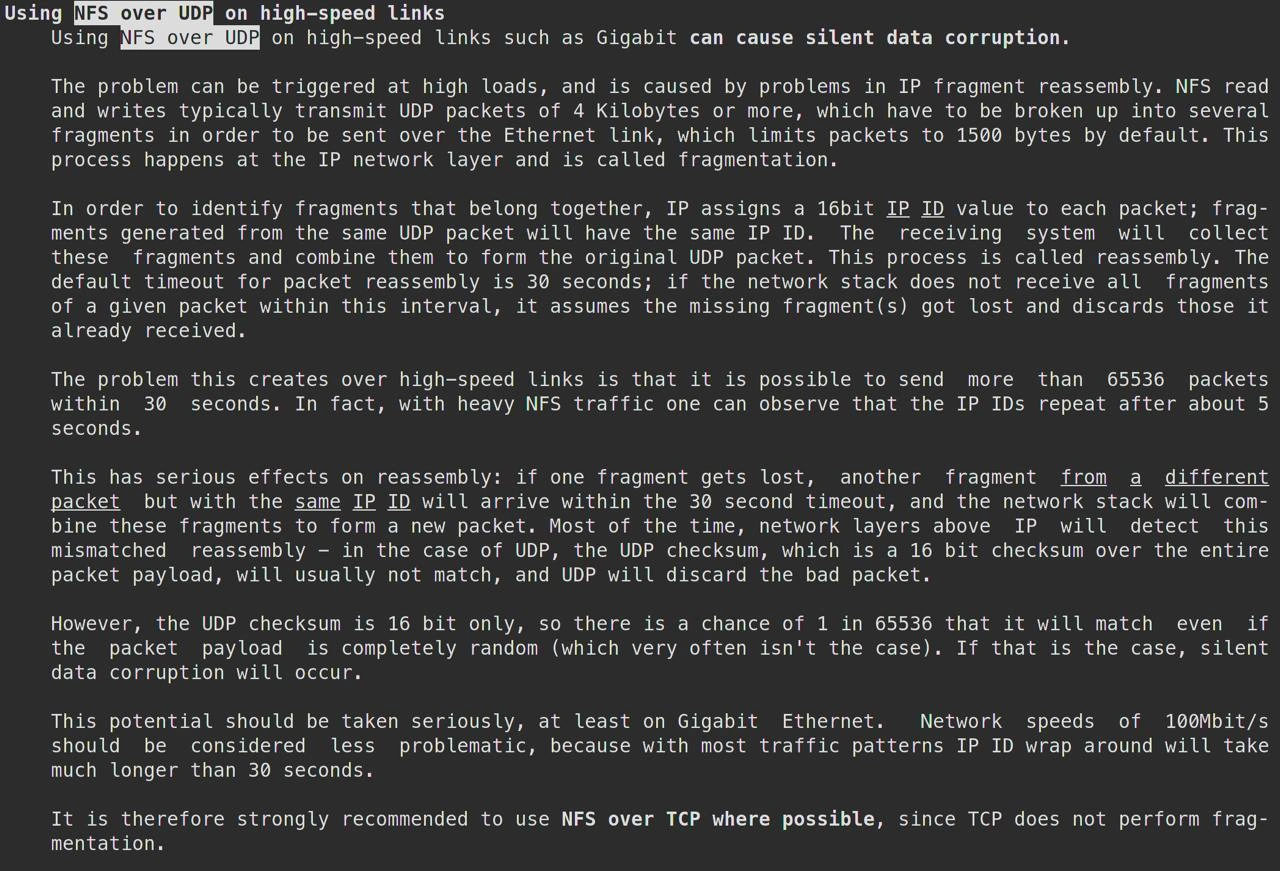
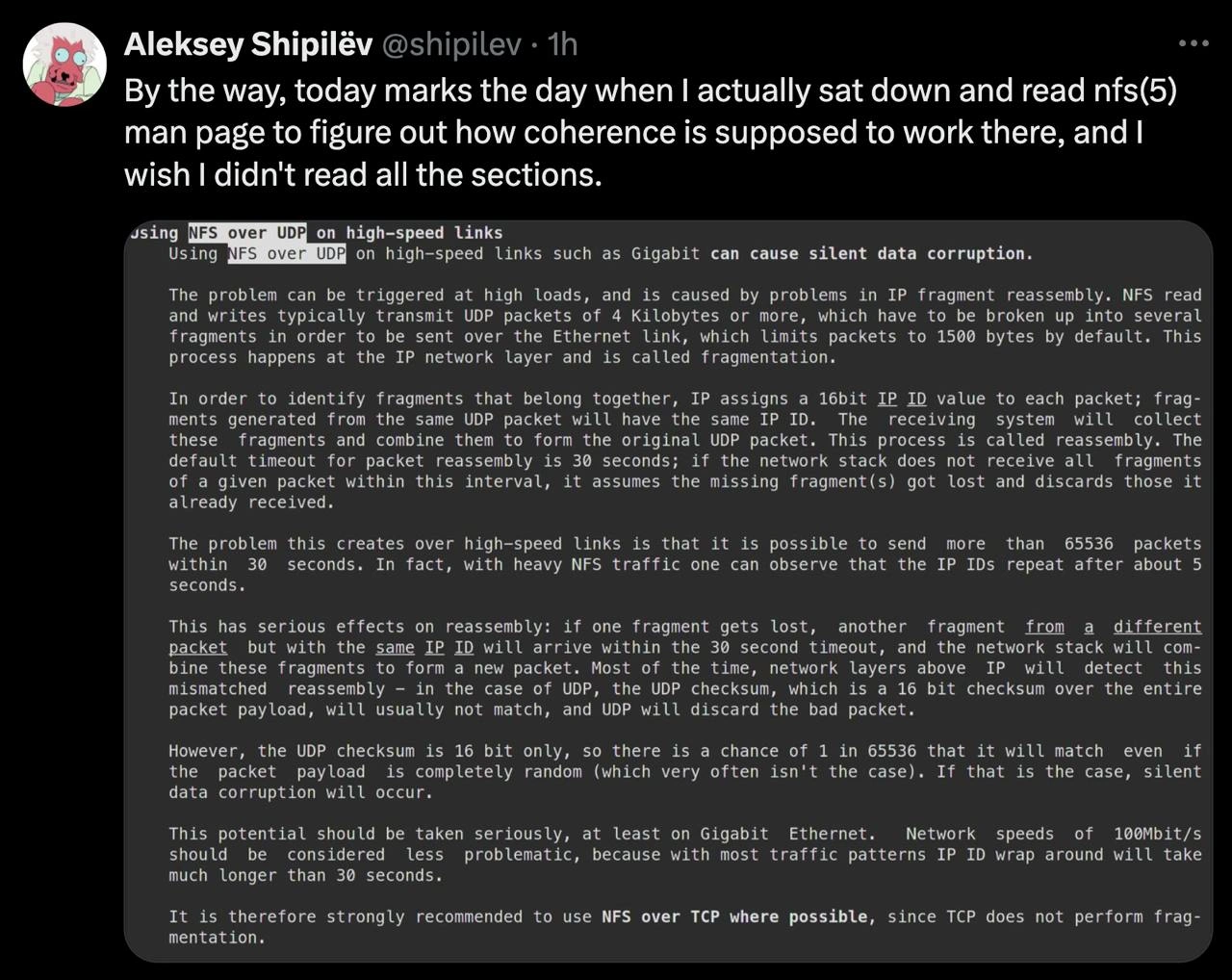
A screenshot of technical documentation detailing a critical flaw in NFS over UDP. The text, under the heading 'Using NFS over UDP on high-speed links,' explains that high-speed networks can cause silent data corruption. The issue stems from IP packet fragmentation, where the 16-bit IP ID can wrap around in as little as 5 seconds on a busy network. This creates a scenario where fragments from different original packets but with the same ID can be incorrectly reassembled. A 16-bit UDP checksum provides a final, but unreliable, check, with a 1-in-65,536 chance of incorrectly validating the corrupted data. The documentation therefore strongly recommends using NFS over TCP instead. This content highlights a deeply rooted, non-obvious failure mode in a widely used, legacy networking protocol


Comments
7Comment deleted
Using NFS over UDP on a 10-gig link is like playing Russian roulette with a 65,536-chamber revolver. It feels fast until one of your packets gets reassembled with fragments from last week's backup
Running NFS over UDP on GigE is like indexing prod with a 16-bit surrogate key - about five seconds in, the network starts JOINing random fragments and your files come back as avant-garde data art
Reading documentation that says "1 in 65536 chance of silent data corruption" and realizing that's basically the same odds as your startup's Series B, except the corruption is guaranteed to happen during the customer demo
Ah yes, NFS over UDP on Gigabit - the networking equivalent of playing Russian roulette with your data, except the chamber has 65,536 slots and you're spinning it every 5 seconds. The 16-bit UDP checksum gives you a 1-in-65536 chance of accidentally accepting corrupted packets as valid, which sounds safe until you realize that's exactly the rate at which IP IDs wrap around on high-speed links. It's the perfect storm: your IP ID counter laps itself faster than a NASCAR race, fragments from different packets arrive with matching IDs, the UDP checksum shrugs and says 'looks good to me,' and suddenly your financial database thinks π equals 3. The real kicker? It's *silent* corruption - no errors, no warnings, just quietly wrong data. This is why senior engineers have trust issues and insist on TCP for anything that matters. Remember: friends don't let friends run NFS over UDP on anything faster than 100Mbit/s
NFS/UDP on GigE: IP frag timeouts silently corrupting files - like mutable shared state in a distributed system, but with 30-second naps
NFS over UDP: IP fragmentation doing a blind join on a 16‑bit key with a 30‑second window - occasionally your files pass the checksum and fail reality
Running NFS over UDP at gigabit is protecting petabytes with a 16‑bit checksum - eventually the dice roll 65536 and you get a ghost write and a very long RCA