
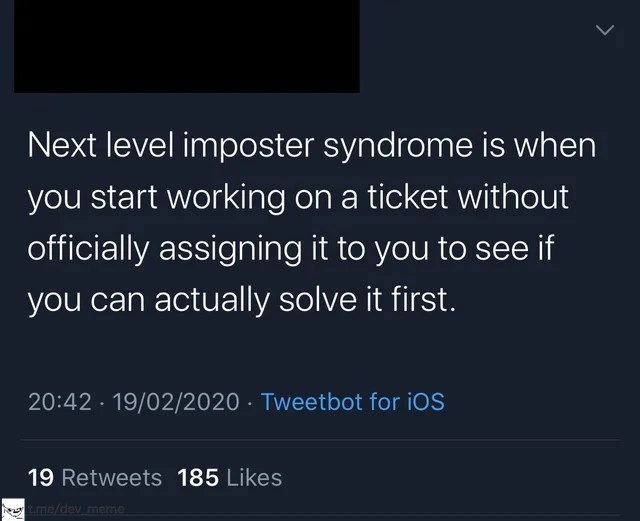
Imposter Syndrome: The Unassigned Ticket
Description
This image is a screenshot of a tweet that reads: 'Next level imposter syndrome is when you start working on a ticket without officially assigning it to you to see if you can actually solve it first.' The tweet, posted on February 19, 2020, captures a deeply relatable behavior for many software developers. It describes the act of secretly tackling a task from a project management tool (like Jira) before publicly claiming it. This is done as a low-risk pre-flight check to validate one's own ability and avoid the potential public failure of getting stuck on a task they've committed to. The humor lies in its specificity and accuracy, defining a subtle but common manifestation of imposter syndrome - the pervasive feeling of being a fraud despite one's accomplishments - within the structured workflow of software development

Comments
7Comment deleted
My workflow? I branch off main, solve the ticket, delete the branch, assign the ticket to myself, and then re-solve it. It's not inefficient if it keeps the 'you're a fraud' voice quiet
Senior-level imposter syndrome is spinning up a secret branch at 2 a.m., canary-deploying the fix, watching the SLO stay green - and only then bravely clicking “Assign to me” in Jira
The real senior engineer move is having three unassigned tickets solved locally, waiting to see which one becomes a P0 incident so you can swoop in like you just started looking at it five minutes ago
The senior engineer's paradox: You've successfully architected distributed systems handling millions of requests, but you still need to privately prove to yourself you can fix a CSS alignment issue before claiming the ticket. It's like running integration tests on your own competence before merging to the 'publicly assigned work' branch
The ultimate dev spike: prototype the ticket in stealth mode before the standup forces a commit
Practicing optimistic locking on self-esteem - don’t acquire the assignee lock until you’re sure you can commit
Imposter syndrome at scale: two-phase commit - prepare the fix under a flag, then assign the JIRA to myself only if the canary and CI reach quorum