
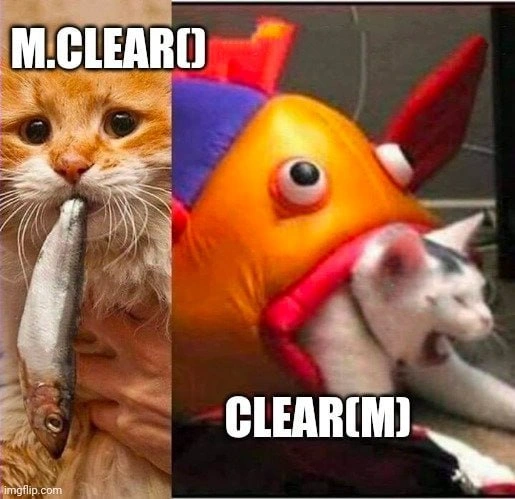
When clear(m) eats more memory than the variable it should free
Description
The meme is a vertical split of two photos. On the left, an orange cat held by a human is proudly gripping a small fish in its mouth. On the right, a bright orange-and-red plush fish toy with bulging eyes has an entire white cat halfway down its maw, comically reversing the predator - prey roles. A bold white caption with black outline at the bottom right reads "CLEAR(M)", and a tiny fragment of text ")" is barely visible near the top. Technically, the image jokes about an over-zealous call to clear() or free() that wipes out far more data than intended - illustrated by the plush fish devouring the cat instead of the cat eating the fish. It resonates with low-level programmers and debuggers who have accidentally nuked memory, triggered segmentation faults, or introduced hard-to-trace bugs through improper resource deallocation
Comments
36Comment deleted
Pro tip for anyone still #defining CLEAR(m): if it expands to memset(heap_base, 0, UINTPTR_MAX), don’t be surprised when the allocator shows up like a plush fish and swallows the rest of your process for dessert
After 20 years of arguing whether it should be m.clear() or clear(m), we finally compromised and made everything immutable. Now nobody's happy, but at least the function signatures are pure
The eternal debate: should the collection clear itself, or should we clear the collection? In OOP languages, m.clear() makes the object responsible for its own cleanup - very self-reliant. But in functional paradigms, clear(m) treats the collection as data to be operated upon. The real question is: when you call m.clear(), does the method belong to m, or does m belong to the method? This meme perfectly captures that moment when you switch languages and spend 10 minutes debugging because you wrote list.clear(m) in Python after a week of writing C's memset(m, 0, sizeof(m))
M.clear(): evict contents politely. clear(M): contents evict you. Mutability's revenge on sloppy APIs
Watching clear(m) in a hot path is feeding your p95 to an inflatable fish - reassign the map unless you don’t actually own the reference
m.clear() keeps capacity; CLEAR(m) keeps only regrets - never trust the all-caps macro that evaluates your argument three times
which lang? Comment deleted
Explain please Comment deleted
same concept different approach Comment deleted
I'm not sure... For example clearing a vector doesn't necessarily empty the memory space it's using Comment deleted
yeah you right Comment deleted
but I haven't seen the expression of this method Comment deleted
and I don't know which lang it is Comment deleted
but generally if the implementation of the method nullifies members it is actually freeing the memory right? Comment deleted
not always too Comment deleted
probably pseudocode Comment deleted
In python x.repr() and repr(x) is exactly the same, as also dir for example So this is definately not python Maybe joke about what we consider as main part of language: object in oop or function in procedural prog Comment deleted
No, not exactly. In Python there are few special behaviours that you can override by methods, such as x.\_\_repr\_\_ for repr(x) or x.\_\_add\_\_ for the + operator. However in Nim x.foo(bar) is just a syntax sugar for foo(bar, x) and it actually works fairly well as you can overload for given types and this subsumes inheritance into subtyping. Edit: Telegram stubbornly interprets underscores as formatting even when there is an explicit formatting, confusing the actual meaning. Comment deleted
Even when I wrap it in code block quotes. Sigh. I give up. Comment deleted
I bet you are an iPhone user. (Because of the bugged link) Comment deleted
Nekogram X. That happened through edits as apparently combining explicit style and inferred from the text makes it miscalculate the positions. Comment deleted
iOS has had it too for a while. Comment deleted
backslash before an underscore to escape it Comment deleted
But that leaves the underscore there. sigh Comment deleted
install a better tg client Comment deleted
What FOSS options are there? I used to be on vanilla telegram-foss and them switched to nekogram x because of better layout. Perhaps desktop does this better. Also *leaves backslashes* ffs, I am sleep. Comment deleted
idk I use the official client Comment deleted
Unfortunately they don't release the source often so telegram-foss builds tend to lag behind and nekogram is even worse at that. OTOH all the new features lately were about "premium" moneymaking nonsense and I chose not to care. Comment deleted
i think owlgram is pretty good and it should be FOSS Comment deleted
I got it Left - method inside, object outside Right - function outside object inside Comment deleted
But dropping it will Comment deleted
Wait this isn’t the same or sm I misunderstanding the meme? Comment deleted
it does the same Comment deleted
Depends on implementation Comment deleted
ig, yeah Comment deleted
It thought it’s the cat’s right rear paw in its mouth Comment deleted