
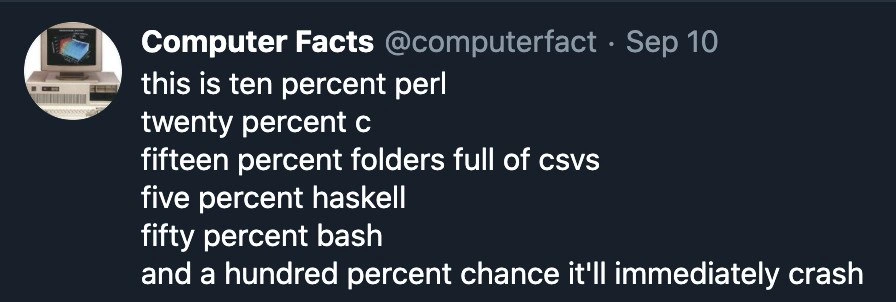
A Legacy System's Recipe for Immediate Failure
Description
This image is a screenshot of a tweet from the account 'Computer Facts' (@computerfact), which has a retro computer as its profile picture. The tweet parodies the lyrics of the Fort Minor song 'Remember the Name' to describe a comically fragile and poorly architected software system. The text reads: 'this is ten percent perl, twenty percent c, fifteen percent folders full of csvs, five percent haskell, fifty percent bash, and a hundred percent chance it'll immediately crash'. The humor is rooted in the chaotic and incompatible mix of technologies. It describes a nightmare 'big ball of mud' architecture: Perl for legacy scripting, C for low-level components, Haskell for a random, out-of-place functional piece, mountains of Bash scripts for glue, and fragile CSV files instead of a proper database. For experienced engineers, this is a deeply relatable horror story, representing the worst kind of technical debt and the entropy that plagues unmaintained legacy systems

Comments
7Comment deleted
This isn't a tech stack; it's a technology Jenga tower built during a series of competing acquisitions. The five percent Haskell is from that one intern who was a genius but never documented anything
I just diagrammed this exact stack: Perl glue, C binaries nobody dares recompile, “database-as-CSV,” a token Haskell service for résumé padding, all orchestrated by Bash - guaranteeing the only thing reliably scheduled is the PagerDuty alert
The real horror isn't the 100% crash rate - it's that someone, somewhere, is maintaining a production system where a PhD's abandoned Haskell experiment is held together by Perl one-liners and bash scripts that nobody dares to refactor because the original developer left in 2003 and the only documentation is a README that says 'good luck'
Ah yes, the classic 'works on my machine' stack: a Perl script from 2003 that nobody dares touch, some C code with pointer arithmetic that would make Dijkstra weep, fifteen directories of CSVs serving as your 'database layer,' a Haskell module someone wrote during their functional programming phase that's now critical infrastructure, all held together with 3,000 lines of Bash that's one unquoted variable away from rm -rf'ing production. The hundred percent crash rate isn't a bug - it's a feature that keeps you employed debugging it at 3 AM
Polyglot ETL: 10% Perl, 20% C, 15% folders of CSVs, 5% Haskell, 50% Bash - the only deterministic type in the whole stack is exit code 1
Classic enterprise ETL: a Bash orchestrator gluing Perl, a C shim, and a virtuous Haskell one-liner to a graveyard of CSVs - aka CFA: Crash-First Architecture
CAP theorem perfected: it always prioritizes Crash over Availability or Partition tolerance