
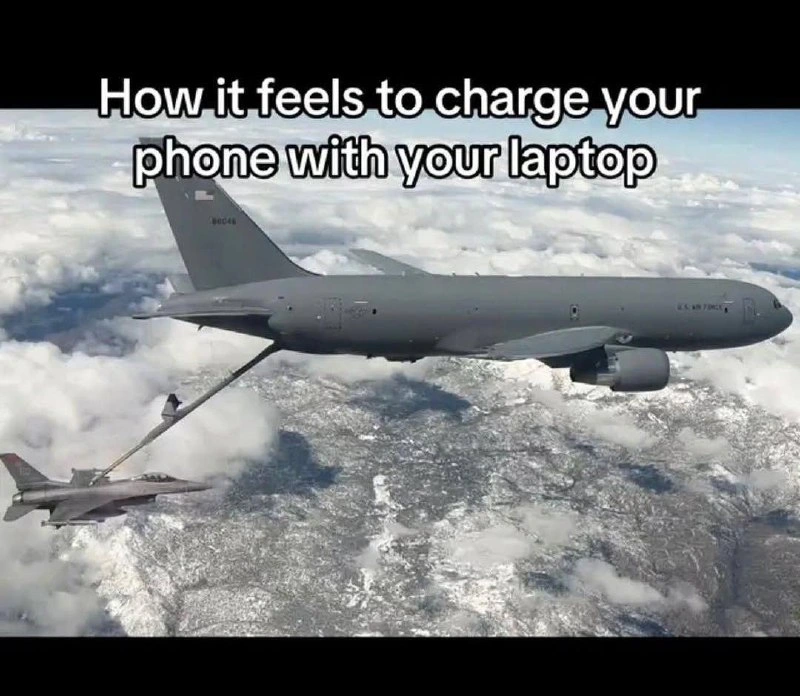
High-Stakes Power Transfer: Laptop to Phone
Description
A photograph showing a large, gray military aerial refueling tanker plane flying high above a snowy, cloud-dusted landscape. A refueling boom extends from the rear of the tanker down to a much smaller fighter jet flying in formation behind it, transferring fuel in mid-air. Overlaid on the top of the image is the white text caption: 'How it feels to charge your phone with your laptop'. The meme creates a humorous and dramatic analogy, comparing the slow, power-draining process of charging a phone from a laptop's battery to a critical, high-precision military operation. It perfectly captures the feeling that the laptop (the tanker) is sacrificing its own vital energy reserves to keep the more mobile but power-hungry phone (the fighter jet) operational, often with a significant cost to its own 'mission endurance' or battery life


Comments
8Comment deleted
My laptop's battery doesn't just experience discharge when charging my phone; it undergoes a full-scale tactical resource reallocation, and my CPU fan starts spinning up like it's preparing for takeoff
Sure, the USB-C PD spec negotiates nicely - until your laptop plays KC-46 tanker and you realise you’ve spun up a c5.24xlarge just to keep an F-16’s cockpit light on
Just like aerial refueling has a 30% fuel transfer efficiency loss, using your laptop's USB-C PD to charge your phone while compiling code is basically running a distributed battery drain algorithm where both devices race to zero, but at least the phone wins
When your laptop becomes a glorified power bank with wings - sure, you can charge your phone, but now you're just redistributing the problem across your device fleet. It's like running a distributed system where both nodes are critically low on resources, and you're hoping the load balancer (your USB-C cable) can somehow create energy from nowhere. Spoiler: thermodynamics still applies, and now both devices are racing to see which hits 5% first
USB‑C PD in practice: a 96Wh laptop burning Docker and Chrome magnanimously offers 5V/500mA so I can get the 2FA SMS - enterprise resource allocation, but for electrons
Charging a phone from a laptop is DR failover for power management - works briefly, then both batteries open an incident
Laptop USB ports: spec'd for data transfer, jury-rigged for power delivery that drains donor faster than recipient fills
And how does it feel when your phone decides to charge your laptop instead?... (true story) Comment deleted