
JavaScript's Unique Interpretation of 'Sorting'
Description
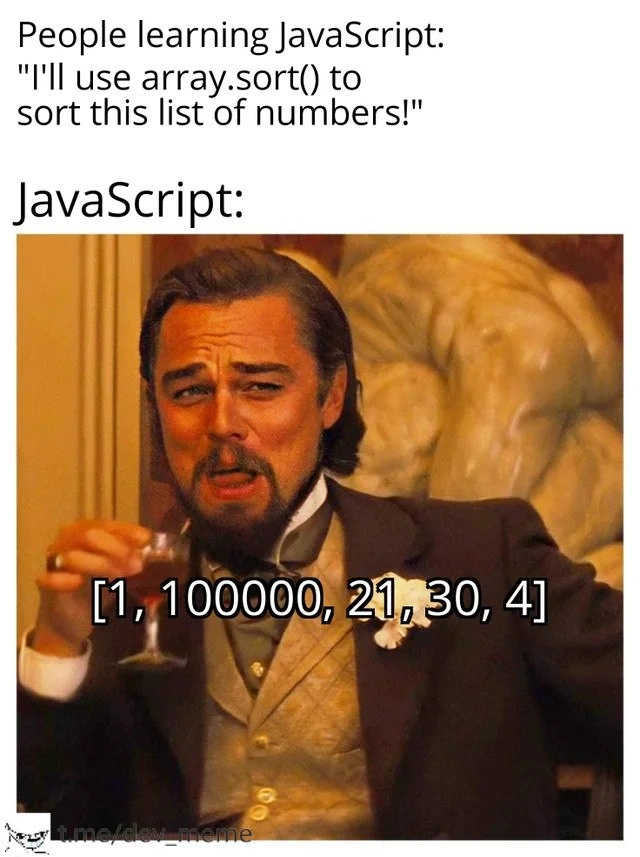
This meme uses the popular 'Laughing Leo' format, featuring a smug-looking Leonardo DiCaprio from the film 'Django Unchained' holding a drink. The meme is divided into two parts. The top text reads: 'People learning JavaScript: "I'll use array.sort() to sort this list of numbers!"'. Below this, the text 'JavaScript:' introduces the punchline. The image of Leonardo DiCaprio has an array overlaid on it: '[1, 100000, 21, 30, 4]'. A small watermark for 't.me/dev_meme' is visible at the bottom. The humor stems from a classic JavaScript quirk where the default `Array.prototype.sort()` method sorts elements lexicographically (as strings) rather than numerically. This results in '100000' coming before '21' because the character '1' precedes '2'. For experienced developers, this is a rite of passage and a well-known 'gotcha' that highlights the language's often counter-intuitive behavior and the importance of providing a custom comparator function (`(a, b) => a - b`) for numerical sorting


Comments
7Comment deleted
The JavaScript `sort()` method is a great interview question. It efficiently sorts candidates into two buckets: those who have been burned by it, and those who are about to be
Array.sort() with no comparator is ECMAScript’s built-in chaos monkey - behaves in unit tests, then lexicographically reorders your revenue numbers at 2 a.m
Twenty years later, we're still explaining to junior devs why their sort comparator needs to be `(a, b) => a - b`, right after we finish explaining why `0.1 + 0.2 !== 0.3` and just before the inevitable "wait, why is typeof null 'object'?" conversation
Ah yes, the classic JavaScript initiation ritual: discovering that array.sort() treats numbers like strings because 'consistency' means everything becomes a string eventually. It's the language's way of teaching you that explicit is better than implicit - usually right after you've deployed to production and your pagination shows page 100000 before page 2. At least it's consistently inconsistent, which is more than we can say for the 47 different ways to define a function
JavaScript’s Array.sort: stable since ES2019; numeric only if you remember a comparator - otherwise 100000 beats 21 on spelling
JS array.sort(): where 1000000 humbly precedes 21, a timeless reminder that your metrics dashboard prefers poetry over arithmetic
Per ES262, sort() compares ToString results - skip the comparator and your “top spenders” dashboard will confidently slot 100000 between 1 and 21; ship (a,b)=>a-b and an ESLint rule