
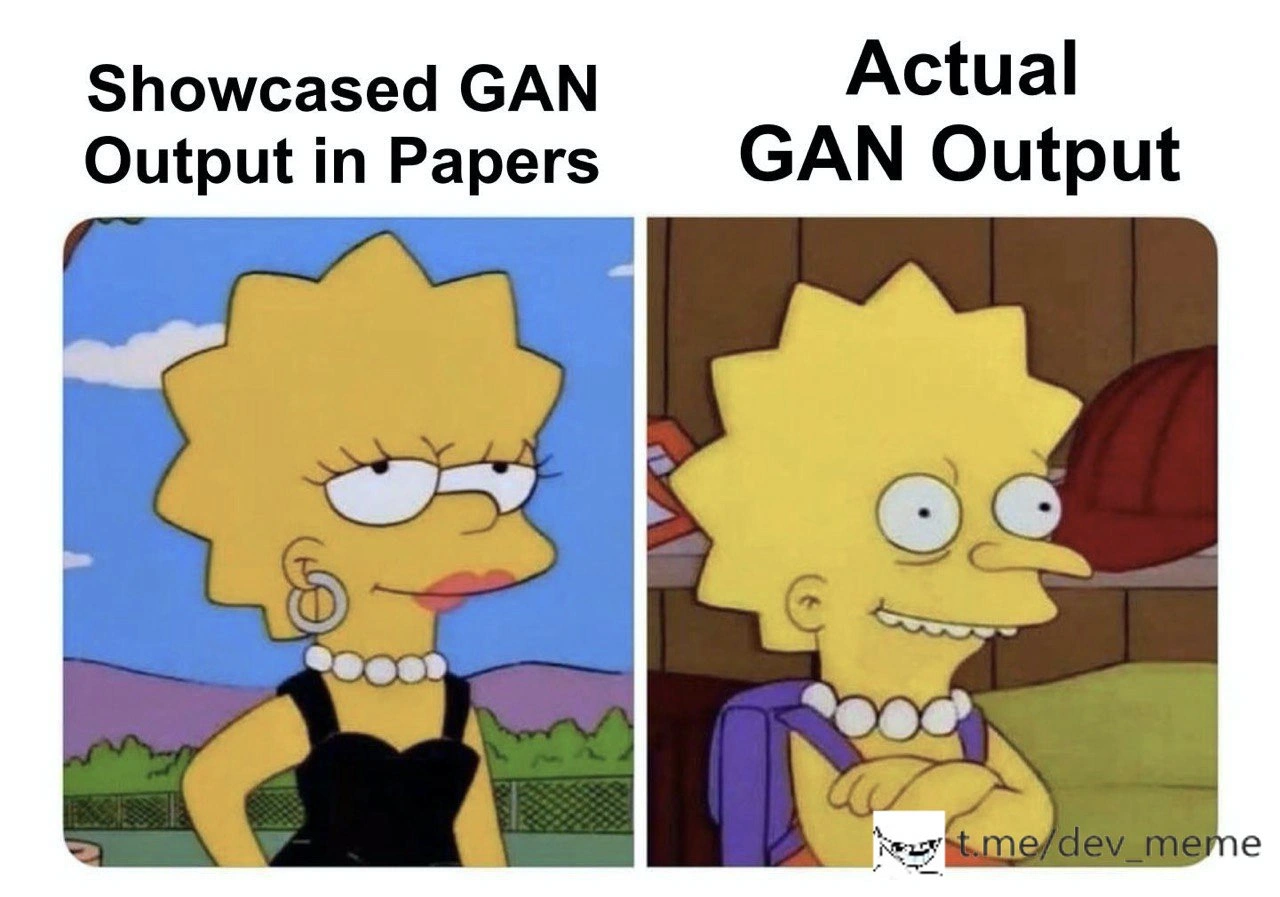
GANs: The Polished Academic Paper vs. The Unhinged Reality
Description
This is a two-panel meme using the 'Lisa Simpson Presentation' format to satirize the gap between academic research and practical application in machine learning. The left panel, captioned 'Showcased GAN Output in Papers,' features a well-known image of Lisa Simpson looking smug, polished, and confident in a black dress and pearls. The right panel, captioned 'Actual GAN Output,' shows a contrasting image of Lisa looking disheveled, wide-eyed, and slightly crazed, with an awkward grimace. A small watermark for 't.me/dev_meme' is visible in the bottom right. The meme hilariously captures the frustration of ML engineers who try to replicate the impressive results of Generative Adversarial Networks (GANs) from research papers, only to be met with chaotic, nonsensical, or downright terrifying outputs. It's a classic 'expectation vs. reality' joke that highlights the cherry-picking of results, the difficulty of training, and the general instability that characterizes many cutting-edge AI models
Comments
12Comment deleted
The GAN in the paper is a super-resolution model that turns a pixel into a photograph. The GAN on my machine is a super-resolution model that turns a photograph into a recurring nightmare
GAN paper: “2.1 FID on a single A100.” Production: cross-eyed Lisa from a lone T4 we stole from the logging cluster - finance called it “adequate GPU coverage.”
After 500 epochs and $10k in GPU costs, you too can achieve the coveted 'mode collapse chic' - where every generated face looks like it's having an existential crisis about whether it's real or fake, just like the discriminator that trained it
This perfectly captures the ML researcher's dilemma: spend 3 months training a GAN, get 10,000 nightmare fuel outputs and exactly 5 photorealistic images - naturally, those 5 make it into the paper while the rest haunt your dreams and your model checkpoints. It's not cherry-picking if you call it 'representative samples,' right?
Every GAN is reproducible - as long as you reuse their exact checkpoint, seed=42, and the undocumented manual cherry-pick layer between the generator and Figure 3
Papers: FID 1.2, NeurIPS-ready. Reality: FID 'fire the data scientist'
GAN papers: truncation trick + aggressive seed shopping = Lisa in haute couture; GAN in prod: mode collapse + distribution drift = Lisa drawn by RNG
So... What's the difference? :-) Comment deleted
What is GAN? Comment deleted
Gay Acceleration Network Comment deleted
gravity-related ambient neuroanalysis Comment deleted
Generative adversarial network https://en.m.wikipedia.org/wiki/Generative_adversarial_network Comment deleted