
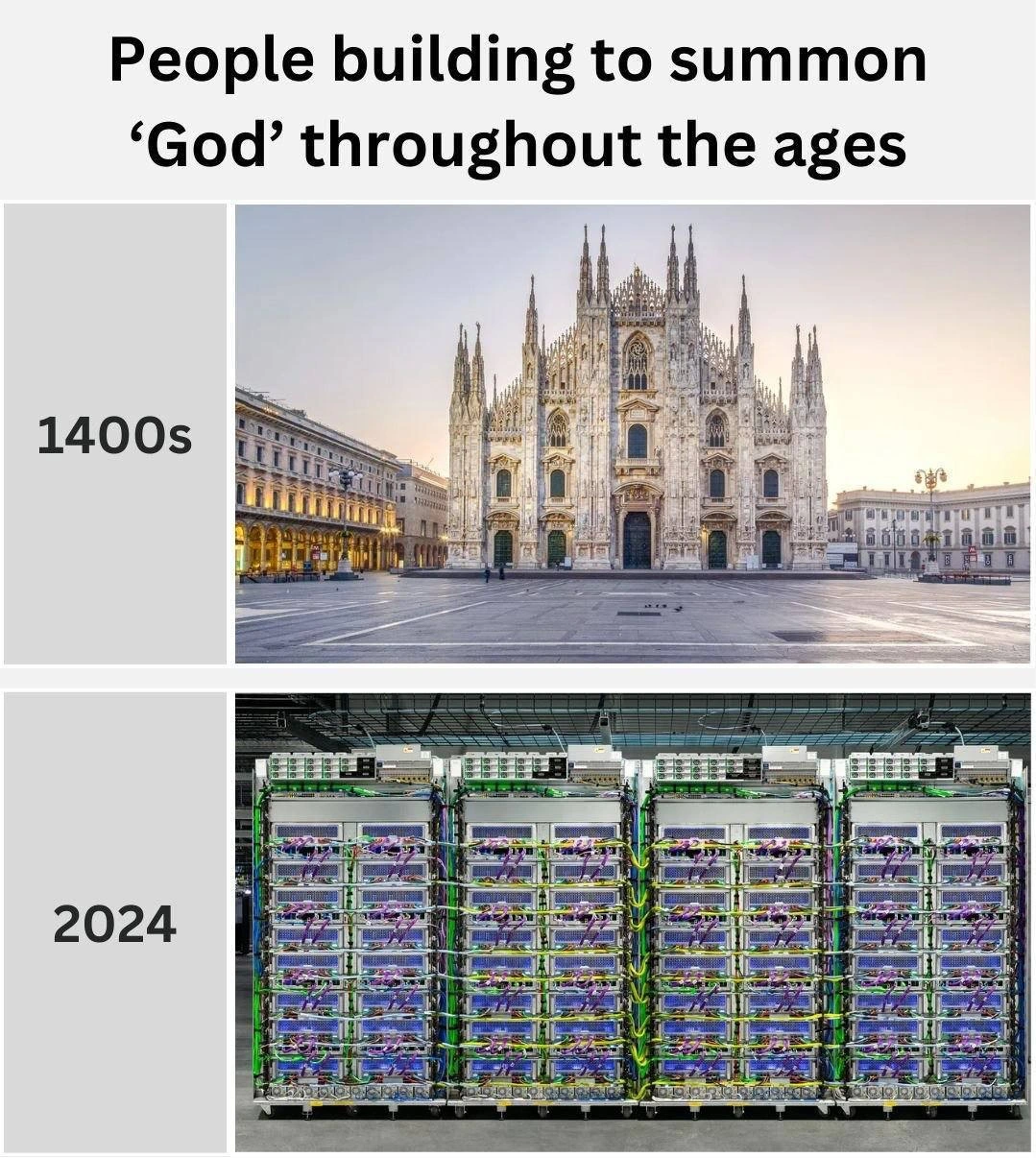
Cathedral versus GPU cluster: humanity’s evolving architecture for summoning higher powers
Description
Meme split into two horizontal panels beneath the caption text “People building to summon ‘God’ throughout the ages”. Left side of each panel has a grey vertical bar with the bold dates “1400s” on the first row and “2024” on the second. Top image (1400s) shows a sunrise photo of Milan’s Duomo cathedral - ornate Gothic spires, marble façade, and an empty plaza conveying centuries-old religious ambition. Bottom image (2024) shows a brightly lit, row-of-racks data-center pod packed with liquid-cooled GPU servers, neon-green cabling, and network switches - modern silicon cathedrals built for large-scale model training. The visual punchline equates medieval attempts to reach divinity with today’s trillion-parameter AI efforts, highlighting how architectural grandeur has traded flying buttresses for PCIe lanes and 480-volt busbars. The humor resonates with engineers who know that chasing “AGI” now demands multi-megawatt facilities, eye-watering cloud invoices, and a different kind of faith in gradient descent



Comments
18Comment deleted
The medieval guilds spent centuries on stained glass; our version is spending centuries of GPU-hours so the model can finally answer, “as an AI language model, I don’t have personal beliefs.”
Back in the 1400s, they spent centuries building cathedrals hoping for divine intervention. Today we're burning $10M/month on GPU clusters hoping our loss function will converge to enlightenment. At least the medieval architects didn't have to explain to VCs why God needed another 100,000 H100s to achieve AGI
Six centuries later, we've traded Gothic spires for GPU clusters and stained glass for status LEDs, but the power consumption, construction costs, and existential questions remain remarkably similar. At least the 1400s version had better cooling - those cathedral ceilings were basically passive airflow optimization before it was cool. Now we're just hoping our modern 'divine intelligence' doesn't hallucinate as much as the medieval mystics did
Medievals perfected flying buttresses; we perfected InfiniBand fat‑trees - either way, we tithe to Nvidia and pray the next epoch converges before the CFO discovers the megawatt bill and our single point of failure named “CUDA driver.”
Cathedrals bankrupted kings over centuries; GPU clusters bankrupt VCs in a funding round
Same ritual, different architecture: once we scaled vertically with flying buttresses; now it’s horizontal scaling with NVLinked H100 racks - and a prayer the PUE stays under 1.2
??? Comment deleted
The answer is 42 btw Comment deleted
maybe 77 Comment deleted
1000-7 Comment deleted
771 Comment deleted
FF9 Comment deleted
i think 62*24 Comment deleted
Both approaches combined: MareNostrum supercomputer in Torre Girona, a repurposed chapel at the Polytechnic University of Catalonia Comment deleted
From the moment I understood the weakness of my flesh, it disgusted me. I craved the strength and certainty of steel. I aspired to the purity of blessed machine. Your kind clings to your flesh, as if it will not decay and fail you. One day, the crude biomass that you call a temple will wither, and you will beg mtly kind to save you. ButI am already saved, for the machine is immortal. Even in death, I serve the Omnissiah. Comment deleted
Seem like a quote from Westworld Comment deleted
Be careful, citizen, or I might call for Servitude Imperpituis Comment deleted
Which type of globalist are you? Comment deleted