
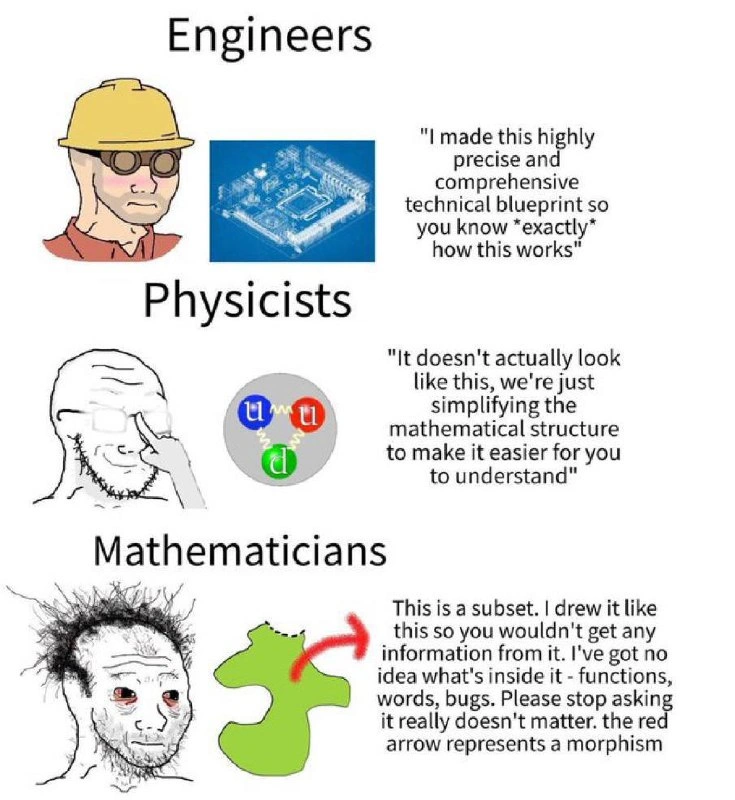
How Different Disciplines Explain Things: From Concrete Blueprints to Abstract Blobs
Description
A three-panel meme using Wojak characters to humorously contrast the explanatory styles of different technical fields. The top panel, labeled 'Engineers', shows a confident engineer with a highly detailed technical blueprint, stating it's to show 'exactly how this works.' The middle panel, 'Physicists', shows a thoughtful academic with a simplified model of a proton's quarks, explaining it's a simplification of the 'mathematical structure.' The bottom panel, 'Mathematicians', features a stressed, disheveled character next to an amorphous green blob, giving a deliberately unhelpful explanation: 'This is a subset. I drew it like this so you wouldn't get any information from it... the red arrow represents a morphism.' The meme satirizes the increasing levels of abstraction, moving from the engineer's concrete reality to the physicist's useful models, and finally to the mathematician's pure, almost comically impenetrable abstractions. For developers, this reflects the different ways systems are understood: from detailed infrastructure diagrams to high-level architectural concepts where the internal implementation is intentionally ignored


Comments
28Comment deleted
An engineer will give you a perfect sequence diagram. A physicist will say it's basically a state machine. The mathematician will just tell you it's a monad in the category of endofunctors and ask why you're still confused
This is why our architecture deck starts with a beautifully rendered system map and ends on slide 42 with one green blob labeled ‘DomainObject ⟶ ???’ - the true enterprise morphism
After 20 years in tech, I've learned that engineers document everything nobody reads, physicists approximate everything to spherical cows, and mathematicians prove things exist without ever showing you where they are - yet somehow we still ship products that mostly work, except when they don't, which is usually because someone assumed their abstraction level was everyone else's reality
This perfectly captures why cross-functional collaboration is so challenging: engineers over-document every implementation detail until you're drowning in UML diagrams, physicists abstract away all the useful information behind elegant but impenetrable models, and mathematicians... well, they've already moved on to proving the documentation itself is undecidable. Meanwhile, the PM just wants to know if it'll ship by Friday
Stakeholder questions are inversely proportional to diagram fidelity - blueprints trigger scope creep, physics-style “not to scale” buys time, and a category-theory blob with a morphism is the only architecture fully backward-compatible with requirements that don’t exist yet
Architecture translation layer: engineers draw the C4, physicists call it a toy model, and the principal reduces it to a morphism prod -> pager that composes nightly
Engineer ships the full monorepo diagram; physicist calls it a Lagrangian approximation; mathematician: Yoneda lemma embedding, peek inside at your peril
you wouldn't usually represent a subset like this if you haven't given it an additional structure of some kind, it has functionally no value. You'd usually use such a drawing for a generic topological subspace, with the red arrow being specifically a continuous function or an homeomorphism Comment deleted
noo not maths in the comments Comment deleted
2+2=5 Comment deleted
*dies* Comment deleted
No politics please Comment deleted
lmao Comment deleted
true for large amounts of 2 Comment deleted
Based Comment deleted
0.1+0.2=0.30000000004 Comment deleted
sorry haha Comment deleted
Also engineers: We dont fucking understand how this shit actually performs under load, neither we dont now how long it can perform without degradation, so we just divide our results by ten and call it a day Comment deleted
"If it works don't touch it" c Comment deleted
in electrical engineering you can buy components with >20% inaccuracy. Comment deleted
yeah can I have uhhh a resistor somewhere between 120Ω and 180Ω? Comment deleted
I love how > 20% technically could be anything, so you could be ordering an E3 150Ω resistor and instead get a 200MΩ resistor, and it'd still be within specifications Comment deleted
At that point you'll specify both the resistance and the tolerance. The point is that if you have >20% tolerance anyway, there's not point asking for values from E12 or E6 Comment deleted
oops. yeah Comment deleted
BTW 150Ω is E6 but not E3 Comment deleted
Intel 13th & 14th generation's vibes here! Comment deleted
meanwhile engineers Comment deleted
pi = 4 Comment deleted