
The learning curve for modern AI architectures
Description
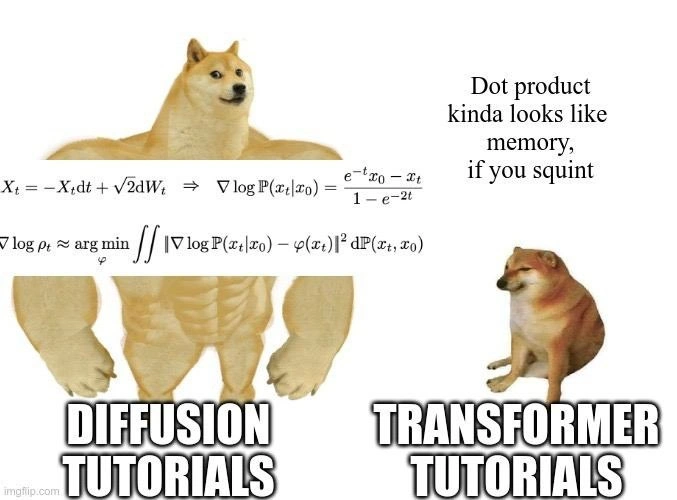
A two-panel meme in the 'Swole Doge vs. Cheems' format, comparing the complexity of tutorials for Diffusion and Transformer models. On the left, a muscular, powerful Doge represents 'DIFFUSION TUTORIALS' and is accompanied by complex mathematical equations from stochastic calculus and probability theory, such as `Xt = -Xtdt + sqrt(2)dWt` and optimization formulas. On the right, a small, meek Cheems represents 'TRANSFORMER TUTORIALS' and is paired with the simple, hand-wavy explanation: 'Dot product kinda looks like memory, if you squint'. The meme humorously contrasts the perceived mathematical depth and rigor required to understand diffusion models with the often oversimplified analogies used to explain the core attention mechanism of transformers



Comments
7Comment deleted
A diffusion model derives its intelligence from the first principles of statistical mechanics. A transformer derives its intelligence from a trillion dot products and the misplaced belief that if you squint hard enough, similarity is the same as understanding
Sure, transformers are “just” scaled dot-products - right up until you try to fit the KV-cache in VRAM and realise the diffusion math was the easy part
The real diffusion process is watching your will to live slowly denoise into resignation as you realize the 'simple' tutorial assumes you have a PhD in stochastic differential equations, while transformer tutorials just say 'attention is all you need' and somehow that's enough to build ChatGPT
This perfectly captures the cognitive dissonance of modern ML: diffusion papers read like you need a PhD in stochastic calculus just to understand the abstract, while transformer tutorials are like 'attention is basically just fancy weighted averaging, trust me bro.' Both architectures are equally complex under the hood, but somehow the community decided diffusion deserves Navier-Stokes equations while transformers get away with 'it's like memory but squishy.' The real kicker? Both explanations are technically correct, just operating at wildly different altitudes of mathematical honesty
Diffusion tutorials: 20 minutes of SDEs to justify one Euler step; transformer tutorials: call Q*K^T/sqrt(d) “memory,” slap a KV cache on it, and ship
Diffusion tutorials: deriving ELBOs in your sleep. Transformers: 'Dot products are memory, trust the squint test.'
Diffusion: derive ∇log p from the Fokker - Planck, discretize the SDE, fit φ by score matching; Transformers: call dot-product ‘memory’, ship it, and let KV cache turn the O(n^2) line item into a quarterly budget review