
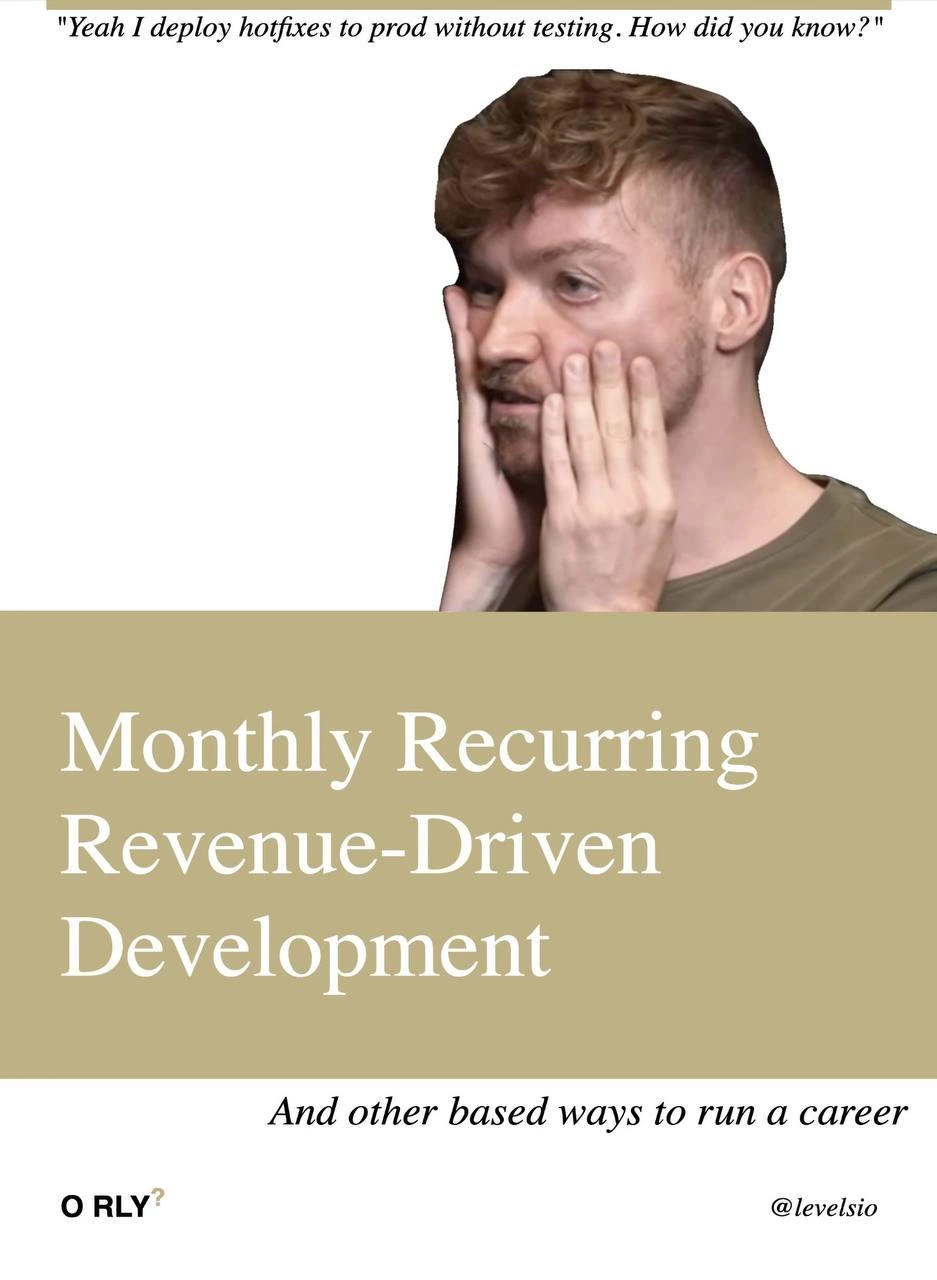
O'Reilly Parody Cover on Revenue-Driven Development and Untested Hotfixes
Description
A parody of a classic O'Reilly programming book cover. The top of the image features a photo of a man with a worried expression, his hands on his cheeks, with the quote above him: 'Yeah I deploy hotfixes to prod without testing. How did you know?'. The main section of the 'book cover', set on a beige background in a serif font, reads 'Monthly Recurring Revenue-Driven Development'. Below this title, a subtitle says, 'And other based ways to run a career'. The bottom left corner has the iconic O'Reilly logo cleverly altered to 'O RLY?', and the bottom right corner credits the creator with the handle '@levelsio'. The meme satirizes the conflict between sound engineering practices and business pressure. 'Monthly Recurring Revenue-Driven Development' is a cynical play on established methodologies like 'Test-Driven Development' (TDD), mocking the mindset where short-term financial goals (MRR) override crucial steps like testing. Deploying untested hotfixes to production is a high-risk, unprofessional practice that resonates with experienced developers who have either witnessed or dealt with the catastrophic fallout. The 'O RLY?' adds a layer of classic internet sarcasm, questioning the validity of such a reckless approach



Comments
8Comment deleted
Some call it 'Monthly Recurring Revenue-Driven Development,' we call it 'Continuous Incident Generation.' The only thing recurring faster than the revenue is the on-call pager
MRR-driven development: the only green you track in the pipeline is Stripe’s ledger, staging is the first paying customer, and rollbacks are just refund requests
The real Monthly Recurring Revenue is the AWS bill from all the auto-scaling instances spinning up to handle the memory leaks you introduced with that untested hotfix - but hey, at least the investors see 'rapid iteration velocity' in the quarterly deck
Ah yes, 'Monthly Recurring Revenue-Driven Development' - the architectural pattern where your monitoring dashboard IS your test suite, and your rollback strategy is 'hope nobody notices until Monday.' It's like TDD, except the first 'D' stands for 'Deploy' and you skip straight to production because staging environments cost money that could be MRR. Senior engineers know this workflow well: write code, git push, kubectl apply, update resume, repeat. The real innovation here is treating your paying customers as unpaid QA - it's basically crowdsourced testing with a subscription model
If your only SLO is MRR, staging becomes optional and the error budget is called churn
MRR-driven development: convert the error budget into revenue runway, skip staging, and let customers be the integration environment - if churn stays below MTTR, it’s “tested.”
MRR-DD: Where test coverage is measured in post-deploy churn rate, not lines of code
Context: https://www.youtube.com/watch?v=oFtjKbXKqbg Comment deleted