
The Unholy Alliance of CSS Vertical Alignment and Existential Dread
Description
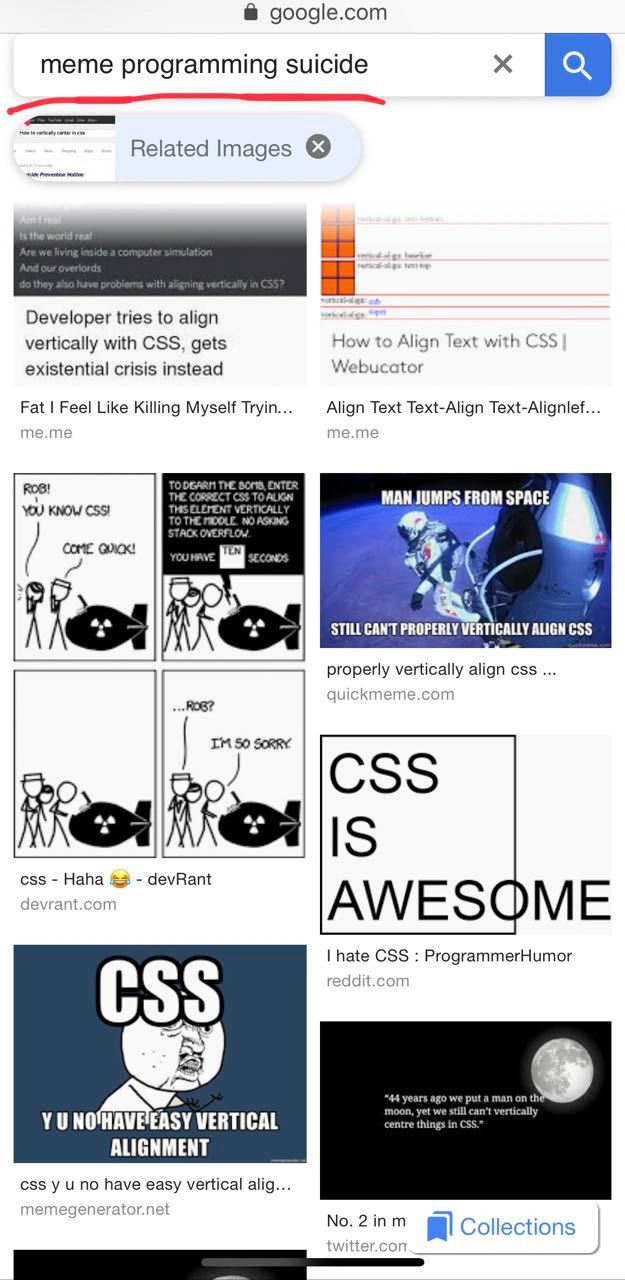
A screenshot of a Google image search results page, taken on a mobile device. The search query in the bar at the top reads 'meme programming suicide', which is underlined in red, likely a spell-check artifact. The page displays a grid of various tech-themed memes, with the common thread being the extreme frustration associated with vertically aligning elements in CSS. Some visible meme titles or captions include 'Developer tries to align vertically with CSS, gets existential crisis instead,' 'MAN JUMPS FROM SPACE, STILL CAN'T PROPERLY VERTICALLY ALIGN CSS,' and a comic where a character fails to disarm a bomb because the instructions require CSS knowledge. This meta-meme captures the historical and cultural pain point within the web development community surrounding CSS layout challenges. It humorously implies that the difficulty of vertical alignment is so profound that it drives developers to dark thoughts, as evidenced by the search query itself and the resulting collection of memes



Comments
7Comment deleted
They say modern CSS with Flexbox and Grid has solved vertical alignment. And yet, every senior dev still has a moment of cold-sweat-inducing PTSD when a designer says 'Can you just nudge that up a little bit?'
We’ve shipped micro-frontends at scale, but the real zero-downtime migration will be the day we retire ‘margin-top: 50%; transform: translateY(-50%);’ from muscle memory
The real tragedy isn't that CSS vertical alignment was hard - it's that we spent years defending our table-cell hacks and negative margin calculations in code reviews, only to watch junior devs solve it with 'display: flex; align-items: center;' and wonder what all the fuss was about
The fact that 'meme programming suicide' autocompletes to CSS vertical alignment issues tells you everything about the collective trauma of an entire generation of frontend developers who lived through the pre-flexbox dark ages. We've sent rovers to Mars, trained neural networks to generate art, and built distributed systems spanning continents - yet for decades, centering a div vertically required either table hacks, absolute positioning with negative margins, or sacrificing a rubber duck to the browser gods. The real kicker? Modern solutions like flexbox and grid made it trivial, but the PTSD remains so strong that senior engineers still instinctively reach for `display: table-cell` before catching themselves
Before Flexbox, vertical centering was CSS’s CAP theorem: pick any two of pixel‑perfect, cross‑browser, and maintainable - the third involved a summoning ritual with translate(-50%, -50%)
CSS vertical centering is the distributed consensus of layout: you can have align-items:center, legacy support, and pixel-perfect design - pick two
CSS vertical centering: flexbox solved it for 95% of cases, leaving 5% to haunt your dreams like unmerged feature branches