
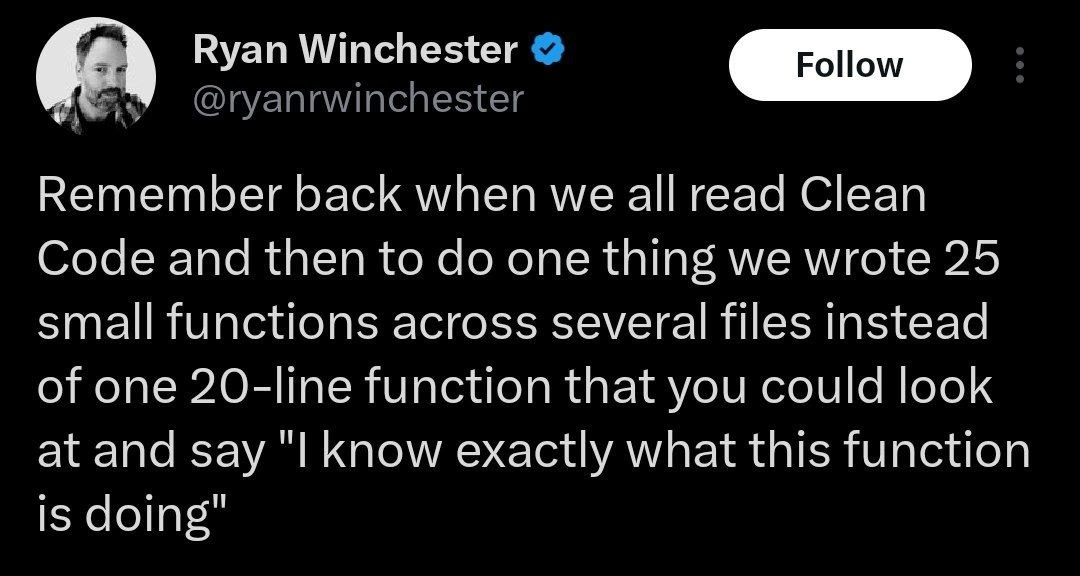
Clean Code's legacy: 25 functions to do the work of one
Description
A screenshot of a tweet from Ryan Winchester (@ryanrwinchester) on a black background. The tweet reads: 'Remember back when we all read Clean Code and then to do one thing we wrote 25 small functions across several files instead of one 20-line function that you could look at and say "I know exactly what this function is doing"'. This post humorously critiques the dogmatic application of principles from the popular software development book 'Clean Code' by Robert C. Martin. The joke resonates with experienced developers who have witnessed or participated in over-engineering where the effort to create 'clean' code, by breaking down functions into minuscule, single-purpose units, ironically results in a codebase that is harder to follow due to excessive fragmentation and indirection, compared to a slightly longer but self-contained and immediately understandable function


Comments
7Comment deleted
Applying 'Clean Code' too literally is how you end up with a call stack deep enough to be a microservices architecture
PagerDuty went off, I hit “Go to Definition,” and five minutes later I’d depth-first-searched 27 one-line helper methods across six packages - turns out the real bug was still in the catch block of the original 20-line function we refactored for “readability.”
The junior who refactored your 20-line function into 25 files just got promoted to architect for "demonstrating deep understanding of SOLID principles" while you're still debugging their AbstractFactoryFactoryBuilder
Ah yes, the classic Clean Code journey: from writing God objects to creating a distributed microservices architecture just to calculate a sum. We've all been there - religiously applying SOLID principles until our 20-line function becomes an archaeological dig across 8 files, 3 interfaces, 2 abstract classes, and a factory pattern. The real clean code was the cognitive overhead we accumulated along the way. Turns out, sometimes a straightforward function that does exactly what it says on the tin beats a beautifully abstracted maze that requires a PhD in your own codebase to understand
Clean Code's SRP: Transforming a glanceable 20-liner into a 25-file call graph that demands a debugger just to grok
After “Clean Code” we turned a clear 20‑liner into 25 SRP helpers; complexity didn’t vanish - it just relocated to indirection and a stack trace that needs pagination
Clean Code said one function per idea; now my Go to Definition key has the worst P99 in the org - compilers inline, humans just thrash their L1 instruction cache