
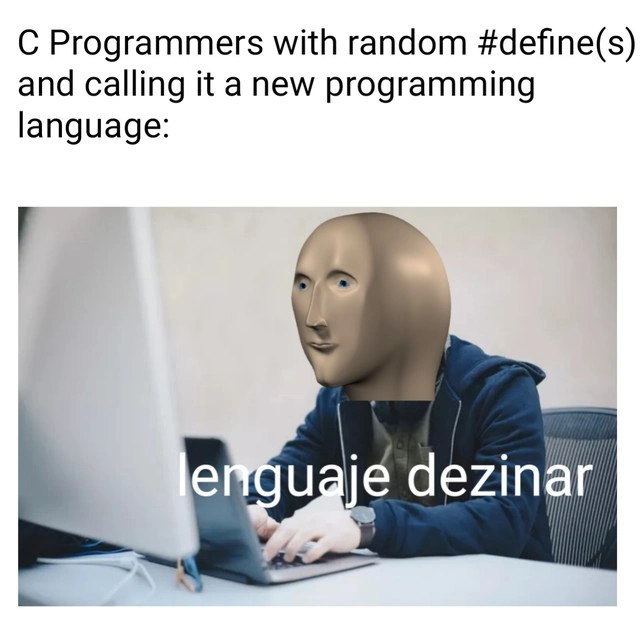
When C macros spawn yet another totally ‘new’ programming language
Description
The meme is a two-panel layout. Top white space contains black text reading: “C Programmers with random #define(s) and calling it a new programming language:”. The lower panel is a stock photo of a hoodie-wearing person typing at a desktop computer; the face has been blurred for anonymity. Super-imposed in large white text across the photo is the deliberately misspelled phrase “lenguaje dezinar”, mocking the idea of grand ‘language design’. Technically, the joke pokes fun at C developers who abuse the #define pre-processor to rename keywords and macros, effectively creating a confusing pseudo-DSL and claiming it’s an entirely new language. It highlights meta-programming excess, over-engineering, and the endless cycle of inventing ‘fresh’ languages by simply aliasing existing syntax

Comments
8Comment deleted
Shipping a 4,000-line header of #defines and calling it a language is the C equivalent of rebranding your monolith as “microservices” - the taxonomy changes, the segfaults stay
Every legacy codebase has that one file where someone tried to make C look like Pascal with #defines, and now the debugger just shows you preprocessor output that looks like it was written by an alien civilization trying to communicate through regex
Ah yes, the classic C programmer's rite of passage: discovering #define and immediately architecting a 'revolutionary' DSL that's just 47 nested macros pretending to be syntax sugar. Bonus points if it includes token pasting (##), stringification (#), and variadic macros (__VA_ARGS__) to create something that looks like Python but debugs like a war crime. The compiler error messages alone could serve as a Turing test - if the developer can decipher 'expected ; before } token' on line 1 when the actual error is in macro expansion 12 levels deep, they've truly ascended. Meanwhile, the next maintainer opens the codebase, sees X-macros and computed gotos wrapped in preprocessor conditionals, and quietly updates their résumé
C macros: the original transpiler, turning token pasting into 'elegant' syntax no one else can read
Ship a “new language” in a header with #define, and suddenly your type system is include order and your debugger is grep
Designing a “new language” with 400 lines of #define just gives you a DSL with zero tooling, negative maintainability, and perfect FFI with C - because it’s still C
😂😂😂😂 Comment deleted
There are some *wild* ones out there. Generally recommend looking some up. Pascal/ALGOL style keywords were popular back in the early days. (I think old ksh was written this way). And then promptly forgetting about all that, possibly with a bottle of vodka to help. Comment deleted