
ArXiv Paper: Language Symmetry Shapes LLM Representation Geometry
Description
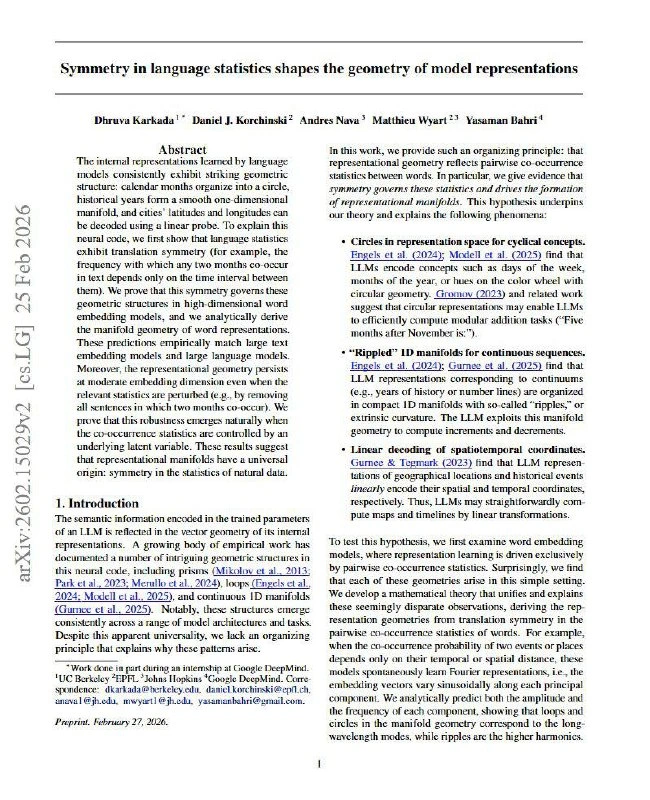
A screenshot of the first page of an arXiv preprint (arXiv:2602.15029v2 [cs.LG], 25 Feb 2026) titled 'Symmetry in language statistics shapes the geometry of model representations' by Dhruva Karkada, Daniel J. Korchinski, Andres Nava, Matthieu Wyart, and Yasaman Bahri (affiliations include UC Berkeley, EPFL, Johns Hopkins, Google DeepMind). The two-column page shows the abstract and introduction, arguing that LLM internal representations form striking geometric structures - months organized into circles, historical years on smooth one-dimensional manifolds, latitudes/longitudes decodable with linear probes - because symmetry in pairwise co-occurrence statistics governs the manifold geometry of word embeddings. Bullet points cite findings on circular representations for cyclical concepts (days of week, months), 'rippled' 1D manifolds for continuous sequences, and linear decoding of spatiotemporal coordinates via Fourier components. Interpretability research catnip: formal confirmation that the model literally learned that time is a circle



Comments
25Comment deleted
Billions of parameters and gradient descent later, the model independently rediscovered the clock face - peer review pending on whether it also learned the calendar has a Q4
The stochastic parrot didn't understand the calendar; it just accidentally learned Fourier analysis.
ok Comment deleted
Thanks for the dose of horrors beyond our comprehension before sleep Comment deleted
the caption but unironically Comment deleted
year 2026, ai bro just discovered how embeddings work Comment deleted
so what? Comment deleted
Same as in our brain, just access mechanism differs. So what? I cannot torture a non human being? Comment deleted
Wasn't roughly this known since like simple GPTs and tokenized word banks? You could find a dimension in weights of words which effectively encodes "gender", and then take a vector in that dimension from "brother" to "sister", then apply the same vector to "father" and get "mother"? Comment deleted
This is the latent space. Theoretically embedding just allow you to map words to numbers and plot distances between them. This is how the words are used in internal reasoning. LLM’s have learned from training data, for example, that the year is a circle, even though that doesn’t make any sense on a surface level. Comment deleted
need to actually read le paper this dropped today too https://arxiv.org/abs/2603.05122 Comment deleted
Not to this extent Comment deleted
What's so special this time? Comment deleted
😳 Comment deleted
Oh, hi there! Comment deleted
You expect me to read all this shi? Comment deleted
That’s just a fucking statistics. Comment deleted
First you say "that's just a fucking tweet", now this, how do we even make you believe things? You gonna listen to whispers of sirens in a forest? (I'm not an FBI agent, trust me on this) Comment deleted
Believe in what exactly? That there’s some kind of divine or sentient entity behind these statistics? Comment deleted
If our month names weren’t cyclical (if after December there’s wasn’t January but rather some shit like Elevenary, then Twelvery, and so on), then I bet the months names would’ve formed a linear manifold, same as years. Comment deleted
that's like saying earth orbit isn't circular, but a spiral and it's never crossing same point twice. It's true, but is that what matters? Comment deleted
but stochastic processes usually form patterns. what's so surprising? Comment deleted
so, LLMs being trained to be stochastic parrots of human data and mirroring ways that humans imagine continuity becomes a proof of them memorizing with understanding… how, exactly? Comment deleted
Nothing sensational in it. Still a stochastic parrot. Comment deleted
For more enlightment I suggest actually trying to read how even months have originated. People always knew cycle of seasons, however to track them more accurately they couldn't rely on just days because it would cause deviations. Agricultural societies started using lunar observations to track the months, and calculated that 12 months roughly fit into a whole solar year (notice how solar years are still a superior measure) Comment deleted