
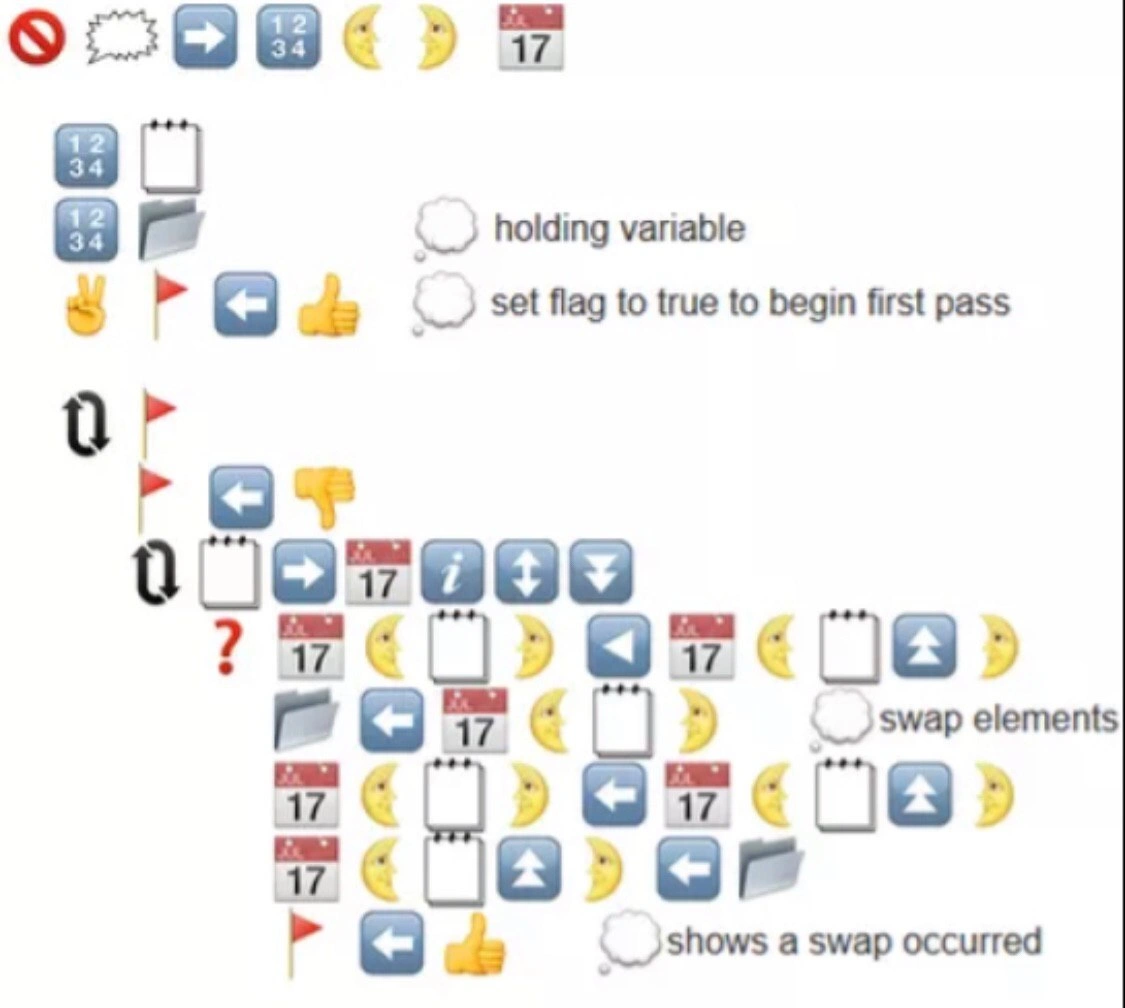
The Bubble Sort Algorithm in Emoji
Description
This image presents a creative and complex visualization of a sorting algorithm, likely an optimized bubble sort, constructed almost entirely from emojis. The flow of logic is depicted using various emoji symbols for loops (repeat symbol), variables (blank page, folder), conditions (question mark), and state (red flag, thumbs up/down). Text annotations in thought bubbles clarify key operations: 'holding variable', 'set flag to true to begin first pass', 'swap elements', and 'shows a swap occurred'. The structure suggests a do-while loop that continues as long as swaps are being made, which is a common implementation of bubble sort. This is a form of visual code or a logic puzzle, representing a fundamental computer science concept in a highly unconventional medium. The humor and appeal for senior developers come from the novelty and the mental exercise of deciphering a familiar algorithm presented in a completely new, symbolic 'language'. It's a testament to the abstract nature of programming and the creative ways developers find to express logical concepts
Comments
8Comment deleted
Finally, a universal programming language. The only problem is that code reviews are just arguments over which emoji best represents a boolean
Turns out the real cost of emoji bubble-sort isn’t O(n²) runtime - it’s O(senior²) reviewers per PR just to decode why “🌙 ➡️📅17” means swap
When you spend three days optimizing a sort that runs once at startup on 50 items, but the emoji documentation gets more praise in the architecture review than your O(n log n) implementation
Finally, a language where the code review feedback and the code are written in the same alphabet - and the red flag is a declared variable instead of the entire architecture
When your algorithm explanation gets so abstract that you resort to emoji-driven pseudocode, you know you've either achieved peak pedagogical innovation or you're one PR away from your team staging an intervention. But hey, at least the calendar emoji accurately represents how long it takes junior devs to grok two-pointer techniques - roughly 17 iterations of 'wait, which pointer moves when?'
Emoji bubble sort: still O(n²) and in-place - now with literal red flags and code reviews that scale at O(eyes²)
Bubble sort's swapped flag: the boolean that optimistically dreams of early exit, yet dooms you to quadratic purgatory anyway
Bubble sort in emoji: the swap flag is 👍 - which is also how it passed code review; runtime O(n^2), comprehension O(n^2) meetings