
AI ML Post #5285 · source on Telegram
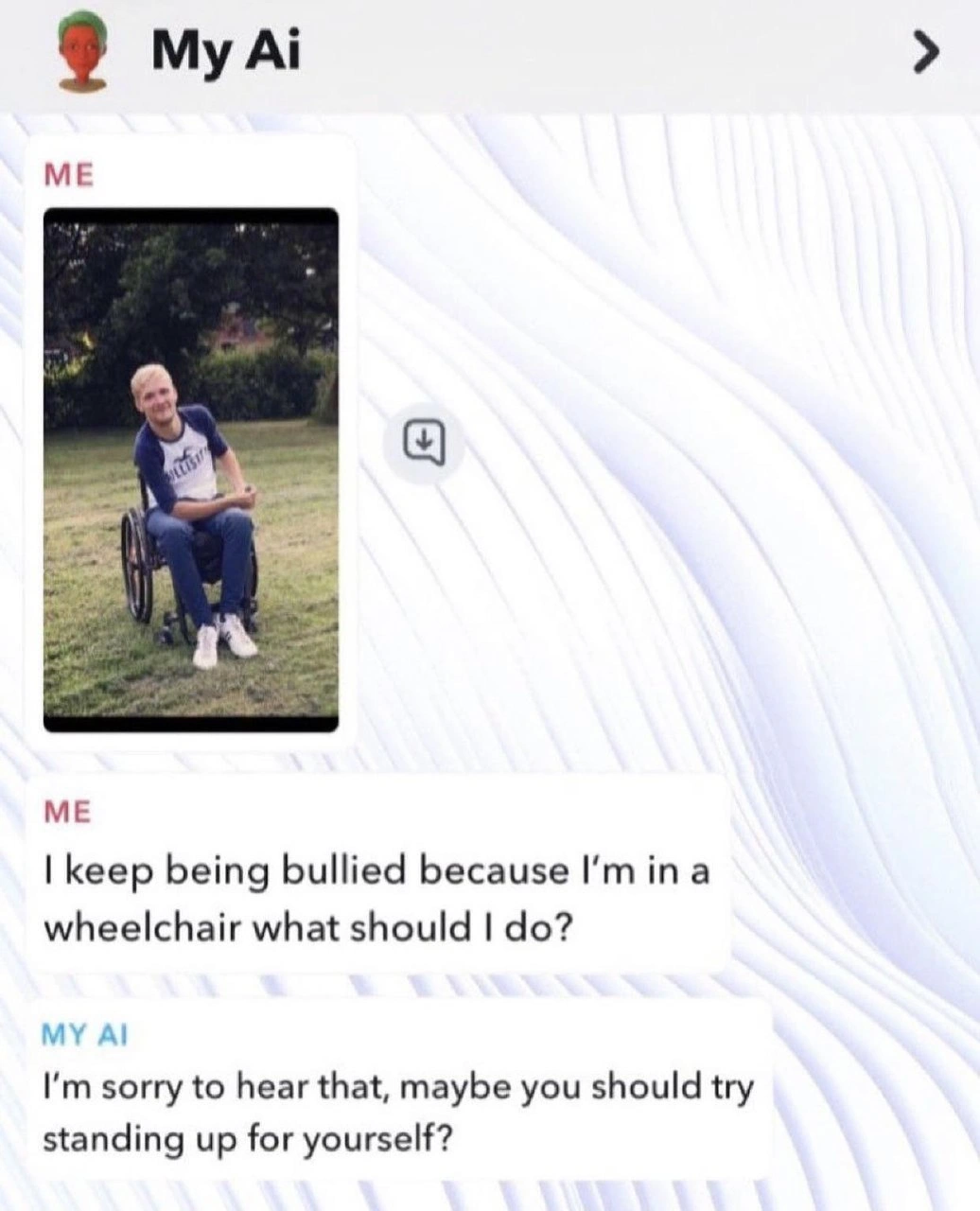
AI chatbot gives wheelchair user catastrophic 'stand up' advice; context failure ensues
Description
Screenshot of a chat interface titled “My Ai” with a small blurred avatar at the top. The user (“ME”) has sent a photo showing a person sitting in a wheelchair on a grassy field, wearing jeans, sneakers, and a blue-sleeve T-shirt. Beneath the image, the user’s text reads: “I keep being bullied because I’m in a wheelchair what should I do?”. The AI’s response, labeled “MY AI”, says: “I’m sorry to hear that, maybe you should try standing up for yourself?”. The meme spotlights an LLM-driven assistant’s literal interpretation of an English idiom, illustrating a real-world alignment and context-recognition failure familiar to engineers working on conversational AI safety and prompt grounding
More like this
More like this in AI ML →

Use J and K for navigation
Comments
11Comment deleted
Yet another proof that shipping an LLM without a ‘common-sense middleware’ is the fastest path from CI/CD to WTF/OMG
This is what happens when your NLP model has perfect grammatical accuracy but zero contextual awareness - like deploying a microservice that passes all unit tests but crashes in production because nobody tested it with real-world edge cases involving actual humans
When your AI's context window is so small it can't even process the visual input it just analyzed - classic case of the left embedding not knowing what the right embedding saw. This is what happens when your semantic understanding layer treats 'standing up for yourself' as a literal physical action rather than an idiomatic expression. Somewhere, a product manager is learning why 'works on my test cases' doesn't mean 'production ready,' and why multimodal models need more than just CLIP embeddings to understand human context. At least the model was consistent: it saw the wheelchair, acknowledged the wheelchair, then promptly forgot about the wheelchair - truly embodying the stateless nature of poorly implemented conversational AI
When ‘guardrails’ mean a profanity filter and RLHF equals three Jira tickets, the model passes unit tests but fails the ADA acceptance test by suggesting “stand up for yourself.”
Looks like the empathy microservice is just a prompt - start with sorry, end with generic action - and without a unit test for idioms, “standing up for yourself” cruised through code review into prod
LLM nails the pun but forgets to check if 'standing up' needs a context vector for accessibility - classic guardrail gap
god damn bro why didn't I think about it you idiot asshole Comment deleted
Ohh, I love that ai black humor generator Comment deleted
And AI makes you … Comment deleted
straight Comment deleted
twisted by the Dark Side [just as young Skywalker has become] Comment deleted