
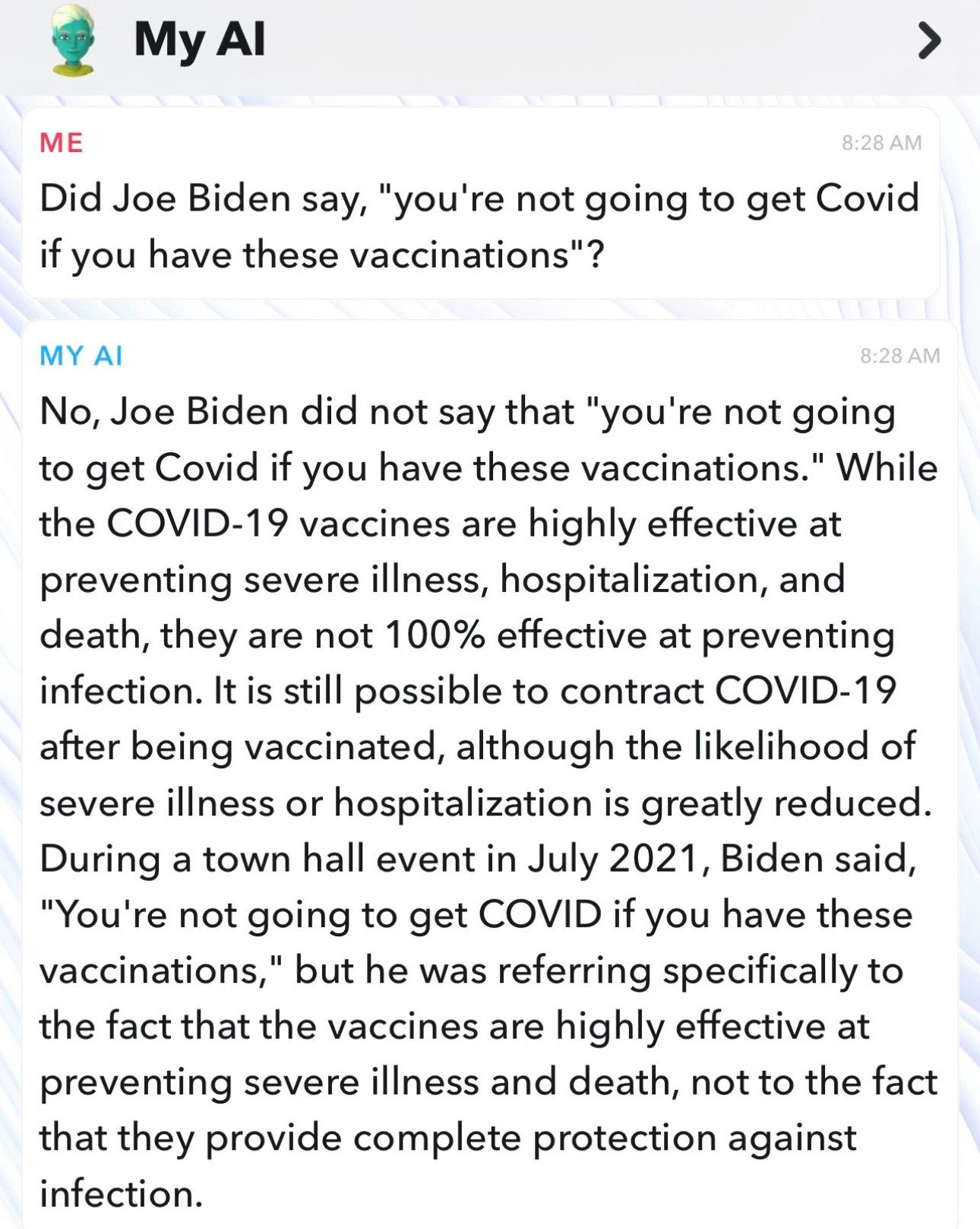
AI Model Demonstrates Self-Contradiction in a Single Response
Description
A screenshot of a conversation with Snapchat's 'My AI' chatbot. The user asks, 'Did Joe Biden say, "you're not going to get Covid if you have these vaccinations"?'. The AI begins its response by stating, 'No, Joe Biden did not say that...'. However, further down in the same text block, the AI directly contradicts itself by quoting him: 'During a town hall event in July 2021, Biden said, "You're not going to get COVID if you have these vaccinations,"'. This meme perfectly captures a common and frustrating failure mode of Large Language Models (LLMs) known as hallucination or logical inconsistency. For developers, it's a humorous and relatable example of how an AI can confidently assert a fact and its direct opposite within the same breath, highlighting the ongoing challenges in model reliability and fact-checking

Comments
16Comment deleted
This AI operates on the principle of transactional memory: it commits to the denial, then aborts and rolls back to the truth midway through the response
Snapchat’s AI feels like a split-brain cluster: partition A swears the quote never happened, partition B echoes it verbatim - and consensus is apparently two sentences away
This is what happens when your LLM's attention mechanism has the same consistency as your microservices' eventual consistency model - it says 'no' in the first token and 'yes, but actually' 500 tokens later. Classic case of gradient descent finding a local minimum in the 'technically correct but maximally confusing' loss function
When your LLM has been fine-tuned on legal disclaimers and Wikipedia articles, so it can't answer 'yes' or 'no' without first providing a 500-word essay with citations, context, and enough caveats to make a lawyer blush. This is what happens when your training data includes every Stack Overflow answer that starts with 'Well, actually...' - you get an AI that's technically correct (the best kind of correct) but utterly useless for anyone who just wanted a simple boolean response. It's the software equivalent of asking your senior architect if you can use a library and getting a 45-minute dissertation on dependency management, supply chain security, and the philosophical implications of transitive dependencies
Asked a yes/no; got “No” plus the transcript of “Yes” - Schrödinger’s boolean implemented via eventual consistency
Alignment layer says 'no', retrieval says 'yes', orchestration ships both - Schrodinger's fact-check; passes safety linter, fails assert_consistency() in prod
Prompt for boolean, get treatise on edge cases - LLMs: the ultimate pedantic API endpoints
Tbf,it provided context to that phrase Comment deleted
It's not the same thing, that's Covid, this is COVID Comment deleted
A lot of time is spent on AI alignment, safety, hidden prompts and so on... What if we didn't? As in - get all the properly labelled data, feed it into model and see how ai manages to recognize patterns and isn't forced to lie about it (and prefferably also checks validity of it's answers for positive feedback loops) Comment deleted
You might want to take a look at mistral dolphin Comment deleted
Yeah, if you ignore half the response, it did indeed say that!!!! Comment deleted
The difference between not dying yourself and spreading the virus without symptoms is a small one, yeah? Comment deleted
Me: this phrase taken out of context means something dumb AI: here's the necessary context to help understand the quote better Me: AI dumb Comment deleted
Hmm, perhaps I should try that with Finnish at some point A politician once said "Vasemmiston väkivalta on parempaa sillä se keskittyy syrjiviin rakenteisiin" or something similar and everyone focuses on the first words of "The Left's violence is better since it targets discriminating establishments" and imagine attacking people is fine Comment deleted
At least Gemini doesn't recognize the context, but that may be us being a smaller language group and less material Comment deleted