Skip to content
DevMeme
7461 of 7506
Accidental AppSec Hero of the Shared Monorepo
Security Post #8178 · source on Telegram

Accidental AppSec Hero of the Shared Monorepo

Level 1: The Accidental Handyman

It is like fixing a loose pipe in what you think is your apartment, then having the building manager congratulate you for restoring water to every family upstairs. Everyone thinks you are a wonderfully helpful expert, while you are standing there realizing for the first time that all the apartments share the same pipe. The handshake is funny because the result is heroic but the reason is complete confusion.

Level 2: One Repo, Many Teams

A repository is the version-controlled home for source code and its history. In a monorepo, multiple applications, libraries, or services live in one repository instead of each project having its own. This can simplify shared tooling and large coordinated changes, but it also makes code ownership important: teams need to know which directories and components they are responsible for reviewing, operating, and supporting.

A security vulnerability is a weakness that could let someone read data, change data, bypass a rule, crash a service, or otherwise make the software behave unsafely. An AppSec officer helps teams find and reduce those weaknesses using practices such as threat modeling, dependency scanning, static analysis, secure design reviews, and remediation tracking.

Imagine a repository containing three web services that all import one helper:

repo/
├── shared/authentication/
├── teams/payments-service/
├── teams/profile-service/
└── teams/support-service/

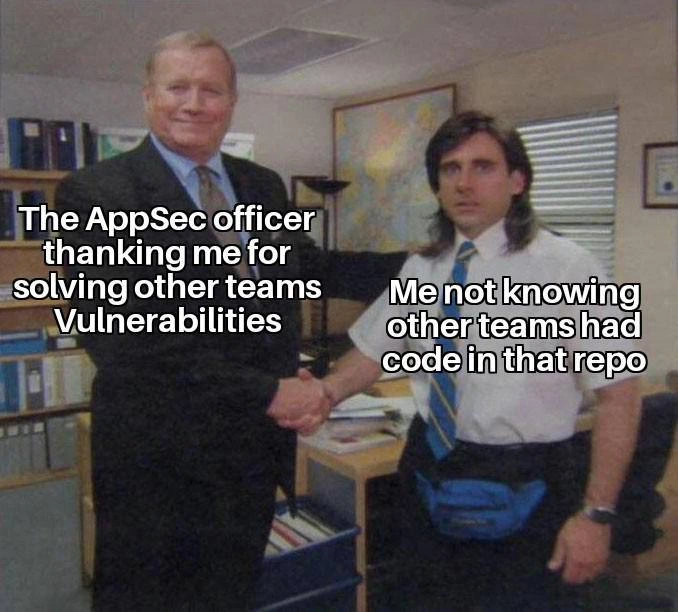
If a developer repairs a flaw in shared/authentication/, all three services might benefit when they adopt the new version or build from the updated source. That is the useful cross-team effect shown by the left-hand caption. The right-hand caption supplies the punchline: the developer did not even know those consumers existed, so the broad benefit came from ignorance rather than deliberate collaboration.

For someone making an early-career change in a large repository, the practical lesson is to check who owns the edited path, search for callers, inspect the test targets, and read the pull-request automation before assuming “one file” means “one team.” Version control can show what changed; it cannot, by itself, explain every human and production system that depends on the change.

Level 3: Ownership Not Found

The image pairs Ed Truck’s proud handshake with young Michael Scott’s unmistakable please do not ask a follow-up question expression. Its two labels create the entire incident report:

The AppSec officer thanking me for solving other teams Vulnerabilities

Me not knowing other teams had code in that repo

The mismatch is perfect corporate irony. Application security, or AppSec, sees a developer whose change removed risk across several teams. The developer sees a repository they apparently modified without knowing who owned half of it. One side thinks it has found a security-minded cross-functional hero; the other has just learned the blast radius of the commit during the awards ceremony.

A shared repository can produce this outcome in several plausible ways. The developer might upgrade a common dependency, harden a reusable authentication helper, repair an unsafe deserialization path, or change a build rule inherited by many applications. If several teams consume that shared component, one patch can close the same vulnerability everywhere. That is one of the strongest arguments for a monorepo: centrally managed libraries and tooling make organization-wide fixes mechanically possible.

The same story also exposes the monorepo’s recurring governance failure. Putting code in one version-control boundary does not automatically make ownership legible. Without accurate CODEOWNERS rules, directory documentation, dependency graphs, mandatory reviewers, and tests mapped to affected services, developers can treat a globally shared component as if it were local. The code is physically nearby while its operational owners, deployment schedules, threat models, and compliance obligations may be several org-chart layers away.

That ambiguity matters because a security fix is still a behavior change. Tightening an input validator may reject payloads another service has accepted for years. Updating an authentication library may alter token claims or expiration handling. Removing a vulnerable API may break a team that quietly depended on it. The patch can be correct from an AppSec perspective and still cause an outage if nobody coordinates rollout. “Fixed every team’s vulnerability” and “changed every team’s production system by accident” can describe the same pull request before and after deployment.

The systemic joke is that the organization rewards the lucky outcome instead of examining the missing controls that made it lucky. Security incentives favor vulnerabilities closed; delivery incentives favor changes merged; ownership work looks like administrative overhead until a broad edit goes wrong. The handshake converts a repository-management warning into recognition. Somewhere, a governance slide now calls this security champions at scale, because “engineer wandered across undocumented boundaries” tests poorly with leadership.

A healthier version of this success would keep the broad fix while making its reach explicit:

  • Generate an affected-component list from the dependency graph.
  • Route reviews to actual service owners through maintained ownership rules.
  • Run tests for every dependent target, not merely the edited package.
  • Roll out behavior-changing fixes in stages when compatibility risk is high.
  • Record the vulnerability, assumptions, and migration requirements in the change.

The meme is not mocking secure coding. It is mocking accidental coordination being mistaken for mature process. The uneasy face and blue waist pouch make Michael look spectacularly unprepared for the praise, which is exactly how it feels to discover that a “small cleanup” was apparently the enterprise security program.

Description

A grainy office-scene meme shows an older man in a dark suit shaking hands with a younger, uneasy-looking man in a white shirt, striped tie, and blue waist pouch. Bold white outlined text over the suited man reads "The AppSec officer thanking me for solving other teams Vulnerabilities". Matching text over the younger man reads "Me not knowing other teams had code in that repo". The humor comes from a developer unknowingly crossing team ownership boundaries in a shared repository and receiving security credit for fixes whose organizational blast radius they never understood.

Comments

1
Anonymous ★ Top Pick The monorepo's security strategy is simple: nobody knows the ownership boundaries, so everybody patches everything.
  1. Anonymous ★ Top Pick

    The monorepo's security strategy is simple: nobody knows the ownership boundaries, so everybody patches everything.

Use J and K for navigation