Skip to content
DevMeme
5323 of 7435
Serverless and the Cloud: A Physical Reality Check
Cloud Post #5840, on Jan 22, 2024 in TG

Serverless and the Cloud: A Physical Reality Check

Why is this Cloud meme funny?

Level 1: Magic Cloud, Real Fire

Imagine you have a special toy box that a magical friend takes care of for you. This friend calls it the “toy cloud.” You don’t see where the box is, but you’re told, “Don’t worry, you can get your toys from the cloud anytime, it’s magical!” It sounds awesome – you don’t need to keep the box in your room or check on it at all. But one night, you look outside and see a big warehouse on fire, with thick black smoke reaching up to the sky. 😳 Your friend then admits, “Uh, that was where your magic toy cloud was…”. Suddenly, the “cloud” doesn’t seem so magical — it was actually a real building, and now it’s gone! The funny (and kinda sad) part of the meme is just like this story: people talk about “the cloud” and “serverless” like it’s some airy-fairy thing with no actual box or server to worry about, but in reality, it does live somewhere real. And if that somewhere catches fire, the illusion of it being untouchable goes poof! into smoke. In simple terms, the meme jokes that when high-tech promises meet the real world, sometimes you end up with nothing but a big smoky mess. It’s like being promised an invincible magic candy factory, and then finding out the factory can burn down like any other. The humor comes from that big contrast: expectation – a perfect, always-there cloud of data; reality – a very real fire and a whole lot of “uh-oh!”

Level 2: Servers Hidden, Not Gone

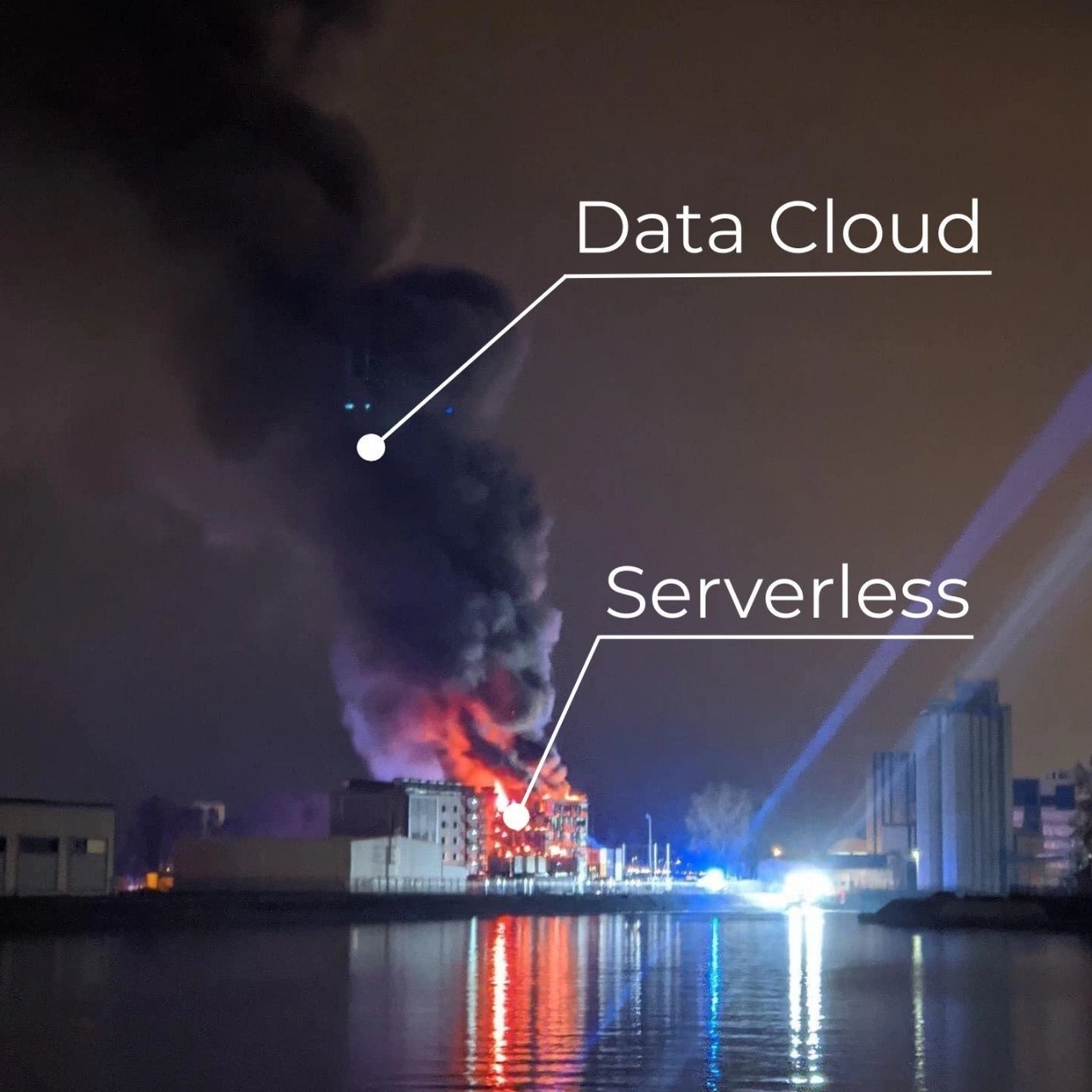
Let’s break down what’s going on for those newer to the cloud world. The term “cloud” in tech simply means someone else’s computers and hard drives that you access over the internet. When you hear “your data is in the cloud”, it evokes an image of something floating and untouchable. In reality, it’s stored in a physical place – a building full of powerful computers called a data center. The meme shows one of these data centers having a really bad day: it’s a night-time scene where an entire building (a data center) is on fire, and thick smoke is pouring out. The joke labels the smoke as “Data Cloud” and the burning building as “Serverless.” Why? Because it’s poking fun at the buzzwords.

Serverless is a popular term you might have heard in modern computing. It sounds like there are no servers at all, right? In truth, serverless means you don’t have to manage the servers yourself – the cloud provider manages them behind the scenes. Your code or your service runs on those hidden servers, and you’re abstracted away from the gritty details (like provisioning, scaling, patching the OS, etc.). But crucially, the servers still exist (they’re just “out of sight, out of mind”). The meme caption “Serverless” slapped on a burning building highlights the irony: those invisible servers can fail in very visible ways. If the data center hosting your serverless functions or data storage catches fire, your application goes down just as surely as if your own on-premises server blew up. Serverless doesn’t mean some magical system immune to problems; it just means the problems are handled by someone else – until something really bad happens.

Now, “Data Cloud” isn’t as formal a term as serverless, but it’s used by some companies to describe big unified clouds of data (for example, Snowflake calls its platform a “Data Cloud”). It suggests all your data is just seamlessly available in this fluffy cloud layer. The meme wittily labels the huge smoke column as “Data Cloud” to imply this is what happens to your “cloud data” when the building housing it burns. In other words, your data becomes a cloud of smoke – not quite the highly-available paradise marketing promised! It’s a visual pun reminding us that cloud data is still sitting on physical storage devices (hard drives, SSDs) in a real location. And if that location is compromised (fire, flood, power outage), your oh-so-safe data cloud can evaporate or go offline.

For a newbie in DevOps or IT, there are a few key lessons here (couched in humor). First, infrastructure matters – even in the cloud. Cloud providers like AWS, Azure, Google Cloud, or others operate huge data centers with lots of redundancy, but they’re not invulnerable. They have fire suppression systems, backup power and networks, but as seen in rare events (like a well-known incident where a French cloud provider OVH had a major data center fire in 2021), failures can and do happen at a large scale. If all your services are in one building and that building has an accident, everything in it can go down. This is why concepts like disaster recovery and multi-region backups are important. Disaster Recovery (DR) is basically a plan for “what do we do if our primary location is destroyed or inaccessible?” It often involves keeping copies of data in another geographic location or being able to spin up your services in a different data center.

Next, the meme touches on the life of an on-call engineer. Being “on call” means you are available (usually rostered in a rotation) to respond to any issues that happen at odd hours. If a critical service breaks in the middle of the night, the on-call person’s pager or phone app gets an alert, and they must start fixing the issue (this could be a developer or a dedicated Site Reliability Engineer (SRE), which is a role focused on keeping services running reliably). Now imagine being on call and getting an alert that an entire cloud region is down because of a fire – that’s the ultimate nightmare scenario. It’s the kind of ProductionIssue that you can’t just solve by restarting a server or rolling back a deploy. It likely means working with your cloud provider’s status updates, communicating to your users or team, and if you’ve prepared, triggering your disaster recovery plan (like failing over to a backup region). The meme’s context of “2 a.m.” is a classic trope in Ops humor: things always seem to blow up in the middle of the night, as any seasoned DevOps engineer will joke.

Let’s demystify a couple of terms dropped in the meme description: CAPEX and turning it into smoke. CAPEX stands for Capital Expenditure, which is basically money a company spends on big, one-time purchases – in tech, that often means buying hardware like servers, building data centers, etc. When they say turning CAPEX into smoke, they literally mean expensive physical servers (that the company invested money in) are now burning up – poof, gone! It’s a sardonic way to describe a costly disaster. Usually, companies move to cloud to avoid big CAPEX– you pay cloud providers monthly (that’s OPEX, operational expenditure). But those cloud providers themselves have huge CAPEX – racks of servers. Seeing those racks on fire is like watching dollar bills burn, which is why that phrase is at once tragic and darkly funny to insiders.

In summary, this meme is a tongue-in-cheek reality check for newcomers: “cloud” doesn’t mean literally a cloud in the sky, it means other people’s computers, and yes, those can catch fire or fail. The fancy terms like Serverless might suggest you’re free from the worries of hardware, but actually it’s a reminder that someone, somewhere (an SRE at your cloud provider) is still worrying about that hardware for you – and if they have a bad day (like a data center burning), it will become your problem eventually. So, while cloud services are incredibly useful and usually very reliable, it’s good practice to understand the physical reality underpinning them, and to plan for failures (even the really rare, crazy ones). DisasterRecovery drills, backups, and not putting all your data in one basket (or one building) are the un-sexy but important parts of using the cloud wisely. The meme’s disaster scenario is extreme, but it drives home the point: always know that the cloud has a ground truth. Or as one popular joke in tech goes, “The cloud is just someone else’s computer on fire.” 🔥

Level 3: Smoke Stack Trace

This meme hits experienced engineers right in the irony. We see a photo of a data center fire at night – an entire waterfront server farm engulfed in flames. The thick black smoke billowing upward is labeled “Data Cloud,” and the blazing building itself is labeled “Serverless.” It’s a darkly humorous smackdown of glossy cloud marketing. Why? Because any senior dev or SRE knows that “the cloud” is really just someone else’s computer… and occasionally, that computer catches on fire.

The humor here is equal parts pun and painful reality. “Data Cloud” in the picture isn’t some magical repository of data – it’s literally clouds of smoke carrying the remains of disk drives and CPUs into the sky. It’s a literal smoke stack trace, a play on words since a stack trace in software shows you where an error occurred, and here the “error” is a towering smokestack from a burning data stack. Meanwhile, “Serverless” is stamped on the building that’s ablaze, pointing out the grand irony: serverless doesn’t mean no servers; it means “not my problem” servers. But when those servers become a very big problem, you realize that serverless was always running on mortal racks in some warehouse. Those servers aren’t truly less — they’re just elsewhere. And in this case, elsewhere is an inferno.

Seasoned engineers will nod (or grimace) at this because it satirizes the marketing buzzwords vs. reality gap. We’ve sat through vendor presentations claiming the “Data Cloud will solve all your analytics” and “Serverless means zero ops, all focus on code!” – sipping the Kool-Aid of NoOps utopia. But when things hit the fan (or the fan stops and things overheat), guess who gets paged at 2 a.m.? The on-call team – those DevOps/SRE folks who know that “serverless” simply means the servers are someone else’s headache until that headache becomes yours. This image is basically the universe’s way of annotating: Data Cloud = smoke, Serverless = burning servers. It’s a cynical veteran’s reminder that behind every high-level abstraction, there’s a rickety pile of actual hardware held together with hope, duct-tape, and runbooks.

Real-world war stories abound that mirror this scene. Remember that OVH blaze in Strasbourg? One night in 2021, a major European cloud provider’s facility went up in flames, taking down thousands of websites and apps. Many businesses learned the hard way that their disaster recovery plan wasn’t as fireproof as the sales brochure implied. Those who kept all their data eggs in one data center basket saw them literally fried. Even the big players like AWS, Google, Azure have had region-scale outages (if not full-on fires, then floods, lightning strikes, and cooling failures) that felt, on the receiving end, just as chaotic. Senior devs joke about converting CAPEX to smoke – CAPEX (capital expenditure) being the fancy term for “buying a ton of servers upfront.” Watching those pricey servers turn into charcoal is a tragicomic way of burning money. It’s the ultimate OnCallNightmares scenario: your whole CloudInfrastructure isn’t just down – it’s physically gone.

The meme’s comedic sting also lies in its visual pun. Data Cloud? Yep, that giant smoke plume is your data “cloud” now – a dark, billowing cloud of lost data. And Serverless? Sure, those servers are now truly “less” – as in less existent, reduced to glowing embers. It’s a wry commentary on cloud humor that resonates with anyone who’s had to explain to non-tech colleagues that no, cloud doesn’t mean the data is literally in the sky. The OpsHumor here is biting: we use these abstract terms to feel invincible (“Our architecture is fully serverless on the data cloud, it just scales, and we don’t worry about infrastructure!”), but the picture shows the physical infrastructure failure that underpins that lie. It’s a smoke signal saying: don’t get too cozy with the buzzwords; reality can bite (or burn).

To a seasoned pro, this image practically screams: “Did you really think serverless meant fireless?” It’s like an involuntary smoke test for your architecture – not the lightweight test suite, but a literal smoke test. 😅 The veteran voice in our heads is chuckling and crying at the same time. We laugh because the labeling is clever, and if we don’t laugh we might cry, because we’ve been there (maybe not a fire of this magnitude, but those 3 a.m. outages where the dashboard is red and your heart sinks). The meme is an exaggerated postcard from ProductionIncidents Land, reminding us that NoOps is a myth – Ops is just outsourced until the moment it escalates back to you. In summary, this is DevOps humor at its finest, compressing a thousand on-call nightmares into one dark joke. As the saying (updated for 2024) goes:

“There is no cloud. It’s just someone else’s computer… on fire.”

Level 4: Fault Domains Ablaze

In distributed system design, we talk about fault domains – isolating components so that a failure in one domain (like a server rack, an availability zone, or even an entire data center) doesn’t bring down the whole system. Cloud architects pour countless hours into redundancy: multi-AZ deployments, cross-region replication, backup power, fire suppression, you name it. Yet here we have the ultimate test of partition tolerance – a data center fire turning an entire cloud facility into a burning fault domain. It’s a visceral reminder that no amount of orchestration or clever algorithms can fully escape the laws of physics or Murphy’s Law. Even the most advanced CloudInfrastructure with five nines uptime can be brought to its knees by something as old-fashioned as a real-world inferno. The Data Cloud in this image isn’t a sleek network of globally replicated databases; it’s literally a column of smoke rising from charred servers.

From a theoretical standpoint, events like this push the limits of distributed consensus and durability guarantees. If a whole region goes offline (or up in flames), CAP theorem suddenly feels very concrete: you must sacrifice either Consistency or Availability until the partition (or smoking crater) is resolved. No fancy consensus protocol (Raft, Paxos, etc.) can write data to a server that has melted into slag. This is where disaster recovery (DR) and geo-replication strategies step in. Academically, we often assume independent failure modes with low correlation – one machine fails, then another, but rarely all at once. But a fire laughs at independence assumptions: it creates a highly correlated failure knocking out thousands of nodes simultaneously. Byzantine fault tolerance? Sure, but what about Byzantine fire tolerance? 🔥

Data center design standards (Tier III, Tier IV) try to anticipate disasters with redundant everything – backup generators, dual cooling systems, multiple network uplinks. However, even a Tier IV data center isn’t literally fireproof if something goes really wrong. Thermal runaway in lithium-ion UPS batteries, electrical faults, or human error can bypass layers of safeguards. The infamous OVH cloud fire in 2021 (a subtle ovh_fire_reference here) demonstrated that once a blaze starts, redundant fiber links and failover routers won’t save you if the physical infrastructure is reduced to ash. It’s a harsh real-world confirmation of the second law of thermodynamics in computing: entropy wins eventually. The marketecture (marketing architecture) diagrams never include a giant “🔥”, but perhaps they should. In high theory, cloud computing promises virtually unlimited resources on demand; in practice, those resources rely on very real machines, in real buildings, with real flammable materials.

In essence, the Data Cloud vs Serverless meme at this level exposes a truth often glossed over in whitepapers: there is no abstract Platonic cloud, only servers (and their faults) at scale. Sophisticated systems try to mask any single failure – a disk here, a server there – but when an entire data center becomes a fireball, we’ve entered the realm of “extreme partitioning.” This is why truly robust systems embrace multi-region redundancy despite the complexity: to survive the rare but catastrophic fault domain explosions. It’s one thing to handle a node crash with a retry or to re-route traffic when one availability zone hiccups; it’s another to lose an entire region and still maintain consistency guarantees and user data safety. The hard reality is that serverless and cloud abstractions can’t fully abstract away thermodynamics and disaster physics. In theoretical terms, the meme hints that our abstractions leak – sometimes in the form of black smoke.

Description

A nighttime photo depicts a massive building engulfed in flames, with thick black smoke billowing into the sky, all reflected in a body of water in the foreground. White text with leader lines points to the heart of the fire, labeling it "Serverless," and to the enormous smoke cloud, labeling it "Data Cloud." The image is a well-known photograph of the fire at the OVH data center in Strasbourg. The meme humorously deconstructs the abstract marketing terms used in cloud computing. It serves as a stark reminder that "serverless" architectures still run on physical servers and the "cloud" is just someone else's computer in a physical data center, which is vulnerable to real-world disasters like fires

Comments

14
Anonymous ★ Top Pick Serverless is great until the someone else's computer you're using spontaneously undergoes rapid, unplanned thermal disassembly
  1. Anonymous ★ Top Pick

    Serverless is great until the someone else's computer you're using spontaneously undergoes rapid, unplanned thermal disassembly

  2. Anonymous

    Remember: the only truly serverless architecture is the one that’s currently smoldering in the parking lot - zero servers, zero availability SLAs

  3. Anonymous

    After 20 years in tech, I've learned that 'serverless' just means the servers burning down are someone else's problem - until your entire region goes offline and you're explaining to the board why your 'cloud-native, highly available' architecture is now literally smoke and mirrors

  4. Anonymous

    When the product manager said 'move everything to serverless and the data cloud,' they didn't specify that both would literally become smoke and fire. This is what happens when your RTO is measured in fire truck response time and your disaster recovery plan is 'call 911.' At least the smoke provides excellent horizontal scaling - truly elastic infrastructure that expands infinitely upward. The real question: is this a multi-region failure or just the primary availability zone having a really bad day?

  5. Anonymous

    True serverless mastery: scaled to zero instances permanently - no cold starts, just eternal outage optimization

  6. Anonymous

    Turns out “serverless” becomes accurate once the racks convert into a literal data cloud; RTO: effectively infinite, RPO: hope you had cross‑region

  7. Anonymous

    Serverless works until you learn multi‑region was a slide, not a budget line - now our RPO is literally in the data cloud

  8. Felix 2y

    that ovh?

  9. @callofvoid0 2y

    can you see the cyber eyes?

  10. @MrStaudinger 2y

    Where was this ?

  11. @karanokyoukai 2y

    old news

  12. @karanokyoukai 2y

    2021,ovh,inferno

  13. @Garyyy_zzZZ 2y

    truely cloudflare(

  14. @Garyyy_zzZZ 2y

    anyone can PS a cloudflare on it

Use J and K for navigation