Steering a Sedan with a Ship's Helm: Kubernetes Edition
Why is this Containerization meme funny?
Level 1: A Ship’s Wheel on a Car
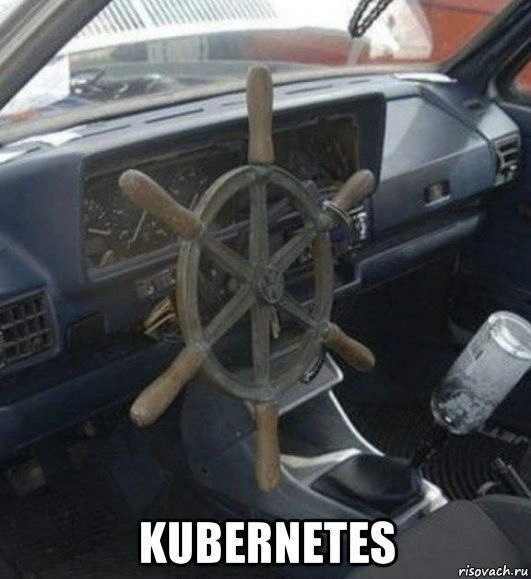
Imagine you have a little car toy that you can push around. It has a nice small steering wheel that’s easy to turn, so the car goes where you want. Now imagine someone takes that steering wheel away and attaches a giant pirate ship’s wheel to the car instead! 🏴☠️ The wheel is as big as the car’s front seat and has those long wooden handles. It looks like it belongs on a huge boat sailing the ocean, not on a car driving down the street. How do you think that car would feel to drive? Probably very weird and hard to handle. You’d have to spin that big wheel round and round just to make a tiny turn. It might even knock against the seats because it’s so large. In one word, it’s silly.
This funny picture is making a simple point: sometimes people use a tool or solution that is way more complicated than what you actually need—like using a big ship’s steering wheel for a normal car. It’s like trying to use an entire playground just to slide a single toy car; it doesn’t fit. The car was working fine with its normal wheel, and now with the boat wheel it’s much harder to drive. The caption “KUBERNETES” is the name of a very powerful tool (named after pilots of big ships) that some computer people use. In this joke, using Kubernetes for a small easy job is just as funny as steering a car with a massive wooden ship wheel. It’s telling us: too much of a good thing can just be too much! Anyone can see that a pirate ship’s wheel on a car is absurd, and that simple feeling is why the picture makes us laugh.
Level 2: Container Ships & Car Trips
Let’s break down the joke for those newer to DevOps and containerization. First, Kubernetes (often stylized as K8s) is a popular system for managing software containers across many computers. Containers are like little packages that bundle an application’s code with everything it needs to run. Think of a shipping container carrying goods: in software, a container carries an app. Container orchestration is how you coordinate lots of these containers (like directing many shipping containers to various ports on many ships). Kubernetes is basically the big control tower ensuring all your app containers are deployed, connected, and healthy in a cluster of machines. It automates tasks like starting/stopping containers, handling failures, and scaling up or down – it’s powerful, but also quite complex.
Now, Kubernetes has a strong nautical theme. The very word “Kubernetes” is Greek for helmsman or pilot – the person steering a ship. Its logo is a ship’s wheel with seven spokes (representing the seven letters in “Kubernetes”). There’s also a tool named Helm in the Kubernetes ecosystem, which is like a package manager to help deploy apps onto K8s; fittingly, Helm’s logo is a little helm (ship wheel) too. So the meme literally shows a ship’s helm wheel installed in a car. This visual is immediately funny to anyone who knows Kubernetes because it’s a direct nod to the Kubernetes logo and terminology placed in a completely wrong setting (a car’s interior). It’s a kubernetes_helm_reference turned into a sight gag.
Why is that an “overengineered” steering wheel? In a normal car, you just need a basic steering wheel connected to the tires, right? Imagine instead replacing that simple wheel with the kind of large wooden helm you’d find on a big old ship. It would be super unwieldy for a car. You’d have to spin it multiple times to turn just a little, it’s far too large for the space, and it’s just unnecessarily complicated for the job at hand. This is an analogy for using Kubernetes in a project that doesn’t need it. Kubernetes is like that big ship’s wheel: powerful, built for handling huge vessels (big applications with many moving parts), but arguably overkill for a small vehicle (a simple app or a single server setup).
The phrase “When DevOps installs Kubernetes” sets the stage: DevOps is a culture/role that bridges development and operations, often focused on automating deployments and infrastructure. DevOps engineers love tools that make systems more reliable and scalable. But sometimes they might introduce a very complex tool (like Kubernetes) even if the project is small, possibly because it’s the shiny new thing or it promises standardization. The meme suggests that after the DevOps team got involved, the car’s steering now “feels a bit overengineered.” Overengineered basically means too complex for its own good. The car here represents a software project or system, and the new steering mechanism (Kubernetes) is far more elaborate than what that project realistically needs.
Let’s also notice the state of this car interior: The dashboard is missing its instrument panel. Wires are hanging out where the speedometer and gauges should be. There’s a random plastic bottle lying in the passenger footwell. Everything looks a bit broken or hacked together. This adds to the comedy: not only did someone stick a ship’s wheel in a car, but they didn’t even finish the job cleanly. It’s a hacky solution visual — implying that the integration of Kubernetes might have been rushed or not fully thought out. In tech terms, it’s like when you adopt a complex tool and in the process you temporarily lose some basic functionalities (e.g., after moving to Kubernetes, maybe you realize your simple log viewer or monitoring stopped working until you set up new equivalents). The bottle and messy dash give the vibe of “we were so excited to set up Kubernetes that we tore everything apart, and now we have a Frankenstein car.” It’s funny because it exaggerates what can happen in real projects: you dive into integrating a fancy new system and things get messy for a while.
In simpler technical terms:
- Kubernetes: a system to manage containerized applications across multiple machines. It’s great for large, complex apps with many microservices.
- Helm: a tool to help deploy applications on Kubernetes easily, kind of like an app store installer but for Kubernetes resources (one reason the ship wheel is doubly appropriate: it’s literally a “Helm”).
- Overengineering: doing something in a more complicated way than necessary. Here it means using an overly complex infrastructure for a simple task.
- DevOps installs Kubernetes: implying the operations team decided to use Kubernetes. Often, when people say “we Kubernetes-ified our project,” it means they broke the app into containers and run them on a Kubernetes cluster, rather than just running it directly on a server.
The meme is an DevOps humor reference to the sometimes excessive enthusiasm for tools like Kubernetes. If you’ve ever followed tech trends, you might have noticed phases where everyone talks about containers, then about orchestration like Kubernetes, etc. Newcomers might wonder, “Do I need Kubernetes for my app?” The truth is, not always—it depends on the scale and needs. This meme drives home that point with a laugh: imagine literally trying to drive a normal car with something designed for a ship—silly, right? It’s saying: “Maybe you don’t need a container ship’s steering system for a little rowboat.” Or as the image conveys, for a car that was doing fine with a regular steering wheel.
So, in plain terms: the picture is funny because it shows an extreme example of mismatched tech. The caption “KUBERNETES” labels the ship wheel as if Kubernetes itself has taken over the car. It’s playing on the idea that Kubernetes (and tools like it) can sometimes feel out of place or overly complex when they’re inserted into smaller projects. If you’re new to these concepts, just remember: Kubernetes is awesome for running lots of software pieces across lots of computers (like managing an entire ship or a fleet of ships). But if you only have one ship—or one car—maybe you can just steer it directly without all that extra mechanism. The DevOps folks in the meme took the “ship” idea a bit too literally, and that’s why it’s humorous.
Level 3: The Helm of Overkill
This meme nails a feeling many seasoned engineers know too well: overengineering. Here we see a car’s dashboard with a giant wooden ship’s helm bolted on as the steering wheel. It screams “someone went way too far” — just like deploying a full Kubernetes cluster for an application that could run on a single server. The humor comes from that perfect storm of references: Kubernetes’s name literally means helmsman (its logo is a ship’s wheel), and there’s even a tool in the Kubernetes ecosystem called Helm (used for packaging apps). So instead of a normal steering wheel, the car has a captain’s wheel — a visual pun on Kubernetes’ maritime theme. It’s a k8s visual pun and a DevOps in-joke: only folks who know Kubernetes’ iconography get the immediate chuckle of seeing a ship_wheel_in_car.
From a senior DevOps/SRE perspective, this image hits on the absurdity of adopting tools like Kubernetes in inappropriate contexts. We’ve all seen it: a tiny startup or a simple internal tool where someone says, “Hey, let’s deploy this with Kubernetes!”, and suddenly a straightforward project gains the complexity of a container flotilla. It’s like using a container ship to deliver a pizza. Sure, it will get there eventually, but did we really need a vessel that big, with its own crew and navigation system? This is DevOps culture humor at its finest, reflecting how engineers sometimes grab the shiniest new tool (K8s in this era of containerization) just because it’s the cool thing, not because the project demands it. The meme’s car looks old and beaten-up (the instrument panel is literally missing!), implying the project or infrastructure might be legacy or simple – yet someone has slapped Kubernetes onto it. This mismatch is the joke: Kubernetes promises powerful container orchestration with self-healing, auto-scaling, service discovery, etc., akin to adding computerized power steering, GPS navigation, and auto-pilot to, say, a 1980s clunker that just needed an oil change. We end up with a hacky solution visual: the fancy new steering (K8s) is present, but the important basics (like the dashboard/instruments) are gone or broken. It’s a steering misfit – the control method doesn’t fit the vehicle it’s in.
Why is this so relatable? In real-life tech scenarios, Kubernetes is amazing for complex, distributed applications, but not every project is Google-scale. Nonetheless, many teams have felt pressure to adopt “modern” infrastructure. Maybe a well-meaning DevOps engineer was excited about everything being containerized and automated. Next thing you know, a simple two-tier app (just a web server and a database) ends up broken into microservices running on K8s with a dozen YAML files, helm charts, and a full CI/CD pipeline. The developers are left feeling like they’re trying to drive a familiar car that now requires kubectl commands to steer:
# Abstract representation of our car-as-a-service in Kubernetes
apiVersion: v1
kind: Car
metadata:
name: old-car
spec:
steering: "helm-wheel" # Use Helm to manage steering config
engine: "1-cylinder"
dashboard: false # Oops, we lost our instrument panel in the upgrade
Above: Our poor man’s “Car” custom resource, defined in YAML. It’s funny because in a normal car you’d just turn the wheel, but here we’ve over-complicated it with config files and infrastructure-as-code.
The meme also slyly references containerization metaphors. In tech, we compare software containers to actual shipping containers, and we talk about “shipping” code. Kubernetes extends that metaphor: it’s like the control system for a fleet of container ships. So seeing a ship’s steering wheel in a car is like saying, “We treated our little app like a massive shipping operation.” It’s a playful jab at how engineers (especially in DevOps) sometimes wield huge, enterprise-grade tools for small-scale problems. It highlights the ContainerOrchestrationWars mindset: everyone racing to use Kubernetes (or similar) even when a simpler Docker compose or a single VM would suffice. Historically, this reflects a pattern: remember when teams moved a simple monolith into a dozen microservices just to be modern, and ended up with a nightmare of network calls and complexity? Same energy. Or when an on-call veteran finds out the weekend crew replaced a perfectly fine Apache server with a full cloud-native stack “because containers!” – you can almost hear that veteran’s sarcastic grumble, “We replaced a wheel with a helm, and now it takes 5 minutes to go left.”
The DevOps/SRE folks also appreciate the hint at operations culture. Installing Kubernetes is non-trivial – it’s a running joke that K8s can feel like configuring a spaceship. Once it’s up, you’ve got to manage nodes, pods, services, ingress controllers… analogously, our car now has a whole ship’s bridge. Need to accelerate? Better check with the Chief Engineer. Want to turn? Hope the helmsman (pun intended) is at his post. The meme exaggerates that overhead in a way that any engineer who’s spent a late night wrangling a cluster can laugh (or cry) about. And of course, the text plastered in bold “KUBERNETES” at the bottom makes it unmistakable: this is the culprit of the comedic misfit engineering. It’s practically shouting, “Kubernetes did this to my car!” – a tongue-in-cheek dramatization of blaming the tool for the absurd situation.
In summary, at this senior-view level, the meme is poking fun at our industry’s tendency to adopt complex tools without due cause. It captures the irony and pain of overengineering: yes, Kubernetes is powerful, but not every problem is a nail for that particular very large hammer (or in this case, not every vehicle needs a ship’s helm). It’s a reminder that just because you can orchestrate something with Kubernetes doesn’t always mean you should. The laughter (and slight groan) it elicits comes from experience: we’ve been in that passenger seat, looking at the plastic bottle on the floor and the missing dashboard, wondering how our simple ride turned into a convoluted voyage.
Level 4: Consensus in a Coupe
Under the hood, Kubernetes isn’t just a buzzword—it's essentially a distributed operating system for containers. It relies on some heavyweight computer science to keep clusters consistent. At its core is etcd, a distributed key-value store that uses the Raft consensus algorithm to agree on the cluster’s state across multiple nodes. This ensures that even if one control-plane instance goes down, the others agree on what pods (think of pods as groups of containers) should be running where. But in the context of this meme, that’s like requiring a committee vote to turn your car’s wheels. Consensus in a simple coupe is total overkill: a single driver in a single car doesn’t need a fault-tolerant distributed database to decide when to turn left. Yet here we are with a full container orchestration control plane metaphorically jammed into an old sedan. It’s a comical collision of scale: Kubernetes was designed to manage fleets of services (like an admiral commanding an armada), but our poor car just needed a direct steering linkage. The meme exaggerates this mismatch by literally using a captain’s wheel (the Kubernetes logo’s helm) for a car’s steering—hinting at the fully nautical control system of Kubernetes running something that’s fundamentally not a distributed fleet at all. This speaks to a deeper truth in distributed systems theory: the tools built for massive scale come with fundamental complexity (e.g. CAP theorem trade-offs, consensus overhead, eventual consistency delays). Using them on a tiny problem won’t magically make the problem better; it often just adds needless layers. In Kubernetes’ case, the control loop model (continually reconciling desired and actual state) is brilliant for cloud infrastructure, but it’s like having an auto-pilot constantly correcting your car’s direction even when you just want to drive straight to the grocery store. The meme’s absurdity lies in these theoretical underpinnings: it’s marrying a single-node problem with a multi-node solution, an academic example of misapplied engineering. By invoking the Kubernetes helm (complete with eight spokes, just like the K8s logo) as a physical steering wheel, it cleverly mocks the idea of using advanced container orchestration concepts where a simple static setup would do. It’s a gentle poke at how our industry sometimes applies distributed design patterns out of context, highlighting the humorous side of solving a simple problem with a PhD-level toolkit.
Description
The image displays the dashboard of an older car, where the standard steering wheel has been absurdly replaced with a large, wooden ship's helm. At the bottom of the image, the single word 'KUBERNETES' is written in a bold, white font. This meme is a visual pun on the origins of the word 'Kubernetes,' which is Greek for 'helmsman' or 'pilot.' The humor lies in the metaphor of using a powerful, complex tool designed for steering a massive ship (Kubernetes) to control a much simpler vehicle (a typical application). It satirizes the trend of over-engineering and using heavyweight solutions like Kubernetes for projects that may not warrant its complexity, a common debate among senior engineers and architects
Comments
7Comment deleted
Using Kubernetes for a simple CRUD app is like replacing your car's steering wheel with a ship's helm. Sure, you feel like a captain of industry, but you're still just trying to parallel park a Toyota
Deploying Kubernetes for a two-tier legacy app is like bolting a ship’s helm into a hatchback - now every U-turn needs an operator, a Helm chart, and a prayer the cluster doesn’t drift
After 15 years of explaining to executives why we need Kubernetes, someone finally understood when I said 'we need better steering mechanisms for our container ships' - though I think they took the maritime metaphor a bit too literally in the company car fleet upgrade
When the architect said we needed Helm to steer our Kubernetes deployment strategy, I don't think this is what they meant - though it's probably still more intuitive than debugging a CrashLoopBackOff at 3 AM. At least with this setup, when someone asks 'who's at the helm?', you can literally point to the wheel instead of explaining your RBAC policies
Kubernetes: because nothing screams 'simple homelab' like swapping your Miata's wheel for a clipper ship's helm
Kubernetes gives you fleet management; we used it to steer one rusty sedan - complete with Helm, an Operator, and a quarterly YAML alignment
Running a monolith on Kubernetes is like bolting a ship’s helm onto a sedan: lots of YAML spokes, a control plane you can’t see, and every turn still needs a Helm chart