Skip to content
DevMeme
3214 of 7435
An Ironic Ode to Unicode
DataFormats Post #3535, on Aug 14, 2021 in TG

An Ironic Ode to Unicode

Why is this DataFormats meme funny?

Level 1: Broken Heart in Code

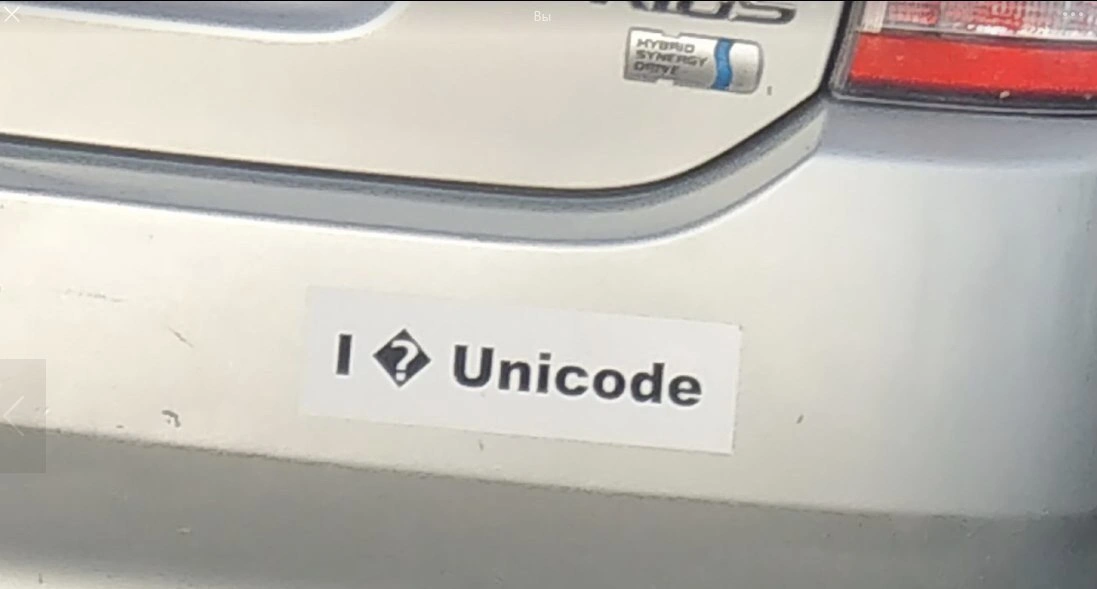
Imagine you send a love note to someone, but you wrote the heart symbol ♥ in a secret code that the other person can’t read. When they open the note, instead of a heart they see a big weird question mark symbol. Oops! The message was supposed to say “I love you,” but now it looks confusing, like “I ? you.” That’s basically what happened here, but with a car’s bumper sticker. The sticker was meant to say “I love Unicode” (Unicode is just a fancy name for the universal language of text that computers use). But because of a mix-up in how the computer printed the sticker, it couldn’t print the little heart. It didn’t know how, so it put a question mark diamond shape as a placeholder.

The result is funny because it’s like the car is proudly saying it loves something (Unicode) – but the very symbol of love (the heart) got lost in translation and turned into a question mark. It’s a broken heart in code. For people who work with computers, this is a familiar kind of goof-up. It’s as if the car is joking, “I tried to show love, but my computer didn’t get it right!”

Even if you don’t know the technical details, you can laugh at the idea that a computer error showed up on a bumper sticker. It’s a simple joke: the heart literally got replaced by a “huh?” symbol. It feels a bit like writing “I love candy” but the printer prints “I ? candy” – you’d get the point, but also realize something went wrong. The person with this sticker is likely a programmer having a chuckle, saying even when we try to make things perfect, technology can mess it up. Sometimes computers speak a slightly different “language” than we expect, and the outcome can be pretty silly. This bumper sticker is a lighthearted way to say, “Hey, technology isn’t perfect, but we can still have a laugh when it glitches!”

Level 2: Mojibake 101

Let’s break down what’s happening in simpler terms. The sticker on the car is supposed to say “I love Unicode”, but instead of a heart symbol (♥), there’s a weird diamond-shaped question mark symbol in its place. That is what computers show when there’s a character encoding problem – basically when a program can’t figure out how to display a particular character. This often happens when text gets passed around different systems that aren’t using the same format for text. You might have heard of UTF-8 and UTF-16 – these are two common ways (encodings) to represent all the Unicode characters (which include letters, emojis, symbols, etc.). If something written in UTF-8 is read by a system expecting UTF-16, or vice versa, the text can come out garbled or with placeholders. It’s like having the wrong key for a lock: the pieces just don’t line up, and you can’t read the message properly.

In developer lingo, Unicode is the standard that assigns a unique number (called a code point) to every character in every language (for example, the letter “A” is U+0041, the heart ♥ might be U+2764). But just knowing the code points isn’t enough – when we store or transmit text, we have to encode those numbers into bytes. UTF-8 is a popular encoding that uses 1 byte for common characters like English letters, but uses more bytes (up to 4) for less common or larger code points (like emojis or that heart symbol). UTF-16 uses 2 bytes for a lot of characters and 4 bytes for others (those that don’t fit in 2). The key is: everyone reading and writing the text has to agree on which encoding is used. If not, you get problems.

Now, the funky term “mojibake” refers to the mess of strange characters you see when text is decoded with the wrong encoding. Imagine you have a secret message coded with one cipher and you try to decode it with a different cipher – you get gibberish. Mojibake is that gibberish in computing. For example, if someone saves “I ♥ Unicode” in UTF-8 and another program mistakenly reads those bytes as Latin-1 (an older encoding), you might see something like “I ♥ Unicode” on the screen instead of a heart. Those odd characters (♥) are actual legitimate characters, but they’re the wrong characters, resulting from the misinterpretation – that’s mojibake.

The � symbol (the black diamond with a question mark) is slightly different: it appears when the program says “This byte sequence doesn’t correspond to any valid character at all in the encoding I'm using.” Instead of outputting random wrong characters, it just puts a generic replacement character as a placeholder. It’s essentially an error symbol for “unknown character”. Many systems today prefer showing � because it alerts you that something went wrong with decoding, rather than silently showing incorrect letters. It’s often called the Unicode replacement character.

So on the bumper sticker, the heart got replaced by �. This suggests that when the sticker text was being made (maybe printed by a computer onto the sticker), there was an encoding mix-up. The text “I ♥ Unicode” may have been in a format that the printing software or hardware didn’t expect or support, and it failed to render the heart. Instead, it printed that replacement glyph. The result is ironically perfect for a programmer joke: it’s saying “I love Unicode” while literally exhibiting a UnicodeSupport failure.

For a junior developer or someone new to these terms, think of it this way: Have you ever opened a text file or a website and seen weird symbols like � or boxes or question marks where letters or emojis should be? That’s exactly this issue. It usually means the program didn’t understand the data format of the text. Maybe the file was saved in UTF-16 and your editor tried to read it as UTF-8 – so it encountered bytes that didn’t make sense and showed placeholders. Or an older system didn’t know how to handle an emoji character because it wasn’t in its limited character set, so it just showed a question mark. These are encoding bugs, and they’re really common in software.

Developers often fix this by explicitly telling programs what encoding to use, or converting text to a standard format (almost everyone uses UTF-8 now for everything to avoid these issues). But as simple as it sounds, it’s easy to slip up. Sometimes a database default might be different, or a library assumes ASCII by default, and boom – your text is broken. It can be a frustrating bug to chase because nothing is visibly wrong with the code – the letters are all there, just in a different form – but the output is clearly wrong. When you finally realize “Oh, it’s reading it in the wrong encoding!”, it’s a facepalm moment.

The bumper sticker dev meme is funny because it brings this very digital, abstract problem into the real world in a silly way. Imagine driving behind a car that proudly says “I [?�] Unicode”. If you know about encoding issues, you instantly get the joke: the car is essentially a nerdy billboard saying “Haha, encoding issues, am I right?”. It’s poking fun at the fact that even something as simple as a heart symbol can go wrong if you’re not careful with how text is handled. CharacterEncoding bugs have caused a lot of headaches, and this person’s way of coping is to literally make a joke out of it and slap it on their car. That’s developer humor for you – turning pain into laughter.

In summary, Mojibake 101 lesson: the heart on the sticker didn’t show up because of a character encoding mix-up, and it got replaced by that funny � symbol. The sticker ended up saying “I � Unicode”, which is both an endorsement of Unicode and an example of what happens when Unicode isn’t handled correctly. It’s a perfect little paradox that software folks find hilarious, because we deal with this stuff all the time.

Level 3: Character Encoding Heartbreak

For the seasoned developer, this image hits right in the feels (and files). It combines wholesome “I ♥ ____” bumper sticker vibes with an inside joke about character encoding failures. The owner of this car is presumably a developer flaunting their war scars: they “love Unicode,” but their sticker itself has suffered an encoding mishap, turning the intended heart into a black diamond question mark. This is programmer humor 101 – saying one thing and simultaneously showing the opposite. It’s like putting a big “I love reliability” sticker on your car, but the sticker is peeling off and misspelled. Here, “I ♥ Unicode” became “I � Unicode,” a visual punchline that any engineer who’s wrestled with text will appreciate. It screams: “I tried to show my love, but my text encoding said nope.”

Why is this so funny (or painful) for developers? Because everyone in software has been burned by encoding issues at some point. You think you’ve handled all your strings properly, you’re happily using UTF-8 (the modern standard encoding for web and most apps), and then – bam! – some UTF-16-encoded data sneaks in, or a library expects text in a different format (UTF-8 vs UTF-16 drama), and suddenly your output is littered with ugly � symbols or garbled characters. This meme is a celebration of that universal developer experience where text that looked fine on one system turns into mojibake on another. Mojibake, for the uninitiated, is the term (borrowed from Japanese) that describes those gibberish characters you get when decoding text with the wrong encoding – you’ve probably seen things like “é” instead of “é” or “Питон” instead of “Питон” when something goes awry. It’s a rite of passage in programming to learn why “UnicodeDecodeError” or weird symbols appear, often at the worst times (like in production, or in a demo to your boss).

This bumper sticker joke condenses that whole saga into one image. The replacement character � on the sticker is exactly what many of us have seen in our UIs or logs when a character can’t be rendered. Maybe you saw in a log file where a user’s emoji didn’t save correctly to the database. Or you received an email with scattered through the text because some email server along the way didn’t handle UTF-8 properly. It’s always a facepalm moment. Here, the car’s owner is basically announcing “Yep, been there, done that, still ♥ Unicode anyway.” It’s a love-hate relationship all developers have with text encoding: we love Unicode for giving us all the world’s characters in one standard, but we hate how easy it is to mess up the handling of that standard and end up with broken text.

The senior dev perspective also catches a whiff of irony and resignation: we’ve spent decades as an industry trying to fix encoding issues. We moved from a wild west of code pages (each language or region using its own 8-bit encoding, causing constant conflicts) to a unified Unicode world. Great — in theory, every character from every language can coexist! But in practice, you still have to get all parts of a system to agree on how to encode/decode that Unicode text (UTF-8 being most common). Any mismatch – say a legacy system expecting Windows-1252 (an old Microsoft encoding) reading data from a modern UTF-8 source – and you get a cascade of � or weird symbols. It’s the classic BugsInSoftware scenario: something trivial (a single heart character) can break if one tiny config or assumption is wrong. And these bugs are notoriously sneaky. They often don’t show up until some user inputs a “•” or “ç” or “😂” that travels through a system not fully configured for Unicode. Everything breaks, tickets get filed, and a tired engineer mutters “it’s always an encoding issue, isn’t it?” (a riff on the old “It’s always DNS” joke).

This meme’s text “I � Unicode” literally demonstrates the bug while talking about it — self-referential humor at its best. The absurdity isn’t lost on veteran developers: you have a standard (Unicode) that’s supposed to handle all characters, yet here we are, proudly sticking a failure of that standard on our car. It’s a tongue-in-cheek admission that, no matter how advanced we get, DeveloperExperience_DX includes endlessly debugging character sets. The bumper_sticker_dev_meme format (putting a nerd joke on a car) makes it extra relatable — many coders actually adorn their laptops or vehicles with inside jokes like this. Seeing “I � Unicode” on a car in traffic would make any programmer chuckle and nod in solidarity, probably thinking of the last time they saw that replacement glyph unexpectedly. It’s a bit of communal commiseration: “Yep, been there. Unicode is awesome… until it isn’t.”

In real-world scenarios, an engineer encountering this might share their own story: “One time, our application logged every non-ASCII character as � for a week because of a misconfigured logger, and we had no clue what users were actually doing!” or “We tried to put a ♥ in our email subject, but half our recipients saw � instead.” These are not rare tales. The characterEncoding woes are so common that this meme barely needs explanation to a seasoned dev — they instantly get the joke. The caption “Some stuff will never always work as intended” sums it up: text encoding is one of those things that never quite works 100% of the time, no matter how much you prepare. There’s always that one environment, that one older system, or that one piece of data that breaks the pipeline.

So, at this level, the humor is in recognizing the scenario and appreciating the clever way it’s presented. The sticker expresses a paradoxical love: loving Unicode enough to joke about its failures. It’s funny because it’s true – Unicode is amazing, but it will still break your heart (or at least your heart character) occasionally. Every experienced dev has a scar from this, and seeing it turned into a bumper sticker is both cathartic and hilarious. Consider it a badge of honor: if you laugh at “I � Unicode,” you’ve earned your stripes dealing with encoding bugs.

Level 4: Lost in Transcoding

At the deepest technical level, this bumper sticker is a wink at the perils of character encoding and how data gets lost in translation between formats. The sticker was meant to say “I ♥ Unicode”, but instead of the actual heart symbol (U+2764 in Unicode), it shows the infamous Unicode replacement character (U+FFFD) – that black diamond with a question mark. This glyph isn’t random; it’s a sentinel value defined by the Unicode standard to mark “unprintable” or “unmappable” bytes. Essentially, when a program tries to decode text and encounters a byte sequence it can’t interpret under the given encoding, it will often substitute as a safe replacement, signaling “I have no idea what this character was supposed to be.”

Under the hood, text is stored as bytes, and character encoding schemes define how those bytes translate to human-readable symbols. Unicode is the universal catalogue of characters (covering scripts from Latin to Chinese, emojis, symbols like ♥, etc.), but computers don’t inherently know how to map bytes to those code points without an encoding like UTF-8 or UTF-16. In UTF-8 encoding, for example, the heart symbol ♥ is represented by a specific sequence of three bytes: E2 9D A4 in hex. If software mistakenly interprets those three bytes using a different encoding (say, ASCII or Latin-1 where each byte is expected to map to a single character), it will be utterly confused by values like 0xE2 or 0x9D which have no meaning in that narrower charset. The result? The decoder throws up its hands and plants a in the output, effectively saying “I can’t decode this” – an encoding failure manifested visibly.

This transcoding error is at the heart of mojibake – the term for text turning into garbled nonsense due to mismatched encodings. In some cases, you get totally wrong characters (for instance, the UTF-8 bytes for ♥ might appear as “♥” in ISO-8859-1 encoding, which is classic mojibake). In stricter decoding modes, you get the replacement glyph instead of potentially misleading gibberish. The black diamond � is essentially Unicode’s built-in error symbol, a way of failing fast and loud so you don’t silently read incorrect data. It’s better to see a conspicuous � than to unknowingly display wrong text. As a result, many frameworks and languages (like Python, Java, or web browsers) will insert U+FFFD whenever they run into a byte sequence that is invalid for the assumed encoding. This prevents crashes or security issues from ill-formed text, at the cost of producing that funky symbol.

Even though Unicode was designed to eliminate the old chaos of code pages and make text interoperable across systems, it still relies on everyone using it correctly. In practice, data often passes through multiple layers (databases, APIs, files, network transmissions), and if any layer mis-labels or mis-encodes the text, you can end up with these replacement diamonds or other text rendering failures. The humor here is that the car’s sticker itself fell victim to an encoding blunder while proclaiming love for Unicode. It’s a meta-joke that resonates with developers who know the fragility of text handling: the sticker’s message got corrupted by the very thing it’s praising. There’s a dash of technical irony in play: a declaration of love for Unicode degraded by a UTF-8/UTF-16 transcoding mix-up or similar, which replaced the heart with a question mark. It’s like the message passed through a faulty encoder on its way to the printer. In a sense, the meme is poking at the edge cases of Unicode support – illustrating that even with a “universal” standard, you’re never completely safe from a sneaking in.

To a seasoned engineer, this conjures memories of chasing down elusive encoding bugs deep in the system. They might recall how forgetting to specify charset="UTF-8" in an HTML page, or mishandling endian markers in UTF-16, could turn innocent text into a minefield of black diamonds and gibberish. The Unicode replacement character is a bittersweet sight: it’s the safety net saving your program from crashing, but it’s also the harbinger of data loss – a sign that somewhere in the pipeline, some bytes went on a bender and didn’t come back. The bumper sticker showcases this concept in a compact, ironic way. It’s basically saying: “I love Unicode, but even Unicode can break my heart (symbol).”

For a concrete illustration, consider the byte sequence for “♥” and how it might be misinterpreted:

text = "I ♥ Unicode"
utf8_bytes = text.encode("utf-8")  
print(utf8_bytes)  # b'I \xe2\x9d\xa4 Unicode'

# Simulate a decoding with the wrong encoding (Latin-1) 
mojibake_text = utf8_bytes.decode("latin-1")  
print(mojibake_text)  # Outputs: I ♥ Unicode

# Simulate decoding with errors replaced (e.g., ASCII decoding with replace)
ascii_text = utf8_bytes.decode("ascii", errors="replace")  
print(ascii_text)    # Outputs: I � Unicode

In the above snippet, the correct UTF-8 bytes for “I ♥ Unicode” are interpreted in two problematic ways. First, decoding as Latin-1 yields "I ♥ Unicode" – classic mojibake where the bytes for ♥ (0xE2 0x9D 0xA4) each got misinterpreted as separate Latin-1 characters (“â”, “™”, “¥”). Second, decoding as strict ASCII can’t map those bytes at all (ASCII only knows 0-127), so each invalid byte becomes , resulting in "I � Unicode". This is exactly what likely happened for the sticker: one or more bytes for the ♥ couldn’t be translated, so we got a single taking its place (the font or software probably consolidated the error into one diamond).

In summary, at this deep-dive level we see that this meme encapsulates a subtle and nerdy truth: text encoding is hard. The UnicodeSupport we take for granted is built on layers of assumptions that can fail in hilarious (and frustrating) ways. The car’s bumper sticker is effectively a bug report on wheels, showing a glitch that every experienced developer recognizes. It’s a reminder that even in a world of supposedly universal text standards, “Some stuff will never always work as intended.” And when things go wrong in encoding-land, we get diamonds instead of hearts.

Description

The image shows a close-up of a white bumper sticker on a silver car. The sticker is intended to read 'I ❤ Unicode', but the heart symbol has been replaced by the Unicode replacement character (a black diamond with a white question mark), so it reads 'I � Unicode'. This is a deeply ironic and classic joke for software engineers. The sticker, meant to express affection for the universal character encoding standard, has itself fallen victim to a character encoding error, perfectly demonstrating the very problem Unicode was created to solve. It hilariously captures the frustrations developers face with text encoding, where even a simple symbol can become garbled if not handled correctly across different systems

Comments

10
Anonymous ★ Top Pick Someone clearly saved that bumper sticker design with the wrong encoding
  1. Anonymous ★ Top Pick

    Someone clearly saved that bumper sticker design with the wrong encoding

  2. Anonymous

    That bumper sticker took the same journey as our customer names: UTF-8 in, EBCDIC mainframe hop, latin1 column, Excel export, and boom - � where the ❤️ used to be

  3. Anonymous

    After 20 years in the industry, I've learned there are only two hard problems in computer science: cache invalidation, naming things, and ensuring your bumper sticker manufacturer's label printer properly handles UTF-8 byte order marks when the intern uploads the design as UTF-16 with a BOM from their Windows machine

  4. Anonymous

    Nothing says 'I love Unicode' quite like displaying the replacement character in your declaration of love - it's the encoding equivalent of proposing with a ring box that won't open. Every senior engineer has debugged this exact scenario at 2 AM when a client's name with an umlaut breaks the entire user registration flow, only to discover someone set the database collation to latin1 in 2008 and nobody dared touch it since

  5. Anonymous

    I ♥ Unicode - in NFC, because NFD always leads to messy combining character drama

  6. Anonymous

    Classic path to U+FFFD: payload is UTF-8, header claims ISO-8859-1, DB default is latin1_swedish_ci, and the font is missing U+2665 - one glyph, four teams on the postmortem

  7. Anonymous

    I � Unicode - when your love for UTF‑8 hits a CP1252 default and the heart gets replaced by U+FFFD

  8. Deleted Account 4y

    Lol

  9. @ZgGPuo8dZef58K6hxxGVj3Z2 4y

    Hahahahahahahahhahaha

  10. @feskow 4y

    Plot twist: 🔫

Use J and K for navigation