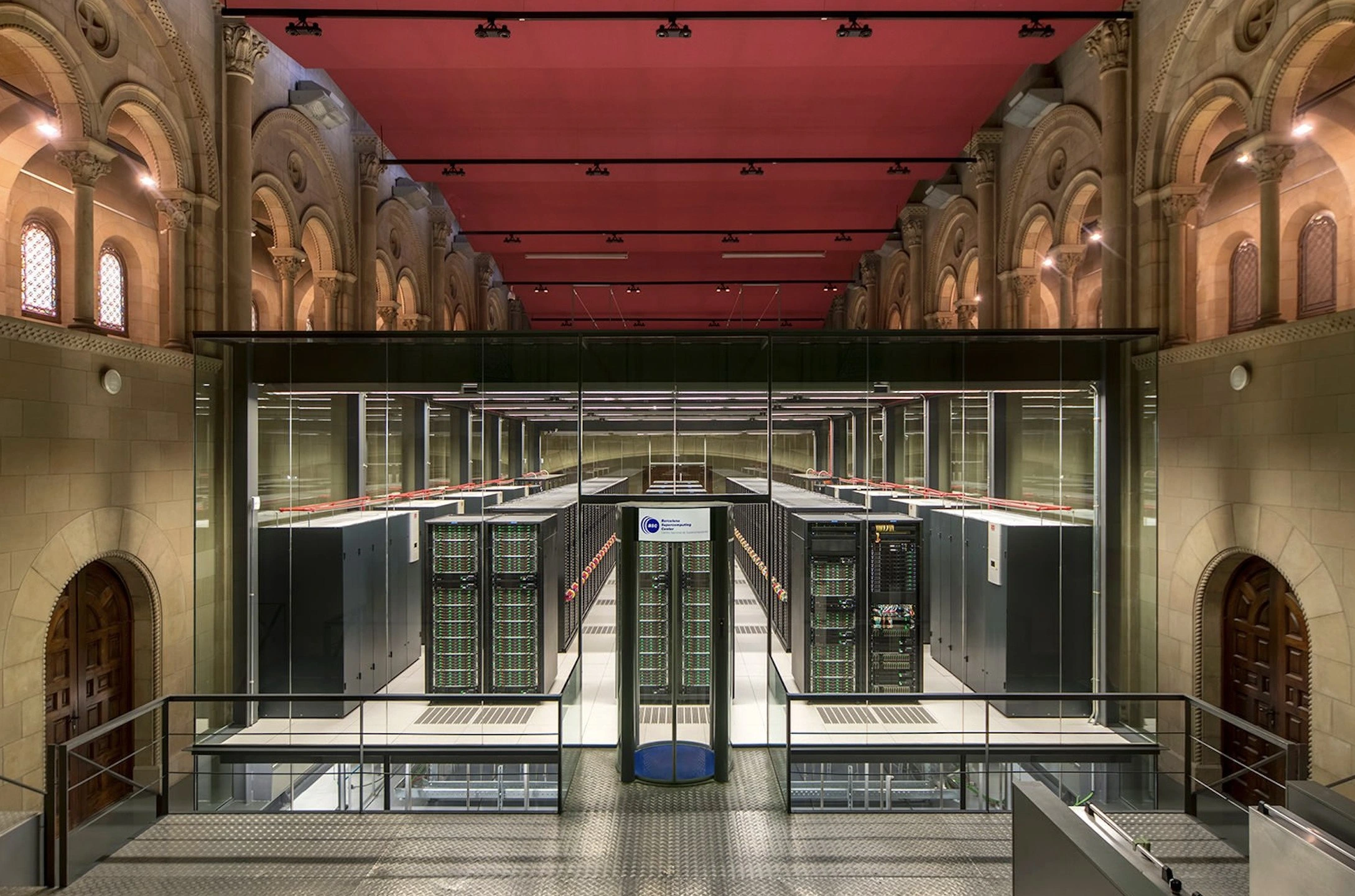
When your data center literally belongs in a cathedral of compute
Why is this Infrastructure meme funny?
Level 1: Tech Temple
Imagine walking into a really old church – high ceilings, stone arches, colorful little stained-glass windows – but instead of pews and altars, you see a giant glass box filled with blinking lights and humming machines. It’s like someone parked a shiny futuristic spaceship in the middle of a medieval castle’s great hall. Pretty wild, right? That’s what’s happening here. The picture is funny and awe-inspiring because it mixes two things that don’t normally go together: ancient architecture and ultra-modern computers. It’s as if the builders said, “This machine is so special, it deserves to live in a castle!” The computers inside are super powerful (the kind that might predict the weather or help research new medicines), so putting them in a place that looks like a temple makes us smile – we’re basically treating technology like it’s sacred. On a simple level, the humor comes from seeing a high-tech heart inside an old stone body. It’s a bit like seeing a race car engine installed inside a classic horse carriage. The old and the new are side by side, and that surprise makes it interesting. Even if you don’t know anything about computers, you can feel that contrast: one part of your brain says “historic church,” the other says “science fiction data center.” The mash-up is cool and kind of cute – it’s showing that our modern “heroes” (in this case, big powerful computers) get placed on a pedestal, literally in a cathedral, almost like we’re worshipping what they can do. In short, it’s funny because it’s so literal: we always talk about how we love our gadgets, but here we’ve given a bunch of computers the royal treatment – their very own temple of technology, complete with arches and all!
Level 2: Church of Computing
For a newer developer or someone early in tech, let’s break down why this image is remarkable. What you’re seeing is a data center – basically a special room filled with many powerful computers (servers) – built inside an old church building. Yes, those are stone arches, carved columns, and even stained glass surrounding the glass walls of a high-tech server room. This specific setup is part of the Barcelona Supercomputing Center. The reason it looks so grand is because it’s home to one of the world’s faster supercomputers, named MareNostrum. A supercomputer is essentially a giant computer made by connecting thousands of smaller computers (nodes) so they work together on really big problems. Instead of one PC solving a problem slowly, you have a whole cluster of machines tackling parts of the problem simultaneously – this is what we mean by high-performance computing (HPC) and parallel processing. It’s like having 4000 people all work on a puzzle at the same time to finish it super fast. In this case, those “people” are GPUs (Graphics Processing Units), which are very good at doing lots of calculations in parallel. NVIDIA’s H100 GPU, mentioned here, is a top-of-the-line processor normally used in big servers for AI or scientific research (far more powerful than the GPU in a gaming laptop). Imagine 4000 of those all crunching numbers together – that’s an incredible amount of computing power, all concentrated in one place.
Now, putting so much hardware in one room brings up practical issues: these machines use a ton of electricity and they get hot – really hot – when they’re working hard. A data center is designed with special infrastructure to handle that: robust power supplies, backup power (so a power outage doesn’t stop the show), cooling systems (like powerful air conditioning or liquid cooling) to keep everything from overheating, and networking cables to have all the machines communicate at high speed. In the picture, the floor under the computers is raised with little holes (perforations). Why? Because cold air is pumped from underneath the floor. This cool air flows up through those holes and passes through the servers to take away heat – like blowing on a hot soup to cool it, but on an industrial scale. The hot air then rises and is removed by AC vents likely hidden in that red ceiling or elsewhere above. The glass walls around the servers form an enclosure that keeps the cold air in and the hot air controlled – kind of like keeping the cool air in your refrigerator from escaping every time you open the kitchen door. There’s even an air-lock style circular door, which ensures that when people go in or out to maintain the machines, the environment inside isn’t disrupted too much. It’s all about protecting the equipment and keeping the temperature and humidity at ideal levels. Computers are like Goldilocks – they don’t like to be too hot, too cold, too damp, or too dry; they want it just right.
Seeing this in a church is unusual, and that’s why it’s the focal point of the meme. Old churches (this one is actually a deconsecrated chapel used for a university, so not an active religious site anymore) are made of thick stone and are usually considered part of cultural heritage. Normally, you find wooden pews and altars inside, not server racks with blinking green lights. So there’s a stark contrast: the outside looks historical and serene, the inside is futuristic and buzzing with technology. Yet, it’s done so neatly – the modern tech is installed with respect for the old architecture (notice they didn’t drill giant holes in the walls; everything is self-contained on a platform). This shows a clever piece of engineering: they managed to fit a cutting-edge compute cluster (another term for a bunch of connected servers) into a building from a completely different era. For a junior techie, it’s a bit like when you upgrade an old computer with new parts – except here the “old computer” is an entire building! They had to carefully run power cables, network lines, and install cooling, all without damaging the historical look. That’s bridging infrastructure management with architectural preservation.
The meme caption calls it a “GPU-church” and a “god-machine.” These are playful terms. Since it’s literally a room of GPUs in a church, calling it a GPU-church is a pun – as if tech people now have places of worship for technology. The term “god-machine” suggests this supercomputer is so powerful it’s almost like a deity of computation. It’s tongue-in-cheek humor: nobody is literally praying to these servers, but we jokingly say that because of how grand and revered the setup looks. In everyday terms, think of how people nickname a really powerful car a “beast” or “monster” – here they nicknamed a really powerful computer cluster a “god-machine.” This cluster can perform an astonishing number of calculations per second (we measure that in FLOPs – Floating Point Operations per Second – usually in the quadrillions for a supercomputer, which we call petaflops). To give a sense of scale: a decent laptop might do billions of operations per second; this does millions of billions per second. Scientists and researchers use such machines to simulate complex things like climate models, physics experiments, or train advanced AI models – tasks that are way beyond a single normal computer’s capability. So, this is like the Ferrari of computation, and they housed it in a place that looks like a classic Ferrari showroom, except it’s a centuries-old chapel. The whole scene is both impressive and kind of funny because it visually says “we worship high performance,” blending the language of tech and religion in a quirky way.
Level 3: Sacred Scalability
For seasoned engineers, this photo hits like an inside joke about literally building a shrine to computing. We often quip about “server rooms as temples” or joke that we pray our deployment doesn’t crash on Friday – and here we see a data center in an actual cathedral nave, turning that metaphor into brick-and-mortar reality. The humor lies in the colossal seriousness of it: this isn’t just any server closet with a few blinking routers; it’s a full-blown supercomputer cluster — the kind normally tucked away in a purpose-built bunker — dramatically showcased inside a neoclassical chapel. The sign reading “Barcelona Supercomputing Center – Centro Nacional de Supercomputación” above the glass door is the giveaway: this is MareNostrum, one of Europe’s most powerful HPC clusters. It’s literally a data center on display, giving off museum vibes for nerds. The absurdly on-the-nose juxtaposition screams “Infrastructure meets Indiana Jones” – as if sysadmins raided the lost ark and decided to fill it with 19-inch rack mounts and top-of-rack switches.
From a senior perspective, the challenges hiding behind this beauty are as impressive as the visuals. Imagine being the systems administrator tasked with keeping 4000 top-tier GPUs and thousands of CPU cores happy inside a historic building. You can’t exactly punch holes in 12th-century stone walls or flood the place with industrial coolant without upsetting historians (and potentially Spanish heritage laws!). So the engineers had to get creative: they built a glass box data center inside the hall. That glass enclosure isn’t just for show – it’s doing heavy lifting for environmental control and containment. The raised flooring with perforated tiles you see is classic data center design for cooling: cold air is pumped up from below, and hot air likely rises and is sucked out overhead. In a normal modern facility, you’d have giant chillers and maybe a cooling tower; here, all that had to be integrated without messing up the building’s facade. They probably routed power and network cables discreetly through old service ducts or newly built shafts that don’t ruin the aesthetic. It’s a scalability challenge in a very non-traditional sense: not just scaling compute power, but scaling modern infrastructure into a legacy space. The crew essentially had to retrofit a cathedral to achieve high availability and uptime for a machine that probably draws a few megawatts and spits out heat like a small volcanic caldera. We’re talking multiple industrial transformers, UPS systems, and backup generators – likely all hidden on the premises or nearby – to ensure this cluster (which some might cheekily call a “god-machine”) never goes offline, even if the grid hiccups. It’s both hilarious and awe-inspiring that an ancient chapel now has better power redundancy and fiber connectivity than most office buildings.
What really tickles the tech funny bone is how reverently everything is arranged. The symmetrical racks of servers facing a central “aisle” – it does look like a nave flanked by pews of compute. If you’ve ever walked into a enterprise server room, you know they’re usually cramped, purely functional spaces. Here, it’s like the servers are on display for pilgrimages: infrastructure as an exhibit. Tour groups actually visit this place, treating it like a museum of modern technology housed in antiquity. Seasoned devs might recall the essay “The Cathedral and the Bazaar,” and smirk: open-source software was the bazaar, closed development was the cathedral. Well, in an ironic twist, this cathedral houses one of the most extreme examples of centralized, carefully managed computing power on Earth. No agile microservice sprawl here – this is a monolithic cluster, a single giant machine in the old-school sense, maintained by a priesthood of HPC engineers. They schedule huge parallel jobs, tune performance, replace failing nodes (with thousands of components, there’s a constant ritual of swapping out the sickly servers for healthy ones), and they probably do it all with a mix of automation and almost religious dedication. It’s easy to imagine a weary admin glancing up at the stone arches during a 3 AM maintenance window and whispering, “please, just let the cooling stay up tonight,” half-jokingly treating the architecture like a guardian angel.
And let’s not overlook the phrase “GPU-church” from the caption – it’s spot-on. Modern AI training and HPC workloads worship at the altar of the GPU for its parallel processing power. Nvidia’s H100 GPUs are state-of-the-art, prized like holy relics in the AI community for crunching neural networks and simulations. So having a whole choir of 4000 of them under one roof is basically a silicon Mass on Sunday for any AI researcher. The meme is winking at this almost spiritual reverence: we joke that geeks treat their machines like deities, and here they literally built a church for GPUs. The “cultural foundation” line alludes to how this cutting-edge system is literally built on a cultural artifact – the historic infrastructure provides both a literal foundation (the floor and walls of the chapel) and a metaphorical one (joining old world prestige with new world tech). To a senior dev, that also hints at the balancing act: preserving tradition while pushing forward with insane performance and scalability. We’ve all dealt with integrating new tech into old systems (though usually not this old!), and it’s equal parts challenging and gratifying when it works. So the meme strikes a chord: it’s a perfect physical metaphor for merging legacy and modern – and doing so with dramatic flair. It says: “Behold, even our data centers have cathedrals now,” implicitly poking fun at how seriously we take our computing prowess, while also genuinely admiring the achievement.
Level 4: Amdahl’s Altar
At the pinnacle of high-performance computing (HPC), this setup is essentially a modern-day supercomputer shrine where thousands of processors operate in parallel under one roof. The cluster in the image – famously known as MareNostrum at the Barcelona Supercomputing Center – embodies massively parallel architecture. With roughly 4000 NVIDIA H100 GPUs humming in unison, it’s pushing the limits of distributed computation. In theory, if you throw $N$ processors at a problem, you hope to get an $N$x speedup – but Amdahl’s Law preaches a sobering truth at this altar of compute: the eventual speedup is limited by the portions of a task that cannot be perfectly parallelized. Even in this “cathedral of compute,” where a cluster of GPUs performs trillions of operations per second, there’s a diminishing return when scaling up. The engineers here practically worship low-latency interconnects and efficient algorithms to minimize any sequential bottlenecks. They’ve likely architected a high-bandwidth internal network (think InfiniBand or NVIDIA’s NVLink fabric) weaving through those racks, so each node can communicate as quickly as possible. This reduces the penalty of GPU-to-GPU chattiness, inching closer to the divine ideal of linear scalability.
But HPC isn’t just about raw compute power – it’s a trial by fire (almost literally) of infrastructure engineering. Housing a multi-megawatt compute cluster inside a historic stone building raises hardcore systems questions: how do you deliver power and cooling to a “god-machine” without turning a 19th-century chapel into an oven? The red vaulted ceiling isn’t just for dramatic effect; it likely hides massive air ducts or acoustic dampeners to manage airflow and noise. Rows of green LED indicators on the server fronts serve as a modern stained glass, conveying system health and high availability status through blinking patterns of light. Beneath the raised perforated floor, cold air channels feed these machines, an underfloor plenum guiding chilled air exactly where it’s needed. Hot air is drawn upward and expelled, obeying the thermodynamic liturgy of data center design. It’s a delicate balance: thousands of GPUs can easily generate heat rivaling a furnace, so the cooling system has to dissipate it continuously or risk thermal throttling (the silicon equivalent of hearing the organ pipes groan). The glass walls form a climate-controlled enclosure – essentially a data center within ancient walls – maintaining optimal humidity and temperature like a hermetically sealed reliquary for circuits. The cylindrical air-lock door isn’t just sci-fi flair; it preserves that internal environment, preventing Barcelona’s humid air (or a curious tourist’s dust) from breezing in and upsetting the hot/cold aisle equilibrium.
Even the distributed systems theory plays out differently in this sanctuary of compute. Unlike cloud datacenters that prioritize fault tolerance across distant regions, an HPC cluster is a single, colossal machine emphasizing synchronized performance. Here, the cluster management software (possibly SLURM or a similar scheduler) acts as an abbey’s abbot, allocating tasks to thousands of nodes in coordinated bursts. Jobs running on 4000 GPUs in parallel must start and finish together in a kind of computational liturgy – if one node falters, the whole parallel job could be in jeopardy. Thus, the system likely relies on checkpointing and redundancy akin to high availability practices: saving state periodically, so a failed node doesn’t mean redoing days of computation from scratch. It’s fascinating that within these stone walls – originally built for quiet contemplation – the loud whir of fans and the buzz of algebraic calculations now resonate. The juxtaposition is poetic: fundamental physical limits (like heat dissipation and speed-of-light signal delays) meet archaic architectural limits (like weight load on a centuries-old foundation). The result is an HPC cathedral where scalability is both a technical quest and almost a spiritual one – engineers striving to transcend traditional limits of compute, as if in prayer to the silicon deities of performance. In this hushed hall, one can practically hear the Litany of Data: bytes flowing, processors communing, and the ethereal glow of status LEDs reflecting off sandstone arches in a harmonious dance of hardware and history. It’s a testament that even the most advanced distributed systems performance ultimately bows to the laws of physics… albeit in the most awe-inspiring venue imaginable.
Description
High-resolution photo, shot straight on, shows a glass-walled server room filled with symmetrical black racks whose front panels glow with rows of green status LEDs. The enclosure sits on a raised perforated floor and is accessed through a cylindrical air-lock door framed by a sign that reads: “Barcelona Supercomputing Center - Centro Nacional de Supercomputacion.” Surrounding the modern hardware is a repurposed Romanesque-style hall: sandstone arches, columns, carved motifs, wooden doors, and small stained-glass windows, all topped by a dramatic red acoustic ceiling. The juxtaposition highlights the engineering challenge of housing a high-performance, massively parallel compute cluster - power, cooling, and cabling - inside a historic building, underscoring themes of infrastructure management, scalability, and distributed systems performance

Comments
19Comment deleted
We put 4000 H100s in a cathedral - now every Sev 1 post-mortem starts with “Root cause: act of God; mitigation: add two more chillers and update the cooling hymnal.”
The only place where 'divine intervention' is actually just someone tripping over a power cable, and where prayers for uptime are answered by redundant power supplies instead of higher powers
When the project manager said 'we need to leverage our legacy infrastructure,' nobody expected them to mean *literally* installing a supercomputer in a 19th-century chapel. Turns out 'cloud computing' was just a mistranslation of 'cathedral computing' all along. At least when the cooling system fails, you can always open the stained glass windows and pray to the patron saint of uptime
The Cathedral and the Bazaar finally reconciled: SLURM queues behind stained glass, K8s pods in the cloud - both require faith, but only one has a change freeze in the liturgy
Proof that on‑prem isn’t dead: we literally built a church around our SLURM queue so the InfiniBand has lower latency than praying to the cloud
Uptime that rivals the cathedral's survival through plagues, wars, and Y2K - now that's mainframe HA
For the name of the Master, the Slave and the Holy Git, commit. Comment deleted
oh no, you have used the forbidden terminology! please use primary/secondary immediately Comment deleted
Oh no, don't cancel me on X, please.(((( Comment deleted
Heaven Comment deleted
For the Glory of the Omnissiah Comment deleted
approx total cost of just GPUs: $120M 🫠 Comment deleted
God willing Comment deleted
Ah, the fabulous MareNostrum supercomputer! I heard that a muslim mosque can occupy any building that is beautiful enough, including a former christian church. It looks like the same holds true for IT temples. 🤓 Comment deleted
MareNostrum mentioned 🥹 Comment deleted
A german documentation about it https://youtu.be/DcbMW_P466o?si=zrn8KUA4CL8Dbuj7 Comment deleted
How can I join this religion? Comment deleted
Depending on which project are those cogitators being used. Trust me, brother. I know the choirs Comment deleted
I was there twice, the vibes it gives IRL are actually amazing Comment deleted